

Expect to pay somewhere between A$3,000 and A$15,000 for a professional small business website in Australia in 2026, with template builds starting around A$300 and custom eCommerce platforms running past A$10,000. Ongoing costs add A$50 to A$300+ a month for hosting, security, and content updates. The biggest hidden extra is content creation. Read on for exact bands by project type and how to compare quotes without getting burned.
TL;DR:
- Small business websites in Australia typically cost between A$3,000 and A$15,000, with ongoing monthly expenses for hosting and maintenance.
- Quotes often vary significantly depending on scope, with discovery, design, development, and content all impacting the final price; itemized quotes are crucial for accurate comparison.
- Custom functions like booking systems or integrations greatly influence project costs, especially during the development stage, which can range from A$2,000 to A$25,000.
- Cutting corners on hosting, SEO, or maintenance can lead to higher long-term expenses, including lost search rankings, security risks, and reduced site performance.
- Phased project approaches and providing your own content can reduce initial costs without compromising core functionality or future growth potential.
Table of Contents
- How Much Does a Website Cost in Australia? Pricing Bands at a Glance
- What Drives the Cost Breakdown by Project Stage
- What Do You Actually Get at Each Price Point?
- What Are the Ongoing Costs After Launch?
- How Do You Compare Website Quotes Without Getting Burned?
- How Long Does a Website Take and How Do You Pay for It?
- How Can You Cut Website Costs Without Cutting Corners?
- Why Local Case Studies Matter More Than Generic Pricing Guides
- What Steve Doig Thinks Australian Businesses Get Wrong About Website Pricing
- Get a Website Built for Your Budget, Not a Template’s Limits
- Sources
How Much Does a Website Cost in Australia? Pricing Bands at a Glance
Website cost in Australia splits into five rough bands, and knowing which one fits your business saves you from either overpaying an agency for a template job or underpaying a freelancer for work that needed proper development. A professional business website with five pages typically starts around A$3,000, while more complex builds climb well past that depending on features and content volume.
Here’s how the market actually breaks down:
Various website types come with increasing price ranges and ongoing costs, reflecting the growing complexity and service levels required.
Those enterprise-tier figures can climb well beyond A$250,000 for large organizations needing custom integrations, multi-region infrastructure, or heavy compliance work, but that’s a tiny slice of the small-business market this guide is written for.
What each band typically buys:
- DIY/template (A$300–A$3,000): A page builder or off-the-shelf theme, basic contact forms, and minimal customization. You’re doing most of the setup yourself.
- Small business (A$3,000–A$15,000): A custom-designed brochure site, usually 5 to 15 pages, built on WordPress or a similar CMS, with basic on-page SEO baked in.
- Custom business (A$15,000–A$50,000): Bespoke design, custom functionality (booking systems, member portals, calculators), and often a content strategy layer.
- eCommerce (A$10,000+): Product catalog setup, payment gateway integration, inventory management, and shipping logic on top of everything a small business site needs.
- Enterprise (A$80,000+): Multi-site architecture, custom APIs, dedicated infrastructure, and ongoing development teams.
Most service-based small businesses in Perth, Fremantle, and Melville land in the small business to custom business range, particularly once they add booking tools or a client portal.
What Drives the Cost Breakdown by Project Stage
A website quote isn’t one number. It’s the sum of several stages, and understanding what each one covers is how you spot a lowball quote that’s quietly skipping work you’ll need later.
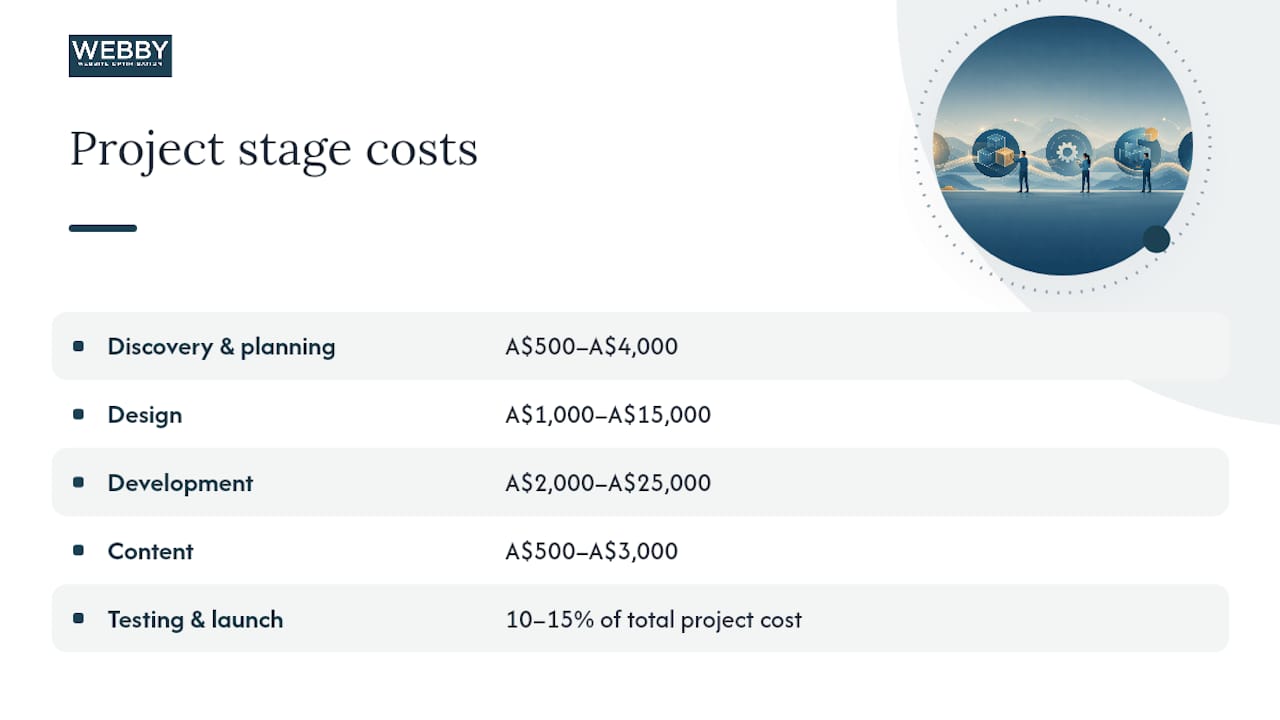
Discovery and planning (A$500–A$4,000). This covers competitor research, sitemap planning, user journey mapping, and technical requirements gathering. A quote that skips this step usually means the developer is reusing a generic template structure rather than thinking through your business.
Design (A$1,000–A$15,000). Wireframes, mockups, brand alignment, and responsive layouts for mobile and tablet. The wide range here reflects the difference between adapting an existing template and designing custom page layouts from scratch for every section.
Development (A$2,000–A$25,000). This is where the design becomes a working site: front-end coding, CMS setup, database structure, and any custom functionality like booking calendars or membership areas. Integrations are the single biggest cost driver in this stage.
Content (A$500–A$3,000). Copywriting, photography, and image sourcing. This is the line item most businesses underestimate, and it’s frequently the reason a “finished” website launch slips by three or four weeks.
Testing and launch (10–15% of total project cost). Cross-browser testing, mobile responsiveness checks, page speed optimization, and staging-to-live migration. Skipping this is how sites go live with broken forms or slow load times that quietly kill conversions.
Project management runs through all of the above rather than sitting as its own line item, though some agencies bill it separately at 10 to 15% on top.
The highest-variance items in any quote are integrations (payment gateways, CRM syncing, booking software), custom booking or payment logic, accessibility compliance work, and anything requiring third-party API connections. A quote that mentions “Stripe integration” as a single line item, for instance, could mean anywhere from two hours of configuration to a full custom checkout build, depending on your product complexity.
Pro Tip: Ask every quote to itemize discovery, design, and development separately. If a provider gives you one lump figure with no breakdown, that’s usually a sign they haven’t scoped the project properly yet, and the final invoice will drift.
What Do You Actually Get at Each Price Point?
Price bands mean little without knowing what lands in your inbox at the end. Here’s what typically ships at each tier:
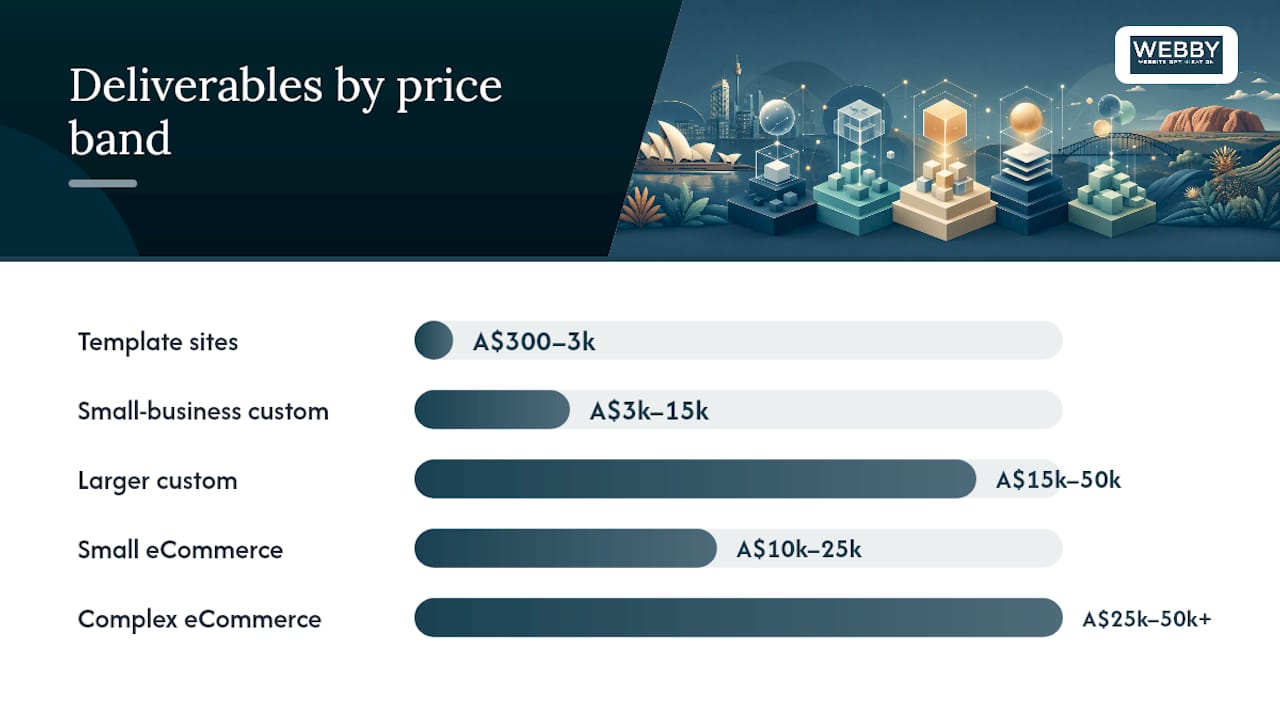
- Template sites (A$300–A$3,000): Three to eight pages, a pre-built theme with color and logo swaps, basic contact form, and no custom copywriting. You supply your own text and images. CMS access is included, but customization options are limited to what the theme allows.
- Small-business custom sites (A$3,000–A$15,000): Five to fifteen pages, a design built around your brand rather than a template, basic on-page SEO structure, and often a content package covering key pages. Full CMS training is usually included.
- Larger custom sites (A$15,000–A$50,000): Fifteen-plus pages, custom functionality like booking or quote calculators, a proper content strategy rather than filler copy, and frequently a dedicated project manager.
- Small eCommerce (A$10,000–A$25,000): Product catalog up to roughly 100 SKUs, standard payment gateway, basic inventory sync, and mobile checkout optimization.
- Complex eCommerce (A$25,000–A$50,000+): Custom product configurators, multi-currency support, ERP integration, and advanced analytics setup.
A few things stay consistent across tiers worth flagging. Custom copywriting is rarely bundled below the A$3,000 mark. CMS ownership (you controlling your own WordPress or Shopify backend, rather than being locked into an agency) should be non-negotiable regardless of budget. And research strategy and scalability planning explain much of why two quotes for what looks like the same project can differ by tens of thousands of dollars.
If your budget sits between two bands, a phased approach often works better than stretching for the higher tier immediately. Launch the core site with essential pages, then add the booking system or eCommerce layer once the business is generating revenue to fund it. This is particularly common for service businesses testing a new market before committing to full custom development.
What Are the Ongoing Costs After Launch?
The build price is only half the budget conversation. Hosting, renewals, and maintenance run every month for as long as the site exists, and skipping this line item in your planning is how businesses get blindsided in year two.
Hosting costs vary by type:
- Shared hosting: A$10–A$30/month, suitable for low-traffic brochure sites.
- Managed WordPress hosting: A$30–A$100/month, with automatic updates, backups, and better speed optimization.
- Premium hosting with CDN: A$20–A$150+/month, needed for eCommerce or high-traffic sites where page speed directly affects conversion.
Cheap shared hosting often costs more in the long run through lost search rankings and abandoned carts than the monthly savings are worth, since Google’s ranking algorithms weigh page speed and uptime.
Domain renewal for a .com.au address runs A$15–A$30 a year, which is trivial compared to everything else. Plugin licenses and third-party tools (booking software, advanced SEO plugins, form builders) can add anywhere from nothing to A$100+ a month depending on how many premium tools your site relies on.
Maintenance and care plans typically bundle backups, security monitoring, plugin updates, and a small allowance of content changes. These range from A$50 a month for basic coverage to A$300+ for full-service plans that include ongoing SEO adjustments.
One detail worth budgeting for early: if your site collects any personal information through forms, bookings, or checkout, Australian privacy guidance requires you to handle that data responsibly, which sometimes means budgeting for a privacy policy review or compliance audit alongside your build. On the tax side, the Australian Taxation Office allows many website costs, including some development and hosting expenses, to be claimed as business deductions, which is worth raising with your accountant before you finalize a budget.
How Do You Compare Website Quotes Without Getting Burned?
Two quotes for the same brief can land A$10,000 apart, and the gap almost never means one provider is ripping you off. It usually means they’ve scoped different amounts of work. Here’s how to read a quote properly before you sign anything.
- Confirm site ownership. You should own the domain, hosting account, and all content outright. If a provider retains admin access and charges to hand it over, that’s a lock-in tactic, not standard practice.
- Check what’s included in hosting. Ask whether hosting is bundled into your monthly fee or billed separately, and whether backups and security monitoring are part of that or an extra line item.
- Ask about CMS access and training. A reasonable answer is a WordPress login with a short handover session. A worrying answer is “we manage all changes for you” with no explanation of what that costs per edit.
- Request the SLA in writing. What’s the response time if the site goes down? Reasonable providers commit to same-day or next-business-day responses for critical issues.
- Clarify what SEO foundations are included. Basic on-page SEO (meta titles, alt text, sitemap submission) should come standard. Ongoing SEO campaigns are a separate service and should be quoted separately.
- Ask for the full itemized breakdown. Discovery, design, development, content, and testing should each appear as their own line, not folded into one number.
Red flags worth walking away from: a quote with no timeline attached, a provider unwilling to name what CMS the site runs on, or a price that’s dramatically below every other quote you’ve received with no explanation for the gap. If a provider can’t tell you why their price is 40% lower than three others, assume something is being cut, whether that’s testing, content, or post-launch support.
Pro Tip: Ask each provider the same six questions in writing and compare the answers side by side, not just the total price. The provider who answers clearly and specifically is usually the one who won’t disappear after the invoice clears.
How Long Does a Website Take and How Do You Pay for It?
Timelines vary by project size, and delays almost always come from the client side rather than the developer’s desk. A small brochure site typically takes two to six weeks from kickoff to launch. A custom business site with bespoke functionality runs six to twelve weeks. eCommerce builds, particularly ones with complex product catalogs or ERP integration, often take eight to twenty weeks or longer.
Payment structures follow a fairly consistent pattern across the Australian market:
- A deposit of 30–50% is due before work begins, which locks in your project slot and covers initial discovery and design work.
- Staged milestone payments follow, typically tied to design approval and development completion.
- A final payment is due at launch, often held until you’ve signed off on testing and content review.
The single biggest cause of blown timelines isn’t the developer. It’s client-side delays: content that’s promised in week two but delivered in week six, or photography that needs a reshoot after the design is already built around placeholder images. If you’re supplying your own copy or photos, get them finalized before the build phase starts, not during it. A two-week content delay on a six-week project doesn’t just add two weeks. It often pushes the developer into their next client’s slot, adding a further wait.
How Can You Cut Website Costs Without Cutting Corners?
There’s a real difference between trimming cost intelligently and cutting the parts that come back to bite you within a year. Here’s where the safe savings are and where they aren’t.
Safe places to save money:
- Supply your own copy and images. Cutting the content stage saves A$500–A$3,000 if you’re comfortable writing clearly about your own business.
- Launch in phases. Build the core site now, add the booking system or blog once revenue justifies it.
- Use proven templates for secondary pages. Your homepage and service pages deserve custom design attention; a standard FAQ or terms page doesn’t need the same treatment.
Places where cutting costs backfires:
- Cheap or free hosting. Slow load times cost you search rankings and visitors before they even see your offer.
- Skipping maintenance entirely. An unpatched WordPress site is a security risk within months, not years.
- Cutting SEO foundations or accessibility basics. Both are far cheaper to build in from the start than to retrofit later.
A sensible phased scope for a service business might look like this: launch with a homepage, three service pages, an about page, and a contact form as the minimum viable site. Add a blog, testimonials page, and online booking in phase two once the core site is generating leads. That approach keeps the initial invoice manageable without locking you into a template that can’t grow with the business.
Pro Tip: If cash flow is tight, ask your provider whether they’ll structure a phased scope with a lower initial deposit tied to the minimum viable launch, then bill the additions separately once you’ve validated demand.
Why Local Case Studies Matter More Than Generic Pricing Guides
Generic pricing guides tell you the range. What they can’t tell you is what a mid-range investment actually returns for a business like yours, which is where local proof points matter more than national averages.
Webby Website Optimisation works specifically with local service businesses across Perth, Fremantle, and Melville, building WordPress sites with speed optimization and conversion rate optimization baked into the build rather than bolted on afterward. That combination matters because conversion improvements from better design and copy consistently justify the higher end of the custom business price band, especially for service businesses where a single extra lead can cover the difference in build cost.
One anonymized example from Webby’s client base: a Perth-based trades business moved from an outdated five-page site with no mobile optimization to a custom-built, speed-optimized site with local SEO foundations. Within months, the business saw measurably stronger organic visibility and lead flow, the kind of return that a A$3,000 template site simply isn’t built to produce.
What that build typically included:
- Custom WordPress design matched to the trade’s branding
- On-page SEO structure for local search terms
- Speed optimization to reduce load times on mobile
- A conversion-focused contact and quote request flow
What Steve Doig Thinks Australian Businesses Get Wrong About Website Pricing
The conventional advice tells business owners to get three quotes and pick the middle one. That’s lazy. The real skill is reading what each quote actually includes, because the lowest number almost always means the least scope, not the best deal.
What I’d tell any Perth or Fremantle business owner staring at three wildly different numbers: stop comparing totals and start comparing line items. A A$4,000 quote missing a content strategy and a A$12,000 quote that includes copywriting, SEO structure, and three months of post-launch support aren’t really competing offers. They’re different products wearing the same label.
The other thing conventional advice underweights is maintenance. Everyone budgets carefully for the build and then treats hosting and care plans as an afterthought, which is backwards. A neglected site loses search visibility within a year regardless of how good the original build was. If you’re going to underspend anywhere, don’t let it be there.
Prioritize the discovery and content stages first. They’re the parts most often cut to hit a lower number, and they’re the parts that actually determine whether the finished site brings in business.
— Steve Doig
Get a Website Built for Your Budget, Not a Template’s Limits
Webby Website Optimisation builds custom WordPress websites for local Perth, Fremantle, and Melville service businesses, starting around A$3,000 for small business builds and scaling into the A$15,000+ custom range for businesses needing booking systems, quote calculators, or eCommerce functionality. Every build includes speed optimization and on-page SEO from day one, not as a paid add-on later.
If you’re not sure which price band fits your business, Webby Website Optimisation offers a free audit that reviews your current site (or your competitors’ sites, if you’re starting fresh) and maps out exactly what a rebuild should include and cost. It’s a straightforward way to get a real number instead of guessing between the ranges in this guide. For businesses needing a fast turnaround on a tighter budget, the website built in a day option delivers a working site without the full custom development timeline. Webby also runs a pro bono program for select local causes as part of its community work in Perth.
Ready to see what your project would actually cost? Request a free website audit and quote and get a line-item breakdown built around your business, not a generic template.
Sources
- How Much Does a Website Cost in Australia? | Conduct
- Web Design Cost Australia 2026: $2,000–$15,000 Verified Pricing
- Attorney-General’s Department — Privacy
Recommended
- Website Construction Cost: A Clear Guide to Savvy Australian Builds
- Decoding Web Page Design Cost in Australia
If this post raised some questions feel free to ask me a question