
Emergency and service+location keywords convert fastest, so plumbers should lock those down first, then layer in water heater, drain, and fixture terms before chasing informational long-tail traffic. Map your top 10 keywords to a dedicated service page and a fully built-out Google Business Profile this week. Everything else, including blog content and voice search tuning, can wait until that foundation is live.
TL;DR:
- Focus initial keyword efforts on emergency and service plus location terms to ensure visibility for high-intent searches with immediate booking potential.
- Create dedicated pages for services with unique pricing or urgency signals, and use blog posts for informational long-tail keywords to support voice search and FAQ schema.
- Optimize your Google Business Profile with complete local content, accurate service categories, and consistent review generation to improve local map pack rankings.
- Track booked jobs and conversion rates rather than just clicks or leads, and set specific goals for GBP and service page rebuilds within the first 90 days.
- Prioritize seasonal content and ad budget adjustments aligned with regional weather patterns to capitalize on predictable demand spikes.
Table of Contents
- Plumber SEO Keywords: A Categorized List You Can Use Today
- Which Plumber SEO Keywords Close Jobs Fastest
- Mapping Plumber SEO Keywords to the Right Pages
- How to Research Plumber SEO Keywords Without Guessing
- Google Business Profile: The Local Ranking Foundation
- Tracking Booked Jobs, Not Just Clicks
- On-Page SEO for Plumber Service Pages
- A Real Example: GBP-First Keyword Wins
- Negative Keywords Every Plumbing Ad Account Needs
- Seasonal Keyword Trends Affecting Plumbing Services
- Competitor Keyword Analysis for Plumbers
- Voice Search and Plumber SEO Keywords
- Content Strategies That Put Plumber Keywords to Work
- What Actually Works for Small Plumbing Businesses
- Let Webby Website Optimisation Handle the Keyword and GBP Work
- Sources
- FAQ
Plumber SEO Keywords: A Categorized List You Can Use Today
Not every plumbing keyword deserves the same attention. A homeowner typing “24 hours emergency plumber near me” is reaching for their phone. Someone searching “how long do water heaters last” is still reading. Both matter, but they belong in different places on your site and in different parts of your marketing budget.
Below is a working plumbing keywords list organized by category, with notes on where each type performs best.
Emergency and transactional (highest urgency, best for paid ads and a dedicated GBP service):
- Emergency plumber near me
- 24 hour plumber
- Burst pipe repair
- No hot water emergency
- Emergency drain cleaning
- Same day plumber
- Plumber open now
Service plus location (core organic and GBP targets):
- Plumber in [city]
- [Suburb] plumbing services
- Licensed plumber [city]
- Residential plumber [city]
- Commercial plumber [city]
- Affordable plumber near [suburb]
Water heater (strong for both service pages and paid):
- Water heater repair
- Water heater installation cost
- Tankless water heater installation
- Water heater not working
- Gas vs electric water heater
Drain and sewer (high commercial intent, good for service pages):
- Drain cleaning service
- Sewer line repair
- Hydro jetting near me
- Clogged drain plumber
- Sewer camera inspection
Fixtures (mid-funnel, good for combined service pages):
- Toilet installation
- Faucet repair
- Garbage disposal installation
- Leaky faucet repair cost
- Shower valve replacement
Commercial accounts (lower volume, high value):
- Commercial plumbing contractor
- Restaurant grease trap service
- Backflow testing and certification
- Commercial water heater service
Informational long-tail (best for blog posts and FAQ schema, feeds AI search results):
- Why is my water heater making noise
- How to tell if a pipe is frozen
- Why does my toilet keep running
- Signs you need a new water heater
- How much does it cost to reroute plumbing
Notes on placement: emergency and service + location terms should live on your homepage and core service pages, ideally reinforced in your GBP business description. Long-tail informational queries belong on blog posts and FAQ sections, where they can be pulled into AI-generated answer boxes. WordStream’s plumbing keyword tool is a solid starting point for expanding this list with local volume estimates.
Which Plumber SEO Keywords Close Jobs Fastest
Not all traffic is worth the same to your business. A keyword’s intent tells you how close that searcher is to booking a job, and that should dictate where you spend time and ad dollars.
- Transactional/emergency intent (burst pipe, no hot water, emergency plumber) — these searchers are calling within minutes. Expect the highest conversion rate and the highest cost-per-click, because long-tail, locality-qualified phrases improve the cost-to-result ratio far more than broad head terms.
- Commercial/service intent (drain cleaning service, water heater installation) — these searchers are comparing providers, often same-week. Good fit for both organic service pages and paid search.
- Navigational/branded intent (your business name, “plumber near me”) — repeat customers or referrals. Cheap to capture if your GBP and site are set up correctly.
- Informational intent (why is my faucet dripping) — early-stage research. Low immediate conversion, but valuable for building topical authority and feeding AI Overviews.
Own tier one first. Tier four is worth doing, but it shouldn’t eat your ad budget or delay your service page build.
Mapping Plumber SEO Keywords to the Right Pages
The single biggest mistake in plumber digital marketing is dumping every keyword onto the homepage. Search engines want depth, not a junk drawer.
Here’s the rule of thumb: if a keyword represents a distinct service with its own pricing, process, or urgency, it earns a dedicated page. If it’s a variation of the same service, combine it. If it’s a question a homeowner asks before deciding whether to call anyone, it belongs in a blog post or FAQ.
- Emergency terms → a standalone “Emergency Plumbing” landing page with the phone number in the hero section, not buried in a footer.
- Service + location terms → individual city or suburb pages if you cover multiple areas, each with unique local content, not copy-pasted text with the city name swapped.
- Water heater, drain, fixture terms → grouped service pages (“Water Heater Services”) that cover repair, installation, and replacement under one URL.
- Long-tail informational terms → blog posts and FAQ sections, cross-linked back to the relevant service page.
Checklist for a service page that actually ranks:
- Unique local content (not templated across every city page)
- LocalBusiness or Service schema markup
- Phone number visible above the fold on mobile
- At least one trust signal (license number, years in business, review count)
Pro Tip: If two service pages are ranking for the same keyword, Google is confused about which one to show. Merge them, keep the stronger URL, and redirect the other.
How to Research Plumber SEO Keywords Without Guessing
You don’t need an enterprise SEO platform to build a solid plumbing keywords list. You need a repeatable process.
- Seed: Start with your actual service list and WordStream’s plumbing keyword tool or a similar free keyword tool for baseline volume ideas.
- Expand: Add location modifiers, urgency modifiers (“emergency,” “same day”), and question variants for every seed term.
- Filter: Drop anything with clear job-seeker or DIY-training intent. If the search volume looks inflated by people wanting to become plumbers rather than hire one, cut it.
- Validate: Search the term yourself. Check who ranks, what the People Also Ask box shows, and whether the intent matches what you assumed.
Volume numbers matter less for local service businesses than most guides suggest. A keyword with modest monthly searches but obvious commercial intent usually outperforms a high-volume, vague one. For deeper technique on discovery methods, Baby Love Growth’s keyword discovery guide covers filtering approaches worth adapting for a local service business.
Google Business Profile: The Local Ranking Foundation
Local search ranking comes down to three factors: relevance, distance, and prominence, and Google’s own guidance confirms all three matter for how your business shows up. Keywords alone don’t move you up the map pack. Your profile has to earn it.
- Relevance — fill out every service listed in your GBP dashboard with the actual keyword phrasing customers use (“emergency drain cleaning,” not just “drain cleaning”).
- Distance — you can’t change where a searcher is standing, but you can make sure your address and service area boundaries are accurate.
- Prominence — review volume and quality directly affect how often Google surfaces your listing, so a steady request-for-review process matters as much as your website copy.
Pro Tip: Write your GBP service descriptions like mini landing pages, using the exact phrases from your priority keyword list, not generic marketing language.
Tracking Booked Jobs, Not Just Clicks
Ranking for the right plumbing business keywords means nothing if you can’t tell which ones actually put a job on the calendar. Track these:
- Booked jobs by keyword or campaign source, not just leads or calls
- Call-to-booking conversion rate (a high call volume with low bookings points to a phone-handling problem, not a keyword problem)
- Cost-per-lead versus cost-per-booked-job, since the two numbers often tell very different stories
Set up call tracking numbers per channel, tag leads in your CRM by source, and pull a monthly report focused on gross profit by keyword source rather than raw lead counts. Response speed matters here too: a five-star keyword strategy still fails if calls go to voicemail.
On-Page SEO for Plumber Service Pages
Once your keyword map is set, execution on the page is what separates a page that ranks from one that just exists.
- Title tags and H1s should include the service and location without sounding robotic (“Emergency Plumber in [City] | 24/7 Response”)
- Use LocalBusiness and Service schema so search engines and AI systems can parse what you offer and where
- Every service page needs scope of work, a pricing cue (even a range), a trust signal, and a phone-first call to action
Local SEO and a fast, mobile-first website are consistently named as the core channels that generate calls for plumbers, ahead of newer tactics like social media. That’s not surprising: most plumbing searches happen on a phone, often mid-emergency, and a slow page loses the click before it loads. Structure long-tail FAQ content in clear question-and-answer format. It’s the format AI Overviews and voice assistants pull from most easily.
A Real Example: GBP-First Keyword Wins
One recent client engagement followed exactly this order of operations: audit and complete the Google Business Profile first, then build out targeted service pages around the highest-intent keyword clusters.
The audit prioritized GBP completeness and service-page targeting over broad content production, treating local ranking signals as the foundation rather than an afterthought.
The client saw a measurable increase in calls within 90 days of the GBP-first audit and service page rebuild, though results vary by market competitiveness and starting point. Readers curious about the exact methodology can request a similar audit rather than guessing at what moved the needle.
Negative Keywords Every Plumbing Ad Account Needs
Wasted ad spend on searches from job applicants, students, and DIY researchers quietly drains a plumbing PPC budget faster than most owners realize. If you’re running Google Ads against your service+location keywords, a negative keyword list isn’t optional.
Add these to every plumbing campaign at minimum:
- “jobs,” “hiring,” “careers,” “apprenticeship”
- “how to become a plumber,” “plumbing school,” “plumbing certification”
- “DIY,” “how to fix,” “how to install” (unless you’re deliberately targeting informational content with a separate, lower-bid campaign)
- “free,” “cheap,” “discount code” (these attract price shoppers who rarely convert into profitable jobs)
- “parts,” “supply store,” “wholesale” (these searchers want to buy fixtures themselves, not hire labor)
Paid-search guidance for trade businesses recommends pairing tight negative keyword lists with strict phrase or exact match types rather than broad match, which tends to pull in exactly the low-intent traffic negative keywords are meant to block. Review your search terms report monthly. New irrelevant queries creep in constantly, especially as Google’s broad match algorithm evolves. A plumber running unattended campaigns for six months is almost always bleeding budget on searches that were never going to become customers.
Seasonal Keyword Trends Affecting Plumbing Services
Plumbing search demand isn’t flat across the year, and treating it as flat means missing predictable spikes. Cold-weather months drive frozen pipe and no-heat searches (“pipes frozen,” “no hot water emergency,” “frozen pipe burst”) sharply upward. That surge is often regional and tied directly to cold snaps rather than the calendar month, so watch local weather forecasts as much as the date.
Spring brings a rise in “sump pump repair,” “basement flooding,” and “sewer backup” as snowmelt and rain expose drainage issues. Summer shifts volume toward “outdoor faucet repair,” “sprinkler system plumber,” and renovation-adjacent terms like “bathroom remodel plumber” as homeowners tackle projects during better weather. Fall sees a preventive-maintenance bump: “water heater flush,” “pipe insulation,” and “plumbing inspection before winter.”
The practical move is adjusting ad budgets and content publishing ahead of these windows, not during them. Publish your frozen-pipe FAQ content in October, not January, so it has time to rank before demand hits. Increase emergency-keyword ad budgets before the first cold front of the season based on historical weather patterns in your service area, rather than reacting after call volume spikes. Plumbers who treat their keyword strategy as static year-round consistently underspend during their highest-value weeks and overspend during slow ones.
Competitor Keyword Analysis for Plumbers
Every plumber in your service area is chasing roughly the same core plumbing business keywords, which means the real opportunity is in the gaps competitors leave open. Start by searching your top 10 target keywords and noting which competitors show up in both organic results and the local map pack for each one.
Look specifically at what service pages competitors are missing. If three plumbers in your city rank for “water heater repair” but none of them have a dedicated page for “tankless water heater installation,” that’s an underserved, buildable opportunity. Check their GBP profiles too: how many reviews do they have, how recently did they respond to reviews, and what services do they list. A competitor with 40 reviews and a sparse service list is beatable with a stronger profile, even without more site content.
Pull up a few competitor blog posts and see what long-tail questions they’re answering. If none of them cover “why does my toilet keep running” or similar high-search, low-competition questions, that’s low-effort content you can publish and likely outrank them on within weeks rather than months. The goal isn’t copying competitor keyword lists. It’s finding where their coverage is thin and building there first, since that’s where new rankings come fastest.
Voice Search and Plumber SEO Keywords
Voice queries skew heavily conversational and local: “who’s the closest emergency plumber,” “is there a plumber open right now near me,” “how much does a plumber charge to fix a leak.” These phrasings differ from typed searches in structure, even when the underlying intent is identical to a typed query.
Optimizing for voice and AI-driven answers requires conversational long-tail phrasing paired with concise, schema-backed FAQ answers rather than terse keyword fragments. A page written to rank for “emergency plumber [city]” as a phrase also needs a sentence somewhere on that page that answers “who is the emergency plumber near me in [city]” in natural language, because that’s closer to how a voice assistant parses the query.
Structured FAQ schema matters more here than almost anywhere else in plumber SEO. Voice assistants and AI Overviews pull directly from FAQ blocks with clear question-and-answer formatting, so a page with three well-written Q&A pairs at the bottom often outperforms a page with none, even if the surrounding content is thinner. Keep answers to two or three sentences. Voice assistants read out short, direct answers, not paragraphs.
Content Strategies That Put Plumber Keywords to Work
Keyword lists don’t rank pages by themselves. The content built around them does, and structure matters as much as the words chosen.
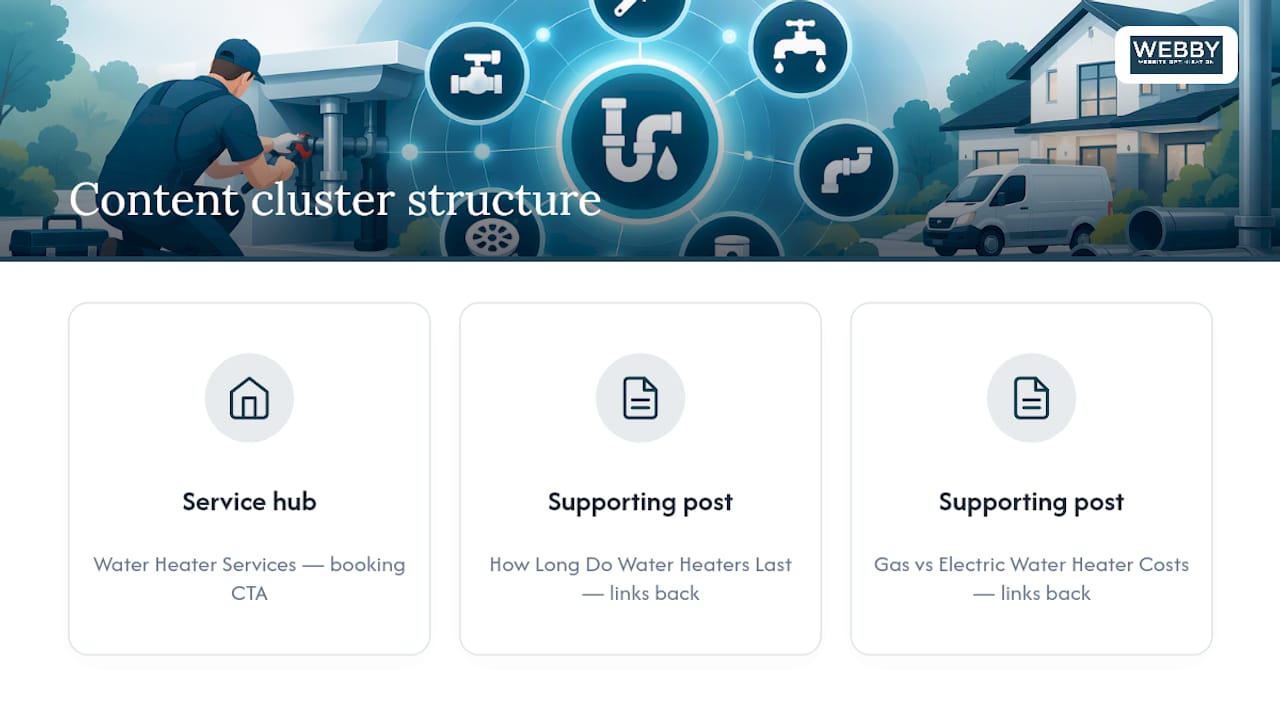
Build a content cluster around each core service: one strong service page as the hub, then two to four supporting blog posts answering the specific questions homeowners ask before booking that service. A “Water Heater Services” page might link out to “How Long Do Water Heaters Last” and “Gas vs Electric Water Heater Costs,” with both posts linking back to the service page for the actual booking action.
Refresh seasonal content on a schedule rather than leaving it static. A frozen-pipe blog post published three years ago and never touched will lose ground to competitors publishing fresher, more specific content. Write FAQ sections in genuine question format, matching how people actually search or ask a voice assistant, and keep the answers tight enough to be pulled into a featured snippet. Every piece of content should link to a service page. Informational content that dead-ends without a path to booking is traffic wasted.
What Actually Works for Small Plumbing Businesses
Keyword research means little without follow-through. Marketing works best as one system: website, GBP, reviews, content, and lead handling all compound together, and neglecting any one piece drags down the rest.
Three mistakes I see constantly: chasing high-volume keywords with zero commercial intent, building city pages with duplicated content, and tracking leads instead of booked jobs. Fix those first.
30 days: audit GBP and top service pages. 90 days: rebuild priority service pages and launch call tracking. 180 days: expand long-tail content and reassess by booked-job revenue, not traffic.
Let Webby Website Optimisation Handle the Keyword and GBP Work
Webby Website Optimisation is the alternative to hiring a generalist agency for plumber SEO: instead of a broad retainer with vague deliverables, you get a GBP-first audit, targeted service-page builds, and ongoing optimization aimed specifically at keywords that convert to booked jobs, not just traffic.
If you want to see exactly where your current site and profile stand before committing to anything, the Website Audit is the logical first step. It is a one-off engagement that identifies which keyword clusters you’re missing and where your GBP is leaving visibility on the table. From there, ongoing Search Engine Optimisation work implements the keyword mapping, service-page structure, and content strategy covered throughout this guide. For plumbers who want service pages rebuilt around priority keywords and conversion elements, the Business Website Optimisation Campaign covers that scope directly.
Results vary by market and starting point, as the case study above notes, but the sequence, GBP first, then service pages, then measurement, doesn’t. Reach out for a free audit consultation to see where your plumbing business stands today.
Sources
- Get started with Business Profile – Google Business Profile Help
- Plumber Marketing: The Ultimate 10-Step Guide – FieldEdge
FAQ
What Are Good SEO Keywords for a Plumbing Business?
The strongest plumbing business keywords combine a service with location and, where relevant, urgency: “emergency plumber [city],” “water heater installation [city],” “drain cleaning near me.” These convert faster than generic terms like “plumbing services” because they signal both intent and geography.
What Are 20 Words Commonly Associated With Plumbing?
Common terms include plumber, pipe, drain, leak, faucet, water heater, sewer, clog, valve, fixture, backflow, hydro jetting, sump pump, garbage disposal, toilet, shower, boiler, plumbing inspection, emergency, and licensed. These words form the backbone of most plumbing keywords lists and show up repeatedly across service pages and search queries.
What Is a Good Tagline for a Plumber?
Effective plumber taglines are short, specific, and lead with reliability or speed, such as “Fast, Licensed, Local” or “Fixed Right the First Time.” A tagline should reinforce the same trust signals your Google Business Profile and service pages already emphasize, not introduce a new message.
What Are Some Effective Marketing Ideas for Plumbers?
The channels that consistently generate calls are a complete, review-rich Google Business Profile, a fast mobile-first website, and content targeting the exact plumber SEO keywords your customers search. Beyond that, a steady review-request process and call tracking to measure which sources actually produce booked jobs matter more than adding new marketing channels.
How Do I Know Which Plumbing Keywords to Prioritize First?
Start with emergency and service + location terms, since these show the clearest commercial intent and typically convert at the highest rate. Long-tail informational keywords still matter for content and voice search, but they should come after your core service pages and Google Business Profile are fully built out.