
The highest-return local link building moves right now are chamber and association memberships, event sponsorships, partnerships with complementary businesses, and genuinely useful local content, because link quality beats volume matters more for local search. Treat every paid or sponsored placement with the correct rel attribute to stay compliant. Below is the full playbook, a monthly workflow, and the rules that keep your links safe.
TL;DR:
- Local link building efforts should focus on community-based sources like chambers, sponsorships, and local business partnerships, as link relevance outweighs volume.
- Building long-term relationships through recurring sponsorships, memberships, and consistent community engagement creates more durable and impactful local links.
- Properly markup all paid or sponsored links with rel=“sponsored” or rel=“nofollow” to stay compliant with Google’s spam policies and avoid manual penalties.
- Avoid bulk buying links from low-quality directories or link farms; prioritize manual outreach to genuine local businesses and associations.
- Tracking key metrics such as referring domains, local keyword rankings, and Google Business Profile visibility is essential for measuring local link building ROI.
Table of Contents
- 1. The 12+ Best Local Link Building Tactics to Try First
- 2. A Repeatable Monthly Workflow for Local Link Building
- 3. How to Measure and Report ROI From Local Link Building
- 4. Staying Compliant: Google’s Link Spam Rules and Safe Sponsorships
- 5. Common Mistakes and Safer Alternatives
- 6. Who’s Behind This Guide and When to Bring in Help
- 7. Why Local Link Building Works Best as Community Building
- 8. How We Help You Put This Playbook Into Action
- FAQ
- Sources
1. The 12+ Best Local Link Building Tactics to Try First
Local link building works differently than general SEO link building. You are not chasing the biggest domain authority sites on the internet. You are earning links from sources that share your geography, your customer base, or your community ties, because those are the links that tell Google you are a real, active business in a real place.
Here are the tactics worth your time, roughly ordered by return on effort.
- Join your Chamber of Commerce or local business association. Most chambers include a member directory with a backlink to your site as part of the membership fee. These links are durable, carry genuine local relevance, and rarely disappear. Steps: find your local chamber, check the membership tiers, confirm the directory listing includes a live link, and ask about additional opportunities like member spotlights. Time and cost: a few hours to join, plus an annual membership fee that varies by chamber. Outreach seed: “We’d like to join as a member and be listed in your business directory.”
- Sponsor a local event, team, or festival. Sponsorship pages on event or club websites almost always link back to sponsors. Steps: shortlist three to five local events or sports teams that match your audience, ask about sponsorship tiers, and request a link to your site (not just a logo) on the sponsors page. Time and cost: a few hours of outreach, plus whatever sponsorship tier you choose. Outreach seed: “We’d love to sponsor this year’s event and be listed with a link on your sponsors page.”
- Build partnerships with complementary (non-competing) local businesses. A plumber and an electrician, a bakery and a coffee roaster, a gym and a physical therapist: these pairs can link to each other on a “recommended partners” or “who we work with” page. Steps: list five businesses you already refer customers to, pitch a mutual link exchange framed around genuine recommendation, and keep the page editorial rather than a bare link list. Time and cost: an afternoon of outreach, no direct cost.
- Publish locally useful content that solves a real problem. A seasonal guide (“Winter plumbing checklist for older homes in your area”), a local resource roundup, or a small original survey of local customers gives other sites a reason to link to you. Steps: pick a topic tied to a local need, add at least one proprietary data point or local example, and promote it to relevant local sites. Time and cost: a few hours to a full day depending on research depth.
- Pitch local news outlets and community blogs with a data-led angle. Local journalists and bloggers respond far better to a specific, local, data-backed story than a generic press release. Steps: identify one interesting number from your own business or a small customer survey, draft a two-paragraph pitch, and send it to a named reporter rather than a general inbox. Outreach seed: “We surveyed 40 local customers about [topic] and found [specific result], happy to share the full data if useful for a story.”
- Reclaim unlinked brand mentions. Plenty of sites mention your business name without linking to you, often in event recaps, award lists, or casual blog posts. Steps: run a Google Alert and a site search for your business name, filter out mentions that already link, and send a short, polite request to add a link. This is one of the lowest-cost tactics available since the mention already exists.
- Get listed in curated local roundups. “Best [service] in [town]” posts from local bloggers or niche publications are common and often open to additions. Steps: search for existing roundup posts in your category and town, check if they accept suggestions, and pitch yourself with one specific differentiator.
- Appear on local podcasts or at community meetups. Being a guest on a locally produced podcast or speaking at a small business meetup usually earns a link from the show notes or event recap page. Steps: identify two or three local podcasts or meetup groups in your industry, pitch a specific topic you can speak to, and ask for a link in the bio or recap.
- Create a scholarship, grant, or community fund page. Local schools, universities, and community organizations frequently link to scholarship sponsors from a dedicated page. This tactic takes more setup (a real award, clear criteria, and a modest budget) but produces links that last for years.
- Build supplier and vendor relationship pages. If you supply or are supplied by other local businesses, ask to be listed on each other’s “our partners” or “where to find our products” pages. This works especially well for retail, manufacturing, and trade businesses with an established supply chain.
- Publish a seasonal guide or community calendar. A list of local events, markets, or seasonal happenings (updated yearly) becomes a reference page that other local sites naturally link to when mentioning community events.
- Offer expert commentary to local journalists on standing topics. Weather-related trades, healthcare, and finance businesses can offer a quick quote whenever a relevant local story breaks, building a relationship that leads to repeat links over time.
- Audit and refresh existing local directory listings. Many businesses have outdated or duplicate directory entries. Cleaning these up and adding links where missing is a quick, low-effort win that also helps citation consistency.
Pro Tip: Start with the three tactics that already fit your existing relationships (your chamber, your current suppliers, and one event you’d sponsor anyway) before chasing cold outreach.
2. A Repeatable Monthly Workflow for Local Link Building
Consistency beats intensity. A four-week cycle of prospecting, outreach, content, and tracking is an effective cadence for small teams, and it fits neatly into a single month.
- Week 1: Prospecting. Build your target list using search operators like
"your city" + "recommended suppliers"or"your city" + "sponsors", scan local media and chamber member lists for linkable opportunities, and track everything in a simple spreadsheet with contact name, URL, and link type. - Week 2: Outreach. Send personalized emails referencing something specific about the recipient’s site or recent content, propose a clear and specific ask (a sponsorship link, a directory listing, a partner page mention), and follow up once after five to seven business days if you hear nothing back.
- Week 3: Content creation. Draft the local content piece, guest post, or data page that supports your outreach, keep the local angle front and center rather than generic advice, and repurpose the piece into a shorter social post or newsletter item to extend its reach.
- Week 4: Tracking and reporting. Check which links went live, log them in your tracking sheet, note what worked in outreach messaging, and carry over unanswered prospects into next month’s Week 2.
To scale this beyond a single person, batch similar tasks (all outreach emails in one sitting, all content drafts in another) and consider outsourcing prospecting or content drafting to a freelancer or agency once your list exceeds what you can manage in a week. A backlink tool roundup can help you track outreach and discover new prospects as your list grows, and a partner-published link building playbook offers a useful ROI-first framework if you want to compare workflows.
3. How to Measure and Report ROI From Local Link Building
Link building only matters if it moves numbers you can report. Track these in order of importance:
- Referring domains rather than total backlinks, since one link per new local domain is worth more than ten links from the same source.
- Referral sessions from the links you have earned, visible in GA4 under traffic acquisition reports.
- Local keyword rankings for your core service and city terms, tracked weekly or biweekly with a rank tracker.
- Google Business Profile visibility, including appearances in the Local Pack for your target searches.
- Leads attributed to organic or local traffic, tied back through your CRM or call tracking so you can connect a link to an actual inquiry.
Google Search Console and GA4 cover the free end of measurement. A dedicated backlink discovery tool helps you confirm which links actually went live and whether they carry a nofollow, sponsored, or ugc attribute, which matters for reporting as well as compliance.
Pages with a handful of topically relevant backlinks tend to outperform pages with far more generic ones, since topical relevance is roughly four times more predictive of ranking improvement than raw link count. That single statistic is worth repeating to any stakeholder who still measures link building by volume.
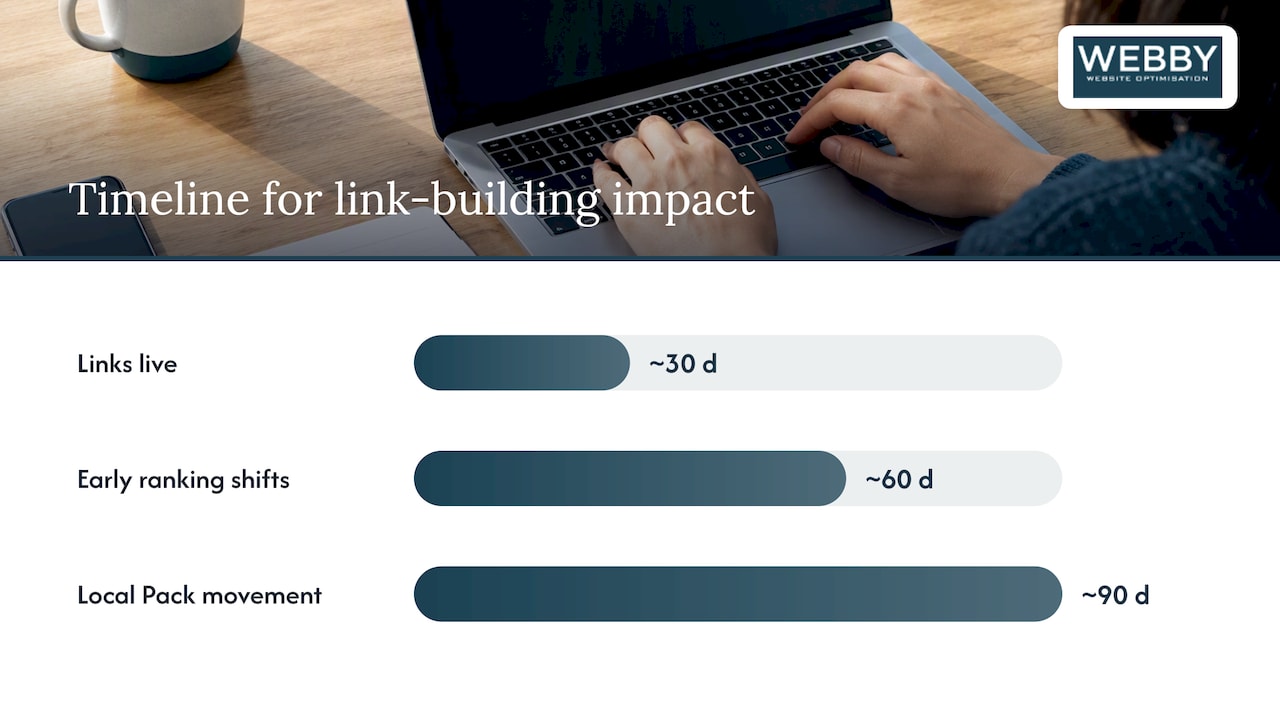
Realistic timelines: expect little movement in the first 30 days beyond links going live, early ranking shifts for lower-competition local terms by 60 days, and more consistent Local Pack or organic movement by 90 days as Google crawls and weighs the new links. A simple monthly KPI report covering new referring domains, ranking changes for five to ten target keywords, and leads attributed to organic traffic is usually enough to show progress to an owner or client.
4. Staying Compliant: Google’s Link Spam Rules and Safe Sponsorships
Every sponsorship, advertorial, or paid placement needs the right markup or it can put your whole site at risk. Google’s spam policies treat buying or selling links that pass ranking value as link spam, and the rules are specific: any paid link, affiliate link, or sponsored placement must carry rel="sponsored" or rel="nofollow", while user-generated content such as forum posts or comments should use rel="ugc". An unmarked paid link can trigger a manual action in as little as 14 days.
Before you sign up for any sponsorship or paid listing, run through this checklist:
- Confirm the site will mark your link as sponsored or nofollow if money changed hands, not just a logo placement.
- Prefer a dedicated sponsor or thank-you page over a sitewide footer link, since footer links across hundreds of pages read as manipulative regardless of intent.
- Avoid reciprocal link arrangements where two sites simply swap links with no editorial reason for either to exist.
- Disclose sponsorships clearly on both sides, which protects you if the relationship is ever reviewed.
- Periodically export your backlink profile and scan for templated anchor text repeated across many domains, which is a common sign of a low-quality directory or an automated outreach service you should drop.
A link spam penalty is largely avoidable: the same Google documentation notes that proper rel attribute use on paid or sponsored content keeps those links outside the spam definition entirely, which means compliance here is a matter of a few lines of HTML, not a reason to avoid sponsorships altogether.
5. Common Mistakes and Safer Alternatives
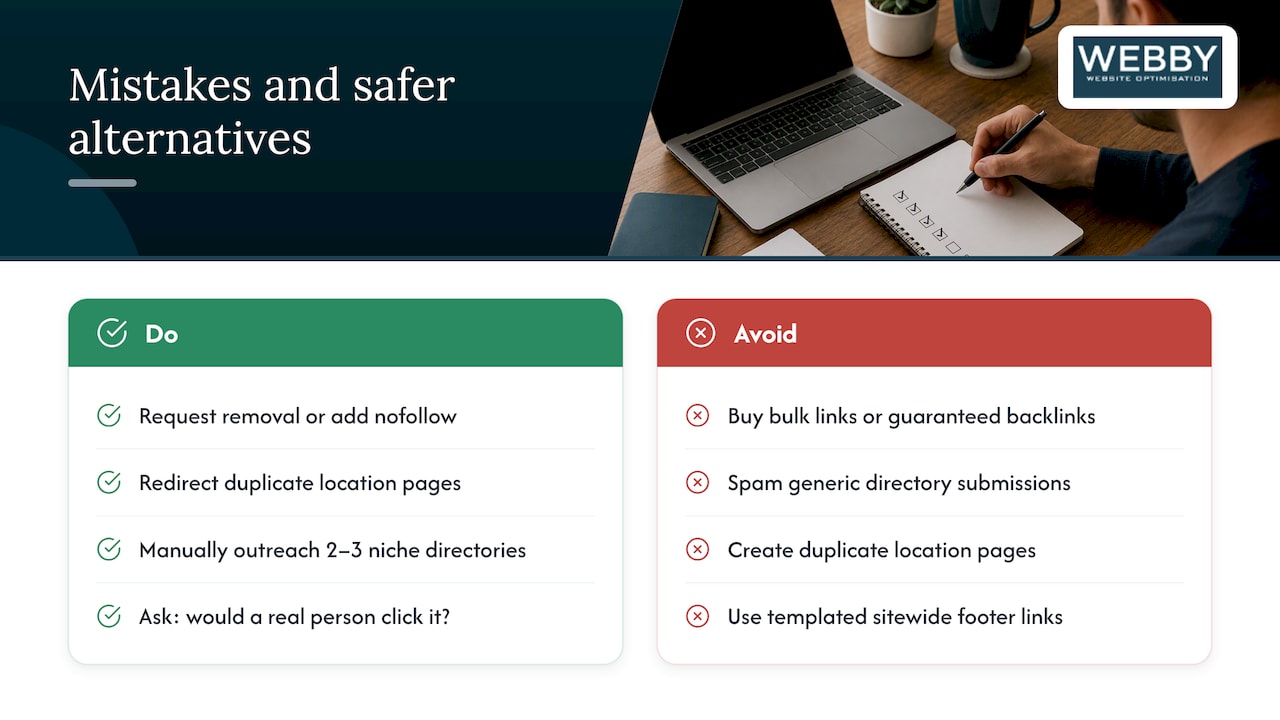
The most damaging mistake is buying links in bulk from link farms or “guaranteed backlink” services, since these patterns are exactly what Google’s spam systems are built to catch. Overusing low-value directories with no editorial review is a close second: a hundred generic directory listings add far less value than three chamber or niche directories with real editorial oversight.
Other red flags worth watching for: duplicate location pages that exist only to hold a link rather than serve a local audience, narrow anchor text patterns that repeat your exact keyword across every link, and templated sitewide footer links from unrelated businesses.
If you find any of these in your existing backlink profile, the fix is usually straightforward: request removal or a nofollow on the worst offenders, redirect duplicate location pages into one strong page per genuine location, and replace any directory submission service with manual outreach to two or three chambers or niche directories instead.
Pro Tip: When evaluating a new link opportunity, ask whether a real person would click it. If the answer is no, the link is unlikely to help your rankings either.
6. Who’s Behind This Guide and When to Bring in Help
This guide was written by Steve Doig, drawing on current local SEO research and Google’s published spam guidance.
Local link building rewards consistency more than cleverness, and many small business owners have the relationships (suppliers, chambers, event organizers) without the time to turn them into links. That is where a local SEO partner earns its keep.
- A site with technical issues or thin content will struggle to convert earned links into ranking gains, which is why a technical review often comes before outreach.
- Ongoing search engine optimisation work typically folds local link building into a broader monthly campaign alongside on-page and technical fixes.
- Businesses already managing their own content and outreach but needing technical site support can lean on WordPress help and support for the publishing side.
DIY works well for business owners with time and existing local relationships. Outsourcing makes more sense once your prospect list outgrows a weekly hour of outreach, or once technical site issues are holding back the links you have already earned.
7. Why Local Link Building Works Best as Community Building
The businesses that earn the strongest, longest-lasting local links are not running outreach campaigns, they are showing up at the same events, sponsoring the same teams, and writing about the same local concerns year after year. Search systems increasingly read these patterns as entity signals rather than isolated links, which rewards the business that sponsors the same youth league for three years running over the one that sponsors a different event each quarter purely for the link.
Plan for 12 months, not 12 weeks. A chamber membership renewed every year, a scholarship fund that grows, a partner page that gets updated as relationships deepen: these compound in a way that one-off outreach campaigns never do. A local trade business that commits to one sponsorship and one supplier partnership per quarter will often have a stronger, more durable link profile after a year than one that chased 50 scattered directory submissions in a single month.
— Steve Doig
8. How We Help You Put This Playbook Into Action
Local link building takes consistent effort, and most business owners already have the relationships, the suppliers, the chamber, the local event sponsors, without the time to turn them into a working outreach system. We handle groundwork so the links actually land and support your local SEO.
If your site has technical gaps holding back the value of new links, our Website Audit identifies what to fix first. For a fuller push, our Business Website Optimisation Campaign combines technical fixes, on-page work, and local link building into one coordinated effort, and our ongoing Search Engine Optimisation service keeps outreach and content running month over month. If your site needs a rebuild before any of this pays off, Website Built in a Day gets you a working foundation fast.
Claim a free website audit and we will show you exactly where your local link profile and site performance stand today.
FAQ
What is the best thing to do for local SEO?
Keep your Google Business Profile accurate and active, and build a small number of genuinely relevant local backlinks from chambers, sponsorships, and partner businesses. Link quality tied to your actual location and industry matters more than any single tactic on its own.
What are some link building strategies?
The strongest local strategies include chamber and association memberships, event or team sponsorships, partnerships with complementary local businesses, locally focused content, and reclaiming unlinked brand mentions. Each of these earns links tied to a real local relationship rather than a transaction.
What will local SEO look like in 2026?
Local SEO continues to weight relevance and entity signals heavily, with link signals carrying roughly 24% of local organic ranking weight and a smaller share of Local Pack weight. Businesses that build ongoing community relationships rather than one-off outreach campaigns tend to hold their rankings more steadily.
How much does link building cost?
Costs vary widely depending on whether you do outreach yourself or hire help, and range from the time cost of a few hours a week to the price of a sponsorship, chamber membership, or an agency retainer. Our own Search Engine Optimisation service price is available on request, and a one-off Website Audit is listed at 1250 AUD.
Do I need rel=sponsored on every sponsorship link?
Yes, if money, product, or any other value changed hands for the placement, Google’s spam policy requires the link to carry rel="sponsored" or rel="nofollow". Unmarked paid links risk a manual action, so confirm the markup before the sponsorship goes live.
Sources
- Spam Policies for Google Web Search | Google Search Central | Documentation | Google for Developers
- Local SEO Link Building: 11 Tactics That Work in 2026