
A lead magnet for a trade business is a free, useful offer, such as a checklist, a cost guide or a quote calculator, that a customer gets in exchange for their name and contact details. Salesforce Australia describes it as an appealing offer or piece of content exchanged for contact information like an email address or phone number. For a plumber, electrician, landscaper or builder, the best ones answer the question a homeowner asks just before they pick up the phone.
This guide covers which lead magnets suit trades, how to pick one, how to build it without a big budget, the Australian spam rules you must follow, and how to tell whether it is bringing in work or just email addresses.
TL;DR
- Pick one lead magnet that answers a pre-purchase worry: a cost guide, a checklist, a quote calculator or a seasonal maintenance list.
- Put it on the pages where people already research your service, not buried in a footer.
- Under the Spam Act 2003 you need consent before sending marketing emails or texts, and every message needs a working unsubscribe.
- Judge it by enquiries and booked jobs, not downloads alone.
- One live lead magnet beats five ideas in your head. Launch a simple version first.
Table of Contents
- Why lead magnets suit trade businesses
- Nine lead magnet ideas that fit trades
- How to choose the right one
- Building it without a big budget
- Where to put it on your website
- Staying on the right side of the Spam Act
- How to follow up so leads turn into jobs
- Measuring whether it works
- How lead magnets compare with paying for leads
- Perspective
- Get help building yours
- FAQ
- Sources
Why lead magnets suit trade businesses
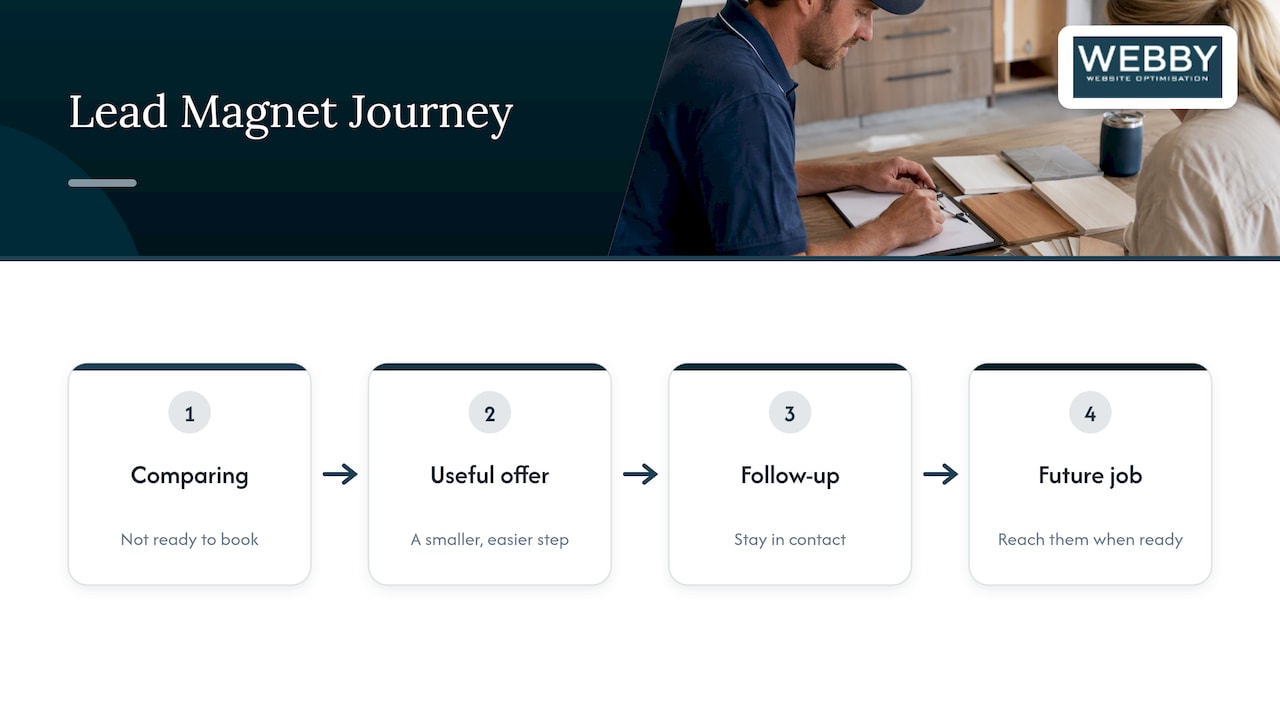
Most people visiting a tradie’s website are not ready to book. They are comparing, checking a rough price, or deciding whether the problem can wait. A contact form that only says “Get a quote” asks for a decision they have not made yet.
A lead magnet gives that visitor a smaller, easier step. They get something useful straight away, you get a way to follow up, and you have shown that you know the job. Salesforce says the best lead magnets bridge a curious visitor and a loyal customer: they grab attention, solve a problem and build trust. That fits trades well, because trust is the thing a stranger needs before letting you into their home.
It also fits how local jobs work. Many jobs are not urgent today but will be in three months: a hot water system that is ageing, a deck that needs recoating, a bathroom reno being planned. If you capture the contact details now, you are the business they hear from when the time comes, rather than the one they find on a search that day.
If you want the wider picture of how this fits with your site, our guide to online lead generation for local service businesses covers the other channels.
Nine lead magnet ideas that fit trades
Salesforce Australia lists guides and e-books, checklists, webinars, templates, quizzes, calculators, video tutorials, case studies and consultations among common formats. Not all suit a tradie. These nine do, because each answers a real homeowner question.
1. A cost guide
“How much does it cost to rewire a house?” is one of the most common searches in any trade. A short PDF that explains what drives the price (size, access, age of the property, compliance work) with honest ranges from your own recent jobs attracts people who are seriously budgeting. Use your own numbers and state the year they apply to, since prices move.
2. A pre-purchase or pre-job checklist
Buyers of older homes want to know what to check before they sign. A plumber can offer a checklist of what to look at in pipes, drainage and hot water. An electrician can do the same for switchboards and safety switches. These people are close to a buying decision and often need a tradie within weeks.
3. A seasonal maintenance checklist
Gutter clearing before storm season, air conditioner servicing before summer, smoke alarm testing at daylight saving changeover. A one-page checklist is easy to make, easy to share and gives you a natural reason to email people twice a year.
4. A “what to do in an emergency” sheet
How to shut off the water at the mains, what to do when a safety switch keeps tripping, what to do after a roof leak. People save these and look for them in a panic. Keep it practical and make it clear when to stop and call a licensed professional.
5. A quote calculator or estimator
A simple form that asks a few questions (room size, number of fixtures, type of finish) and returns a ballpark range. It takes more work to build than a PDF, but it filters well: people who fill it in have a real project.
6. A “questions to ask before hiring” guide
Customers worry about cowboys. A short guide on what to ask any tradie (licence, insurance, written quote, warranty) positions you as the careful operator. Make sure your own business can meet every point on the list.
7. A before-and-after case study pack
Photos of a few completed jobs with a short explanation of the problem, the fix, the timeline and what it cost. This works well for renovation trades, painters, landscapers and builders where the buyer wants proof of finish quality.
8. A first-booking offer
A discount or free inspection in exchange for contact details. It is the most common idea and the easiest to launch, but it attracts bargain hunters more than the others do. Use it alongside a useful guide rather than instead of one.
9. A short video walkthrough
A five-minute video on how to spot early signs of a problem (damp, a failing switchboard, a blocked drain) gives people a reason to trust your expertise. Gate it behind a form only if it is genuinely worth the exchange.
How to choose the right one
Start with the job you most want more of, not the format you find easiest. Three questions help.
What is the most profitable work you do? If it is switchboard upgrades, a switchboard safety checklist beats a generic home maintenance guide.
What do customers ask before they book? Look at your last twenty enquiries. The same three or four questions will repeat. Each one is a lead magnet.
Who do you not want? A free-quote-style offer pulls in anyone. A cost guide for a $20,000 bathroom renovation pulls in people who can afford one. The more specific the offer, the better the leads.
A sensible rule: choose one, build the simplest version and put it live this month. A lead magnet that is actually on your site beats a better one that never leaves your head, and you can improve it once real visitors use it.
Building it without a big budget
You do not need a designer or a marketing team.
- Write it in your own words. Talk through the answers on your phone, then tidy up the text. Customers can tell when a guide comes from someone who does the work.
- Keep it short. Two to six pages, or a single page for checklists. People want the answer, not a book.
- Give it a specific title. “The Perth Homeowner’s Guide to Hot Water System Costs” beats “Free Plumbing Guide”. Name the problem and the reader.
- Use simple design. A clean document with your logo, licence number and phone number is enough.
- Add a next step. End the guide with one clear action: book an inspection, request a quote, call you.
For the page that delivers it, a simple landing page works best: one headline, a few bullets about what they get, a short form and nothing else to click. If you run WordPress, our review of WordPress landing page plugins will help you choose a tool. Ask for as little as you can. Name and email is usually enough, and add a phone number only when your follow-up is a call.
Where to put it on your website
The best place is where the visitor already has the question.
- On service pages. A plumber’s hot water page should offer the hot water cost guide, right beside the quote button. Our look at optimised service pages that convert shows how offers and service content can work together.
- On blog posts. If an article ranks for “signs your switchboard needs upgrading”, end it with the switchboard checklist.
- In the header or a slim banner. Useful for a seasonal offer, but do not let it compete with your phone number.
- On your Google Business Profile. Link to the landing page from a post or the website field so people searching locally can reach it.
Avoid pop-ups that appear the moment a page loads. Someone with a leaking pipe does not want to be interrupted. If you use one, trigger it when the visitor is about to leave, and make it easy to close.
More on turning visitors into enquiries is in our guide to turning website visitors into leads.
Staying on the right side of the Spam Act
Once you collect email addresses or mobile numbers, you are sending commercial electronic messages, and Australian law applies. According to business.gov.au, under the Spam Act 2003 you must get express or inferred consent before sending, and each message must give a clear, functional way to unsubscribe.
In practice for a tradie:
- Say what you will send. Next to the form, add a line such as “We will email you the guide and occasional maintenance tips. Unsubscribe any time.” That makes consent express and clear.
- Do not tick the box for them. Leave any marketing consent checkbox empty.
- Put an unsubscribe link in every marketing email. The same official page says unsubscribe requests must be actioned within 5 working days, at no cost and without making the person log in or create an account.
- Identify your business. Include your business name and contact details in each message.
- Do not buy email lists. Consent does not transfer.
Enforcement is real. The ACMA reported that Betfair paid an $871,660 penalty in 2025 for spam-law breaches. A tradie list is far smaller, but the rules are the same, so build the habit from the first email. If you are unsure about your situation, check the business.gov.au page above or ask your solicitor.
One more practical point: send from an address on your own domain, not a free webmail account. Business.gov.au notes that a business email address can build credibility and is less likely to land in spam. Our walkthrough on how to set up a business email for your WordPress site shows how.
How to follow up so leads turn into jobs
The guide is only the first step. A simple three-email sequence is enough for most trades:
- Immediately: deliver the guide, thank them and say who you are.
- Two or three days later: one useful extra tip related to the guide, with a short line offering a quote or inspection.
- A week later: a recent job or customer story, and a clear invitation to call or book.
After that, move them to a low-frequency list: a seasonal reminder or two a year. Keep every message short and written the way you would speak to a customer on the doorstep.
If the form collects a phone number, call within a day or two, especially for quote-style offers. Speed is a big advantage for a local business.
Measuring whether it works
Downloads feel good but pay no bills. Salesforce suggests judging a lead magnet by both conversion rate and lead quality: whether contacts fit your ideal customer, engage with follow-up content and move through the sales funnel.
For a small trade business, track five numbers each month:
| Measure | What it tells you | How to get it |
|---|---|---|
| Page visitors to sign-ups | Whether the offer and page are persuasive | Website analytics plus form submissions |
| Sign-ups from your service area | Whether you attract locals, not the whole country | Suburb or postcode field, or analytics location |
| Email opens and clicks | Whether people read the follow-up | Your email tool |
| Quote requests or calls from leads | Whether the magnet leads to real enquiries | Ask “How did you hear about us?” |
| Booked jobs and their value | Whether it makes money | Match emails to your job list |
Add the cost: your time to build it, any tool fees and any advertising spend. Divide by the number of leads, then by the number of jobs. A magnet that brings 20 sign-ups and two $3,000 jobs is doing far more than one that brings 200 downloads and none.
If results are weak, change one thing at a time: the title, the form length, the placement, the follow-up email. Testing several changes at once leaves you not knowing which one worked.
How lead magnets compare with paying for leads
Many tradies buy leads from marketplaces or run ads for each enquiry. Those can work, but you pay for each lead whether or not it becomes a job, and you often share the same enquiry with other businesses. A lead magnet is different: you build the asset once, it keeps working on your own website, and the contacts belong to you.
When comparing costs, count your build time and tools against the total cost per booked job, not per lead. Prices for paid leads differ by trade and city, so look at current figures for your own trade before deciding. Many businesses use both: paid channels for urgent work today, and a lead magnet to capture the people who are not ready yet.
Perspective
Over the years of working with local service businesses, we have noticed that the sites that win are rarely the ones with the most clever offer. They are the ones that answer a real customer question clearly, on the right page, and follow up quickly.
For a trade, the lead magnet is not a marketing trick. It is how you show your expertise before someone has met you. We build the page, the form and the follow-up as one system, because a great guide on a slow, confusing page will not generate a single job.
Our advice is to start small. Choose the one question you hear every week, answer it in a page or two, put it next to your quote button and check the results in a month. Then improve it. That habit beats any big launch.
Steve Doig
Get help building yours
If you would rather have this done for you, we build and tune lead-capture pages for local service businesses in Perth and across Australia. A good first step is our Website Audit, priced at $1,250 (AUD) one-off, which shows what is stopping your site turning visitors into enquiries. If you need a site fast, Website Built in a Day is $750 (AUD) one-off.

You can also claim a free website audit to see where you stand, or read about our conversion optimisation work.
FAQ
What are the best lead magnets for tradies?
The best ones answer a question customers ask before booking: a cost guide, a pre-purchase or maintenance checklist, a quote calculator or a seasonal tips sheet. Pick the one tied to your most profitable work. A specific offer attracts better leads than a generic discount.
Do I need to follow the Spam Act if I only email a few people?
Yes. The Spam Act 2003 applies to commercial electronic messages whatever the size of the list. You need consent before sending, a clear sender identity and a working unsubscribe, as set out on business.gov.au.
How long should a lead magnet be?
As short as it can be while still solving the problem. A checklist can be one page and a cost guide two to six pages. People want a quick, useful answer they can act on, not a long book.
How do I know if my lead magnet is working?
Track sign-ups against page visitors, then follow those contacts through to quote requests and booked jobs. Salesforce recommends looking at both conversion rate and lead quality. If you get downloads but no enquiries, the offer may be attracting the wrong people or the follow-up may be too slow.
Sources
- Lead Magnets: A Complete Guide, Salesforce Australia
- Lead Magnets: A Complete Guide, Salesforce
- Promoting your business by email or text messages, business.gov.au
- Betfair pays $871K for VIP customer spam breaches, ACMA
- Get a business email address, business.gov.au