
If you run a plumbing, electrical, cleaning or other local service business in Australia, you have probably seen Google’s pay-per-lead Local Services Ads (LSAs) mentioned in US or UK marketing advice and wondered whether you can use them. The short answer: the Google help pages we reviewed describe LSAs by country, and none of them lists an Australian rollout or an Australian category list. Until Google says otherwise on its own pages, plan your lead generation around tools you can actually switch on today: Google Ads campaigns tied to your Business Profile, a strong local presence in Google Maps, and a website that turns clicks into calls.
This guide explains what LSAs are, what the official documentation does and does not say about Australia, how they differ from standard Google Ads, and what to do in the meantime.
TL;DR
- Google’s Local Services help pages we reviewed do not list Australian eligible locations or service categories, so do not budget for LSAs as if they were live here. Check Google’s own pages for the current position.
- LSAs are keywordless, pay-per-lead and appear only on Google Search and Maps. Standard Google Ads is mostly pay-per-click with keywords and runs across more of Google.
- Where LSAs run, they involve screening that can include identity, licence and insurance checks. Having your licences and insurance in order helps whatever channel you use.
- Australian service businesses can combine Performance Max, search campaigns, a well-run Business Profile and a fast, conversion-focused website to get similar results.
- A tracked call or form enquiry is the number that matters, not clicks.
Table of Contents
- What Local Services Ads are
- Are Local Services Ads available in Australia?
- How LSAs differ from standard Google Ads
- What setup looks like where LSAs run
- Billing, disputes and refunds
- What Australian service businesses can run instead
- Which option suits which business
- The step most people skip: the page the click lands on
- Our perspective
- How Webby can help
- A practical plan for the next 30 days
- FAQ
- Sources
What Local Services Ads are
Local Services Ads are a Google format built for businesses that win work by phone or booking: plumbers, locksmiths, cleaners, electricians, and similar trades and professionals. Google describes them as designed for specific service categories, including home, business, health, wellness and automotive services.
Three features set them apart:
- No keywords. You do not bid on search terms. Google matches your business profile, job types and service area to what people search.
- Pay per lead. You are charged for an enquiry (a call or a message), not for every click.
- Limited placement. Google says LSAs appear exclusively on Google Search and Maps, not across the wider Display or YouTube networks.
The badge you see on LSAs in other countries is part of the appeal. It signals that Google has checked the business. Google has said it will discontinue the Money Back Guarantee tied to the Google Guarantee badge as it moves to a single Google Verified badge, so older articles that sell the “guarantee” as a refund promise are out of date.
Are Local Services Ads available in Australia?
This is the part most pages ranking for this search gloss over. Many agency pages talk about LSAs as though they are a normal Australian option. When we read Google’s own documentation, the picture is less clear:
- Google’s screening and verification requirements page is written for the United States. It asks you to choose a country and business category to see requirements, and says they can depend on business type and the state, province and country where you operate. It does not give an Australian list of eligible locations or categories.
- Google’s page on how providers qualify says screening varies by service category and country. It does not establish an Australian rollout.
- Google’s 2026 notice about moving LSAs to Performance Max says the first wave covers selected US advertisers, with non-US accounts and remaining categories following in 2027. It does not announce Australian availability.
Put plainly: we cannot point you to an official Google page that says Australian businesses can sign up. Treat any provider promising you an LSA “setup” in Australia with caution, and ask them to show you the official sign-up screen for your category and postcode. If Google does extend the product here, it will say so on its own help pages first, and that is where to check.
How LSAs differ from standard Google Ads
Even if LSAs are not available to you, understanding the difference helps you pick the right substitute.
| Local Services Ads | Standard Google Ads | |
|---|---|---|
| Targeting | Business profile, job types, service area | Keywords, audiences, locations |
| Pricing model | Pay per lead (call or message) | Mostly pay per click |
| Keywords | None | You choose and manage them |
| Where they show | Google Search and Maps | Search, Maps, Display, YouTube and more |
| Control | Limited: categories, areas, budget | Wide: ads, landing pages, bids, schedules |
The model difference is summarised in Google’s own guide to growing with Local Services Ads: LSAs are built around phone or booking leads for local service businesses, while standard ads give broader reach across Google networks.
The trade-off is control against convenience. LSAs take away the keyword work. Standard campaigns give you back that work, and with it the ability to exclude wasteful searches, test different ads and send people to a page built for the job they searched for.
What setup looks like where LSAs run
Even though you cannot assume access, the setup logic is useful because it mirrors what good local advertising needs anywhere.
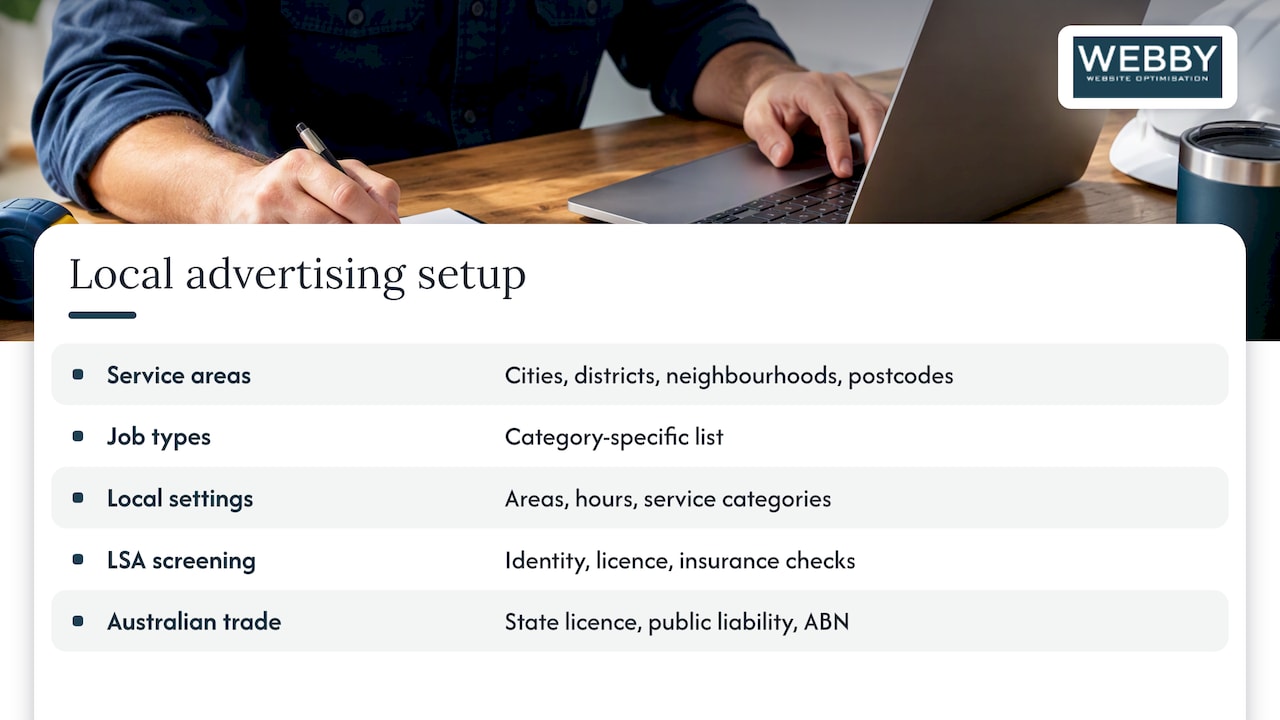
Service area. Google says advertisers define areas using cities, districts, neighbourhoods and postcodes, and pick job types from a category-specific list. This is general Local Services functionality and not proof that it exists for Australian accounts.
Hours and categories. Local advertising generally asks you to define your service areas, hours and service categories so ads reach relevant people.
Verification. Where LSAs are active, businesses go through screening that can include identity, licence and insurance checks. Google’s advertising policy also states that advertisers must comply with local laws, licensing and insurance rules in their jurisdiction, and that responsibility sits with the advertiser.
For an Australian trade, that means having your state licence details, public liability insurance certificate and ABN details accurate and to hand. You will need them for any credible advertising platform, and customers increasingly look for them on your site.
Billing, disputes and refunds
We could not find an official Google page describing LSA billing, lead disputes or refunds for Australia, and we will not guess at the terms. If you are ever offered LSA access here, ask for the written billing terms, how a lead is defined, and how you can dispute one before you commit budget. For the channels you can run now, billing is simpler: Google Ads charges according to the bidding strategy you choose, and you can see every click and conversion in your account.
What Australian service businesses can run instead
The good news is that the goal of an LSA, getting local people to call you at the moment they need a tradie or a professional, can be reached with other tools.
1. Search campaigns with call and form tracking
A tightly built search campaign puts you in front of people typing “blocked drain Fremantle” or “emergency electrician Perth”. You set the suburbs, the hours your phone is answered, and the jobs you want. The tracking is the important part: every phone call and form fill is recorded so you can see cost per enquiry, not just cost per click. Our guide to PPC marketing on Google for Australian SMBs goes through the structure in more detail.
2. Performance Max tied to your Business Profile
Performance Max can use automation across Google’s surfaces without you managing keyword lists. Google documents that Performance Max campaigns associated with a Business Profile can send ad clicks to a Business Profile optimised for your ad. That is useful for service businesses with no product catalogue. We cover how this works for trades in Performance Max for local services in Australia.
A warning: automation optimises toward whatever you tell it counts as a conversion. If you count every page view, you will buy page views. Count calls over a minimum length and completed enquiry forms.
3. Your Google Business Profile and local organic results
The map results are free to appear in and often drive the most calls for service businesses. Accurate categories, service areas, photos, reviews and consistent business details do much of the work. Our explainer on the Google Business Profile for local service owners covers what to fix first. For longer-term growth, local SEO builds the visibility that paid ads rent, and our hiring guide for local SEO companies in Australia shows what to ask a provider.
4. Retail-only local formats
Local inventory ads and free local listings are available in Australia for retailers wanting to show products and store information. If you sell services, they are not the fit; if you also sell products from a shopfront, they may be.
Which option suits which business
| Situation | Start with |
|---|---|
| Emergency trade, phone-driven, wants leads this month | Search campaign with call tracking, plus a tuned Business Profile |
| Several services across several suburbs | Performance Max plus separate search campaigns per service |
| Small budget, long-term view | Business Profile and local SEO first, paid ads at a small test budget |
| Retail shopfront with products | Local inventory ads and free local listings |
The step most people skip: the page the click lands on
Any paid lead channel is only as good as the page behind it. A slow page, a buried phone number or a generic homepage will waste budget. Before you spend on ads, check that:
- The phone number is tappable at the top of the mobile page.
- The page names the service and the suburb the visitor searched for.
- Licence, insurance and review proof sit near the call to action.
- The page loads quickly on a mobile connection.
- Every call and form is tracked as a conversion.
Fixing these often lowers your cost per lead more than any change inside the ad account.
Our perspective
We work with local service businesses in Perth, Fremantle and Melville, and the pattern we see is consistent: owners hear about a shiny lead product from overseas, ask if they can have it, and neglect the basics that decide whether any channel pays back. The channel matters less than three things: whether you show up for the right local searches, whether your page convinces a stressed customer to call, and whether you can see which ads produced actual jobs.
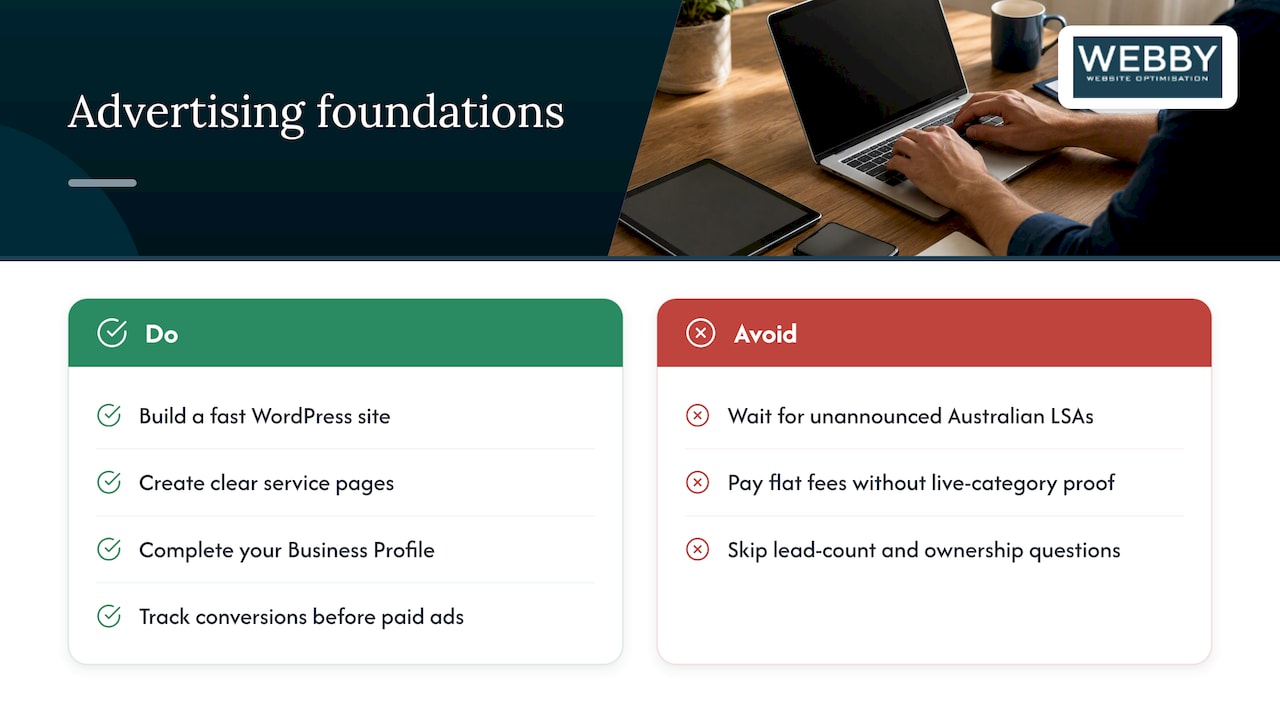
So our advice is not to wait for a product that Google has not announced for Australia. Build the foundation now, a fast WordPress site with clear service pages, a complete Business Profile, proper conversion tracking, then add paid search or Performance Max with a budget you can afford to test. If LSAs ever arrive here, a business with that foundation will be ready to use them well, instead of starting from zero.
Be wary of anyone who quotes a flat price for “LSA management” in Australia without showing you where the product is live for your category. Ask what you are buying, how leads are counted, and what you own at the end.
— Steve Doig
How Webby can help
If you want to know where your site stands before putting money into ads, start with our Website Audit, a one-off A$1,250 review of what is holding back your visibility and conversions. If you already know the site needs work, the Business Website Optimisation Campaign is a one-off A$3,125 project. For ongoing SEO and local visibility, see our Search Engine Optimisation service. If you would rather start with a free look, you can claim a free website audit.
A practical plan for the next 30 days
- Week 1: Gather your licence numbers, insurance certificates and ABN. Claim and complete your Business Profile, and ask recent customers for reviews.
- Week 2: Set up call and form conversion tracking. Test every number and form yourself.
- Week 3: Tighten the service pages you will send traffic to: one page per main service, with the suburb names you work in.
- Week 4: Launch a small, tracked search campaign for your two most profitable jobs. Review search terms weekly and exclude the ones that bring the wrong calls.
After a month you will have real numbers: cost per enquiry, enquiry-to-job rate, and which suburbs perform. Those decide whether to scale, shift to Performance Max, or invest more in organic search.
FAQ
Can I use Google Local Services Ads in Australia?
We could not find an official Google page that lists Australia as an eligible location or gives an Australian category list. Google’s help pages describe requirements by country and say screening varies by country and category. Check Google’s own Local Services pages for the current position before paying anyone to set it up.
What is the Australian alternative to LSAs?
The closest options are tracked Google search campaigns, Performance Max linked to your Business Profile, and strong local organic visibility in Maps. Together they put your business in front of people searching for a local service and measure calls and forms as results.
Do I need a licence and insurance to advertise?
Google’s policy says advertisers must comply with local laws, licensing and insurance requirements, and that this is the advertiser’s responsibility. For regulated trades, keep your current licence and insurance details ready, and display them on your site to build trust.
Is pay-per-lead better than pay-per-click?
Not automatically. Pay-per-lead removes the risk of paying for clicks that never call, but it gives you less control. Pay-per-click with proper call and form tracking lets you see your real cost per enquiry and cut wasted spend.
Sources
- How to grow your business with Local Services Ads (Google Business)
- Local Services Ads transition to Performance Max campaigns (Google Ads Help)
- Business screening and verification requirements (Local Services Help)
- How providers qualify for Local Services Ads (Local Services Help)
- About Google Verified badge (Local Services Help)
- About reaching customers with your Local Services Ads (Local Services Help)
- Reach local customers with Local Service Ads (Google)
- Local Services Ads requirements (Advertising Policies Help)
- Use your Business Profile as a landing page (Google Ads Help)
- Local inventory ads and free local listings overview (Google Ads Help)