
Painter SEO is the work of making your painting business show up when people nearby search for a painter, in the map results and in the ordinary listings. For most painting contractors it comes down to four things: a complete Google Business Profile, one strong page for each service you sell, one page for each area you work in, and a steady stream of real reviews. Do those well and the phone rings with people who already want a quote.
This guide is for owners of residential, commercial and specialty painting businesses, including painting contractors with a small crew. It covers what to build, in what order, and how to tell whether it is working.
TL;DR
- Painting is a local search. Customers look for a painter near them, so your Google Business Profile, reviews and suburb pages matter more than blog volume.
- Build one page per service (interior, exterior, roof, commercial, strata, and so on) and one page per area you genuinely serve, each with real project photos.
- Track calls, quote forms and direction requests, not just rankings. A lead is the goal, not a position.
- Fix the basics first: mobile speed, a visible phone number and a short quote form. Ranking without conversion wastes the work.
- Expect SEO to build over months. Plan for steady effort rather than a quick switch.
Table of Contents
- What painter SEO actually is
- Why painters benefit more than most trades
- Step 1: Get your Google Business Profile right
- Step 2: Build one page for each service
- Step 3: Add area pages that are genuinely useful
- Step 4: Reviews, photos and proof
- Step 5: Fix the website so visitors become enquiries
- Which keywords to aim for
- A realistic first 90 days
- How to measure whether it is working
- Perspective
- Doing it yourself, hiring help, or both
- How we can help
- FAQ
- Sources
What painter SEO actually is
When someone types “house painters near me” or “exterior painting” plus a suburb, Google shows a map block with three businesses and, under it, a list of websites. Painter SEO is the set of improvements that gets your business into both.
Google describes local results as being based mainly on relevance, distance and prominence. In plain terms for a painter:
- Relevance: does your profile and website clearly say you paint the type of job being searched for?
- Distance: how close are you to the person, or to the suburb they named? You cannot change where you are, but you can be clear about the areas you serve.
- Prominence: how well known and trusted are you, as shown by reviews, mentions and a solid website?
Everything below is a way of improving one of those three.
Why painters benefit more than most trades
Painting is a considered purchase. Homeowners compare several quotes, look at photos of finished work and read reviews before they call. That behavior suits search well: the customer is actively looking, and the business that shows clear proof of quality wins the call.
It also means your website has two jobs. It must be found, and it must then persuade. A page that ranks but has no photos, no phone number above the fold and a slow mobile load will lose the enquiry to the next painter in the list.
Step 1: Get your Google Business Profile right
For a painter this is usually the biggest single lever, because it drives the map results.
- Use your real business name. Google’s representation guidelines ask that the name match how the business is consistently presented in the real world, on signage, stationery and branding. Do not stuff suburbs or keywords into it.
- Choose the fewest categories that describe your core business. The same guidelines advise this. For most, the primary category is the painting category, and extras should only be added where you truly offer that service.
- Set your address or service area accurately. If you work from home and visit customers, use a service area rather than publishing an address customers cannot visit. List the suburbs or regions you actually cover.
- Keep one profile per business. Duplicates cause problems with how information appears on Maps and Search, according to the same Google guidelines.
- Add services, hours and photos. Upload before-and-after shots of real jobs: kitchens, fences, weatherboards, commercial fit-outs. Real photos beat stock images every time.
- Ask for reviews after every finished job, while the result is fresh, and reply to each one in a normal human voice.
For more on this topic from our own site, see our notes tagged Google Business Profile.
Step 2: Build one page for each service
The most common mistake on painter websites is a single “Services” page that lists everything in one paragraph. Google cannot tell which search that page deserves to rank for, and a customer cannot find their job.
Instead, give each major service its own page:
- Interior painting
- Exterior painting
- Roof painting and restoration
- Commercial and office painting
- Strata and body corporate repaints
- Fence, deck and timber staining
- Cabinet and trim spraying
- Wallpaper and decorative finishes, if you do them
Each page should show the process, the types of property you do, the paint and prep approach you use, a few real photos with the suburb and job type, and a clear way to ask for a quote. Aim for useful, specific text that a customer would read, not a block of repeated keywords.
Specialist work deserves the same treatment. A trade that does surface preparation, for example, benefits from a dedicated page, in the way a paint removal service page lays out the surfaces it handles and the finish it prepares for. If you strip old paint, treat lead-safe work or restore timber, give that its own page too, because those customers search very differently from someone wanting a fresh coat in the lounge.
What goes at the top of a service page
Put the answer first. A short opening paragraph should say what you paint, where, and how to get a quote. Then add your phone number, a short form and a line or two of proof, such as the number of homes painted or a review. Visitors on a phone decide in seconds.
Step 3: Add area pages that are genuinely useful
If you cover Perth, Fremantle, Melville or any other region, a page for each area you really serve helps both customers and Google understand where you work. The key word is genuine. A page that is the same text with the suburb name swapped is thin, and customers notice.
A good area page includes:
- Local detail: the housing styles you see there (federation, brick-and-tile, new builds, heritage homes), and what that means for prep and paint choice.
- Two or three real jobs in that area with photos and a short description.
- Reviews from customers nearby, where they have agreed to be named.
- Clear boundaries: which suburbs you cover and which you do not.
Start with the three to five areas that bring you the most work, then add more only as you have real material to put on them.
Step 4: Reviews, photos and proof
Painting is a visual trade, so proof carries weight. Prominence in Google’s local ranking draws on how well known your business is, and reviews are the most visible signal of that.
A simple routine works better than a one-off push:
- Send a short thank-you message with your review link on the day the job is signed off.
- Ask for a photo of the finished room or house, with permission to use it.
- Reply to every review within a few days. For a poor review, be calm, factual and offer to fix the issue offline.
- Show a handful of reviews on your service pages too, not only on Google.
Never buy reviews or invent them. It breaks the platform rules and damages trust far more than it helps.
Step 5: Fix the website so visitors become enquiries
Traffic only matters if it turns into quote requests. Check these on your own phone:
- Speed: does the page appear quickly on mobile data? Large uncompressed job photos are the usual cause of slow painter sites.
- Phone number: is it tappable and visible without scrolling?
- Quote form: is it short (name, suburb, phone, job type)? Every extra field loses people.
- Photos: are they real, sized properly and labelled with a short description?
- Trust: are licence details, insurance and review highlights easy to find?
This is conversion work, and it often delivers more extra enquiries than another round of keyword changes. If you want to go deeper, our Comprehensive Guide to Conversion Rate Optimisation walks through it.
Which keywords to aim for
Painter keywords follow a pattern: a service, a place and sometimes a property type. Examples of the shape (not a list to copy):
| Type | Example pattern | Best page |
|---|---|---|
| Service + area | exterior painting [suburb] | Service page or area page |
| Property type | strata painting, commercial painting | Dedicated service page |
| Problem-led | peeling paint repair, repainting weatherboard | Service page with a how-it-works section |
| Near me | painters near me | Google Business Profile and home page |
| Cost | house painting cost | A pricing guide page |
Cost questions are worth a page of their own. Customers ask them early, and an honest guide explaining what affects a quote (surface condition, prep, number of coats, access, paint grade) builds trust before they ever call you.
A realistic first 90 days
| Period | Focus |
|---|---|
| Weeks 1 to 2 | Audit the site and profile. Fix name, categories, service area, contact details and mobile speed. |
| Weeks 3 to 6 | Write or rewrite the main service pages. Add real photos and a short quote form. |
| Weeks 7 to 10 | Add area pages for your top suburbs. Start a routine for asking for reviews. |
| Weeks 11 to 13 | Review calls, form leads and profile actions. Decide what to expand. |
Results build over months, not days, so judge progress by leads and enquiries rather than by checking rankings daily.
How to measure whether it is working
Three numbers tell you most of what you need:
- Calls and form submissions from the website and the profile. Ask every caller how they found you, and write it down.
- Profile actions: calls, direction requests and website clicks in your Google Business Profile.
- Search impressions and clicks for your service and area pages in Google Search Console.
Compare month on month, and against the same month last year, because painting is seasonal. Exterior enquiries tend to cluster in drier months, so a quiet patch does not always mean a problem.
Perspective
Most painters we speak to are excellent at the work and have a website that undersells it. The pattern is familiar: one services page, a handful of stock photos, a slow mobile load and a profile that has not been touched in years.
Our view is that SEO for a local trade is not a bag of tricks. It is making your real business easy for Google and customers to understand. That means clear service pages, honest area pages, real photos and a site that is quick to use. We build and optimise WordPress sites for local service businesses, and we focus on search visibility and conversion together, because a ranking that does not produce a call has not done its job.
If you are starting from a weak site, we would rather fix the foundation first and then build search on top of it. It is the approach we are designed around: transparent communication, practical steps and work you can see in your enquiries.
Steve Doig
Doing it yourself, hiring help, or both
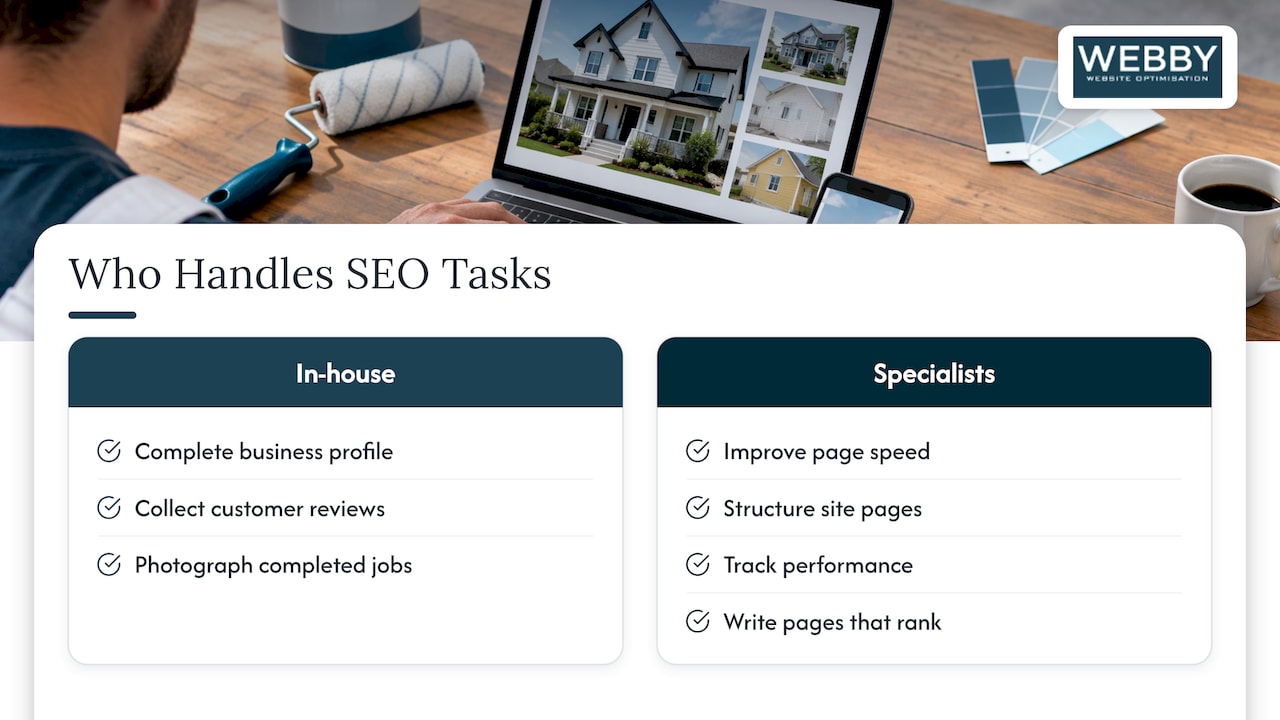
Some of this is well within reach for a busy owner: filling in the profile, collecting reviews and photographing jobs. Other parts are technical: page speed, site structure, tracking and writing pages that rank. Many painters handle the first group in-house and bring in specialists for the second.
If you decide to hire, look for an agency that explains what it will do each month, shows you the numbers that matter (calls and leads) and gives you access to your own accounts. Our guides on hiring an SEO agency, what SEO costs and the SEO services small businesses need in Australia help you compare options, and our piece on choosing a local search agency covers what to ask.
How we can help
We are a Perth agency that works with local service businesses on SEO, WordPress design, speed and conversion. If you are not sure where your painting website stands, the Website Audit is a good first step at $1,250 (AUD, one-off): it shows what is holding the site back before you spend on anything else.

If the site needs a rebuild, our Website Built in a Day is $750 (AUD, one-off), and the Business Website Optimisation Campaign is $3,125 (AUD, one-off). For ongoing local search work, see our Search Engine Optimisation service, or claim a free website audit and talk to us about your area.
FAQ
How long does painter SEO take to work?
Most painting businesses see movement over a few months rather than a few days, and the speed depends on your competition, your current site and how much you publish. Profile improvements and reviews often show effects sooner than new pages. Judge progress by calls and quote requests.
Do I need a website if I have a Google Business Profile?
Yes. The profile helps you appear in the map results, but your website is where you show your services, your process and your proof in depth. The two work together, and the profile links to the site.
Should I make a page for every suburb?
Only for suburbs you genuinely serve and can say something real about. Start with your top three to five areas and add local photos, jobs and reviews. Copy-and-paste pages with only the suburb name changed do little for customers.
What should a painter track?
Track phone calls, quote form submissions and actions on your Google Business Profile, then look at clicks and impressions in Google Search Console. Ask new customers how they found you so you can match the numbers to real jobs.
Sources
- Tips to improve your local ranking on Google, Google Business Profile Help
- Guidelines for representing your business on Google, Google Business Profile Help
- Paint removal service page