
You can’t delete a Google review yourself. You report it, and Google removes it only if it breaks Google’s policies or the law. So the work is not clicking “flag”. It is picking the right policy reason, backing it with evidence, tracking the decision and appealing once if you need to. Done well, it protects your star rating. Done badly, it wastes your one appeal. And a strong, steady flow of genuine reviews is the best long-term defence against any single fake.
This guide is written for Australian owners of local service businesses. It covers how to spot a fake, how to report it, what to do when Google says no, and where Australian Consumer Law draws the line.
TL;DR
- Only Google can remove a review. You report it from your Google Business Profile and choose the policy reason that matches.
- A review you simply disagree with usually stays. Fake engagement, spam, conflict of interest, harassment and off-topic content are what Google acts on.
- Gather evidence before you report: customer records, reviewer patterns and dates. You get one appeal per review.
- Under Australian Consumer Law, never remove, edit or hide genuine negative reviews, and never create fake positive ones.
- If a review can’t be removed, a calm public reply and a steady flow of real reviews do the most to protect your rating.
Table of Contents
- What Google will and won’t remove
- How to tell if a review is fake
- How to report a fake Google review, step by step
- Track the report and appeal once
- What if Google still says no?
- The Australian Consumer Law line you must not cross
- Make one fake review matter less
- How we can help
- Our perspective
- FAQ
- Sources
What Google will and won’t remove
Businesses cannot directly delete or edit customer reviews on Google. Only Google controls removal, according to an Australian legal publisher.
Google’s test is whether the review breaks its content rules, not whether it is unfair to you. Reviews that tend to qualify include:
- Fake engagement: reviews from people who never used your business, or reviews bought, traded or posted in bulk.
- Rating manipulation and conflicts of interest: a competitor, a former staff member or a relative reviewing you.
- Spam and off-topic content: ads, links, or comments about something unrelated to your business.
- Harassment, hate speech, profanity and personal information.
A harsh but honest account of a real experience generally stays up, even when you think it is wrong. That is the review to answer publicly rather than report. Our guide on responding to negative Google reviews covers how.
How to tell if a review is fake
Before you report, build the case. The ACCC lists the warning signs of fake reviews: a short-term spike in very positive or very negative reviews, many reviews from the same email or IP address, similar reviewer names, generic comments with no detail, and similar wording across reviews of the same business.
For a single suspicious review, run through this:
- Search your records. Look for the reviewer’s name in your jobs, quotes, invoices, emails and booking system. No trace of them is a strong signal.
- Compare the details. Does the review describe a service you don’t offer, a suburb you don’t cover, or a staff member who doesn’t exist?
- Check the reviewer’s profile. Many reviews in a short time across unrelated cities, or reviews of your direct competitors, suggest a pattern.
- Look for a link. Is the name the same as a former employee, a competitor’s owner or someone you had a dispute with?
- Note the timing. A cluster of one-star reviews within days, especially after a social media post or a dispute, is evidence of a campaign.
- Screenshot everything with dates, including any posts or messages calling for negative reviews.
This matters because Google runs its own detection first. Its Transparency Report says most fake reviews are removed automatically by machine-learning models that look at account behaviour and sudden surges of one- or five-star ratings, and community-flagged reviews may go to trained human reviewers. What reaches you is often the borderline case, which is why your evidence counts.
Google also says it blocked or removed more than 240 million policy-violating reviews in 2024, so a report is joining a large, well-used system and not shouting into a void.
How to report a fake Google review, step by step
The exact labels change from time to time, but the path is stable.
- Open your Google Business Profile while signed in to the account that manages it. Search your business name on Google or open Google Maps.
- Open your reviews (“Read reviews”) and find the one you want to report.
- Select the three-dot menu or “Report” next to that review. On Google Maps the three-dot menu also works, as this walkthrough of the process describes.
- Choose the reason that fits the evidence. In Australia the menu has included options such as conflict of interest, off topic, spam, harassment, hate speech, personal information and profanity, plus a “Report a legal issue” link. Google can change the list at any time.
- Send the report, and report each review once. Repeated reports do not speed things up.
Where it goes wrong. The most common mistake is the wrong reason. A fake review reported as “not helpful” is easy to reject. If you suspect a former employee or competitor, saying “ex-employee” alone gives Google nothing to verify. The reviewer name matching the person, or the timing matching a dispute, is what helps, as one policy analysis of the 2026 rules points out. A one-star rating with no text can only be challenged on grounds that don’t depend on the wording, such as fake engagement or rating manipulation, usually by showing a pattern across several reviews.
If you have several suspicious reviews that look related, report them all with the same reason, and keep a log of each one with its date and why you chose that reason.
Track the report and appeal once
Google’s Reviews Management Tool lets you check the status of a report. The usual outcomes are decision pending, report reviewed with no policy violation, or escalated, with a decision to follow by email. Evaluation typically takes several days.
If Google keeps the review, you can submit a one-time appeal for eligible reviews, up to 10 at a time, and explain the violation with evidence. The final decision comes by email. Treat the appeal as your one real shot:
- Put the strongest evidence in it: the matching customer record gap, the pattern of reviews, screenshots of a social post asking people to leave bad reviews.
- Name the specific policy, not a general complaint.
- Don’t treat “escalated” as a win. Wait for the email, and check whether the review is still on your profile.
Removed reviews can occasionally come back if the reviewer’s own appeal is approved, so keep your evidence file.
What if Google still says no?
You have three sensible options.
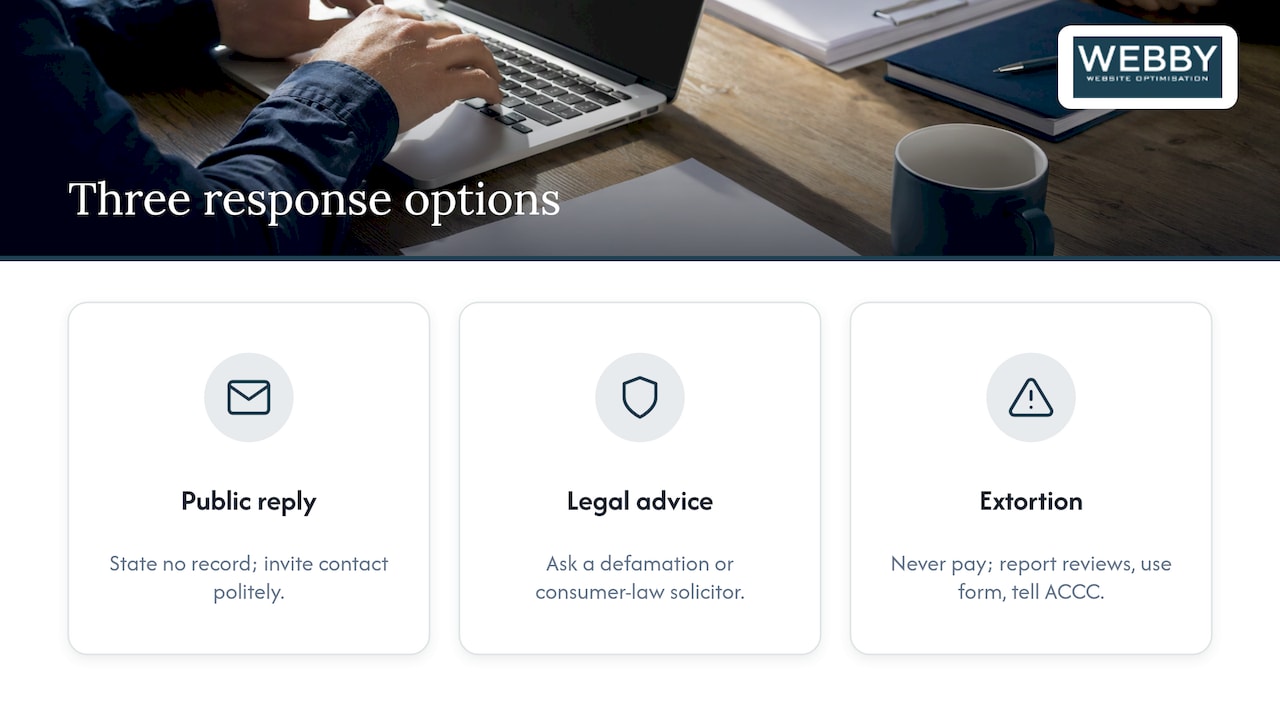
Reply publicly. The ACCC says businesses worried about fake reviews can ask the platform to remove them or respond publicly. A short, factual reply works: state that you can’t find a record of the person, invite them to contact you, and stay polite. Future customers read the reply as much as the review.
Use the legal route if the review is defamatory. Google has a “Report a legal issue” link and a legal removal page. In Australia, a business with fewer than 10 employees can generally sue for defamation only where the review causes, or is likely to cause, serious harm to its reputation, while larger companies generally cannot, according to a 2026 guide. That is a matter for a lawyer, and a solicitor experienced in defamation or consumer law is the right person to see before you send any legal letter.
If you are being threatened. Scammers sometimes demand payment to stop or remove a flood of bad reviews. Google introduced a dedicated form for this kind of extortion in late 2025, and Australian guidance is to never pay, report the reviews, use the form and tell the ACCC. If you think you are being targeted this way, also see our guide to spam on Google Maps.
The ACCC accepts reports about fake reviews, but it uses them for education, compliance and enforcement and does not resolve individual disputes. Don’t expect an ACCC report to take down your review.
The Australian Consumer Law line you must not cross
The temptation after a bad review is to fix your rating fast. Don’t. Under Australian Consumer Law it is illegal to create or arrange a fake or misleading review. The ACCC adds that this covers AI-generated reviews and manipulating genuine ones, and that removing or editing a genuine negative review can itself mislead consumers.
In practice, that means:
- No fake positives. Reviews from staff, family or friends without disclosure count as fake in the ACCC’s view.
- No filtering. Don’t ask only happy customers to review, or pressure unhappy ones to delete theirs.
- Incentives need care. Offering a reward is legal only if it applies to both positive and negative reviews and is clearly disclosed. Our guide to Google review incentives in Australia goes through what is allowed.
The stakes are real. The ACCC’s guide for business cites a Federal Court case in which a solar panel company paid $125,000 in penalties for fake testimonials, and notes that corporations face much larger maximum penalties under the law.
Make one fake review matter less
A single one-star review hurts most when you have 12 reviews, and barely registers when you have 150 genuine ones. The durable fix is volume and recency of real feedback:
- Ask every satisfied customer for a review at the end of a job, by text or email, with a direct link to your profile.
- Ask everyone, not just the people you think will be positive.
- Reply to every review, good or bad, within a few days.
- Keep your profile complete and accurate so that real customers recognise your business. Our Google Business Profile guide for local service owners shows what to fill in.
Reviews feed straight into how often local customers see you and whether they call. That is the ground we work on every day.
How we can help
The quickest way to protect your leads is to make sure your site and your Google presence bring in enough genuine customers that one fake review can’t sink you. Webby builds and optimises websites and runs SEO for local service businesses, and our Website Audit is a one-off 1,250 AUD review of where your website is losing visitors and enquiries. If you want ongoing visibility work, see our Search Engine Optimisation service.

You can also claim a free website audit to see where you stand.
Our perspective
Most owners we speak with treat a fake review as an emergency to be solved today. It is better treated as a small piece of evidence work: gather the facts, report once with the right reason, and then get on with the thing that really moves your numbers.
The businesses that cope best with a fake or unfair review are rarely the ones with the cleverest reporting trick. They are the ones whose websites and Google profiles already attract a steady stream of real customers, so one bad rating is a blip and not a verdict. That is the outcome our SEO, website design and conversion work is designed to deliver for local service businesses in Perth, Fremantle and Melville.
Resist the shortcut. Deleting honest criticism or inventing praise can cost far more than any star rating, and it is not how we would want you to grow.
Steve Doig
FAQ
Can I delete a fake Google review myself?
No. Only Google can remove a review. You can report it from your Google Business Profile, and Google removes it if it breaks its policies or the law. A review you simply disagree with generally stays, and you can reply to it publicly.
How long does Google take to remove a reported review?
Evaluation typically takes several days, and you can check progress in Google’s Reviews Management Tool. If Google decides there is no violation, you can submit a one-time appeal with evidence. The final decision is emailed to you.
Will reporting a review to the ACCC get it removed?
No. The ACCC takes reports for education, compliance and enforcement but does not resolve individual disputes. To get a review removed, report it to Google, and use the legal removal route if you believe it is defamatory.
Is it legal to ask customers for reviews?
Yes, asking real customers is fine. What breaks the law is creating fake reviews, offering rewards only for positive ones, or editing or suppressing genuine negative feedback. If you offer an incentive, it must be open to positive and negative reviews alike and clearly disclosed.
Sources
- Deleting Google Reviews, Sprintlaw Australia
- Online reviews for product and services, ACCC
- Online reviews, business.gov.au
- Google Maps Content Trust & Safety Report
- Google Maps uses AI to fight fake Business Profiles
- How to report a Google review and get it removed
- Google Review Policy and Guidelines (2026)
- What Happens When You Report a Google Review
- Scammers use fake Google reviews to pressure businesses
- Advertising and selling guide, ACCC