
Content freshness matters in SEO, but only for queries that genuinely demand it. The single most important action you can take right now is a targeted audit of your highest-traffic pages to identify which ones serve time-sensitive queries and which ones are stable evergreen content that should be left alone.
Here is a 48–72 hour action plan to get started:
- Pull your top 20 pages by organic impressions in Google Search Console and flag any showing a 3-month decline in clicks or average position.
- For each flagged page, run a quick SERP check: if the top results show recent dates, news blocks, or rapidly changing results, that page is a candidate for a substantive update.
- For confirmed candidates, fix outdated statistics, replace stale examples, and update any terminology that no longer matches how users are searching, then resubmit via URL Inspection.
That is the playbook in three steps. The rest of this guide explains the reasoning, the measurement, and the workflow to make it repeatable.
Table of Contents
- What content freshness actually means in SEO
- How freshness affects your SEO outcomes
- When does freshness actually affect your rankings?
- How to plan and execute meaningful content updates
- How to measure freshness impact and track organic and AI visibility
- A practical workflow your team can actually follow
- What the research says about semantic freshness and AI citations
- Common mistakes that make freshness updates backfire
- Key Takeaways
- A practitioner’s honest take on freshness programs
- How Webby Website Optimisation can help you stay visible
- Useful sources and recommended reading
What content freshness actually means in SEO
Most practitioners use “content freshness” as shorthand for “recently published or updated,” but that framing misses half the picture. There are two distinct types of freshness, and confusing them leads to wasted effort.

Temporal freshness is what most people think of: the publish date, the dateModified schema field, the “Updated March 2026” label at the top of a post. It signals to both users and crawlers that a page has been touched recently.
Semantic freshness is subtler and more powerful. It refers to whether the terminology, examples, data points, and framing of a page still match how users and AI systems currently understand the topic. A page published in 2023 that uses outdated tool names, references deprecated APIs, or cites statistics from a 2019 study is semantically stale, even if someone slapped a new date on it last month.
The distinction matters enormously in the AI era. Semantic currency convinces AI retrieval systems that your content is current because those systems evaluate meaning via vector representations, not just timestamps. A date change without a substance change fools no one. A genuine terminology and data refresh, on the other hand, signals real currency to both Google and the large language models pulling from search indexes.
A concrete example: a guide to “best project management software” that updates its publish date but still recommends tools that were discontinued or rebranded in 2024 will not recover lost rankings. The same guide rewritten with current tool names, 2025–2026 pricing data, and updated feature comparisons will.
How freshness affects your SEO outcomes
The impact of content freshness on rankings is real, but it is concentrated in specific, measurable ways.

Ranking recovery for time-sensitive queries. Pages targeting QDF-sensitive queries (more on those in the next section) can recover lost positions after a substantive update. Republished content generally jumps several SERP positions, and updated posts often see a significant increase in organic traffic, according to HubSpot’s historical optimization data cited in multiple industry analyses.
Increased crawl frequency. Google’s crawl budget allocation responds to update signals. Sites that publish or update content regularly tend to get crawled more often, which means new changes get indexed faster. This compounds over time for sites running systematic refresh programs.
CTR improvements from updated titles and snippets. An outdated title tag with a stale year or obsolete framing gets fewer clicks, full stop. Title changes averaged an 11% increase in Google pageviews in Raptive’s analysis of over 103,000 content refreshes. Image changes drove a 14% lift. These are not marginal gains.
Higher AI citation probability. This is the metric most teams are not tracking yet, and it may be the most consequential one going forward. AI-cited content is notably fresher than organic results, based on Ahrefs’ analysis of AI citations. ChatGPT specifically targets URLs that are substantially newer than equivalent organic Google results.
Reputation accuracy in AI answers. Outdated pages are not just an SEO liability; they are a brand liability. When AI systems synthesize answers from your content, they pull pricing, feature claims, and brand facts directly from your pages. A page with stale pricing or discontinued services actively misleads potential customers through AI-generated responses.
Stat: Refreshed pages in Raptive’s matched-control study averaged a 19-percentage-point lift in Google pageview growth compared to similar pages that were not updated.
The metrics to watch in Google Search Console are impressions, clicks, CTR, and average position, tracked in 30-day windows before and after an update. In GA4, monitor organic sessions and engagement rate. For AI visibility, tools like those described in the measurement section below give you citation frequency by platform.
When does freshness actually affect your rankings?
Not every page benefits from an update. Refreshing stable evergreen content without a performance reason can actually signal instability to Google’s quality systems, which discount sites that appear to be gaming freshness signals. The key concept here is Query Deserves Freshness (QDF), a query-level signal Google uses to decide when recency should influence rankings.
QDF evaluates news volume, blog and forum activity, and search spikes to determine whether users expect recent information for a given query. When those signals are strong, Google boosts fresher content. When they are absent, freshness is essentially neutral.
Query types that trigger QDF:
- Breaking news and current events
- Annual comparisons (“best CRM software 2026”)
- Pricing and availability queries
- Regulatory, legal, or medical updates
- Product launches and software releases
- Industry statistics and benchmark reports
How to detect QDF in the wild. Run the query and look for three signals: dates visible in top-10 titles or snippets (if the top 5 results all show “2025” or “2026,” freshness is a factor), top results published within the last 6–12 months, and explicit freshness SERP features like “Latest” news blocks or Top Stories carousels. Two or three of those signals present means the query rewards freshness. Update accordingly.
When to leave a page alone. A stable definition page, a foundational tutorial, or a technical explainer that has held its ranking for two or more years without a decline is not a freshness problem. Touching it without a performance reason wastes time and can introduce errors. The rule: check Search Console for a 3-month declining impression trend before scheduling any update. No decline, no urgency.
For types of Google search features and how QDF interacts with them in 2026, the landscape has shifted enough that it is worth reviewing which SERP features your target queries trigger before deciding on an update strategy.
How to plan and execute meaningful content updates
A meaningful update is not a grammar pass or a date change. Industry guidance defines a meaningful refresh as adding 31–100% more content on average, not cosmetic tweaks. Here is how to prioritize and execute.
Prioritization checklist:
- Traffic volume: pages with current or historical traffic deserve more attention than low-traffic pages
- Business value: pages tied to high-intent queries or conversion paths rank higher
- QDF sensitivity: pages targeting time-sensitive queries need annual or more frequent updates
- AI citation likelihood: pages that have appeared in AI Overviews or AI-generated answers are high-value maintenance targets
- Performance decay: 3-month declining impressions in Search Console is the clearest trigger
What to actually change in a meaningful update:
- Replace outdated statistics with current figures and link the sources
- Update tool and product names to reflect what is current
- Add new examples, case studies, or use cases from the past 12–18 months
- Rewrite sections where the framing no longer matches search intent
- Update internal links to point to newer relevant content
- Refresh images and screenshots (pages with image changes averaged a 14% pageview lift in Raptive’s study)
- Update
dateModifiedin schema, but only after making substantive changes - Update CTAs if pricing, offers, or services have changed
What to avoid:
- Changing only the publish date or
dateModifiedwithout content changes - Rewriting sections that are still accurate and performing well
- Changing the URL slug (this destroys accumulated link equity)
- Shifting the page’s core topic away from its established ranking keywords
Update cadences by content type:
- Product, comparison, and marketplace pages: every 90 days or when pricing/features change
- Guides, how-tos, and blog posts targeting QDF queries: every 6–12 months
- Stable definitions and foundational tutorials: every 2–3 years, or only when performance data shows decay
Pro Tip: After publishing a substantive update, use Google Search Console’s URL Inspection tool to request indexing. This forces a re-crawl within days rather than waiting for Google’s natural crawl cycle, which can take weeks for lower-priority pages.
How to measure freshness impact and track organic and AI visibility
Measurement is where most freshness programs fall apart. Teams update content, see some traffic movement, and cannot tell whether the update caused it. A controlled pre/post tracking approach fixes that.
Metrics to track before and after each update:
| Metric | Tool | What to look for |
|---|---|---|
| Impressions | Google Search Console | Upward trend within 30 days post-update |
| Clicks and CTR | Google Search Console | CTR lift often precedes ranking improvement |
| Average position | Google Search Console | Position recovery toward page 1 |
| Organic sessions | GA4 | Sustained growth 30–60 days post-update |
| Crawl frequency | Server logs or GSC Coverage | More frequent bot visits after update |
| AI citation frequency | AI citation tracking tools | Appearance in AI Overviews, ChatGPT, Perplexity |
| SERP position shifts | Ahrefs or SEMrush | Rank changes for target keywords |
Tool shortlist:
- Google Search Console: the primary tool for impressions, CTR, and position tracking. Set up date comparison views to isolate pre/post-update windows.
- GA4: track organic sessions by landing page and monitor engagement rate as a proxy for content quality signals.
- Server logs: the most direct way to confirm Googlebot crawl frequency increased after an update. Most hosting platforms expose this through log analysis tools.
- Ahrefs or SEMrush: track keyword rank changes and identify which competitor pages are gaining ground on your target queries.
- AI citation trackers: platforms that monitor AI Overview appearances and third-party AI citation frequency are increasingly available. Note that AI platforms vary in recency bias: Perplexity and Gemini-derived Overviews show stronger freshness preference than ChatGPT for certain content types, so platform-specific tracking matters.
A simple pre/post tracking template: Create a spreadsheet with one row per updated URL. Columns: URL, update date, update type (light/meaningful/major rewrite), target keyword, and then 30-day and 60-day snapshots of impressions, clicks, CTR, average position, and organic sessions pulled from Search Console and GA4. After 10–15 updates, patterns emerge quickly about which update types and content categories respond best.
Pro Tip: Track AI citation frequency separately from organic rankings. A page can lose one organic position after an update while gaining significantly more AI citation appearances, which now drive real referral traffic. Treating these as the same metric will cause you to misread the ROI of your freshness program.
A practical workflow your team can actually follow
Knowing what to do and having a repeatable process for doing it are different things. Here is a workflow that assigns clear responsibilities and prevents the most common execution mistakes.
Step-by-step process:
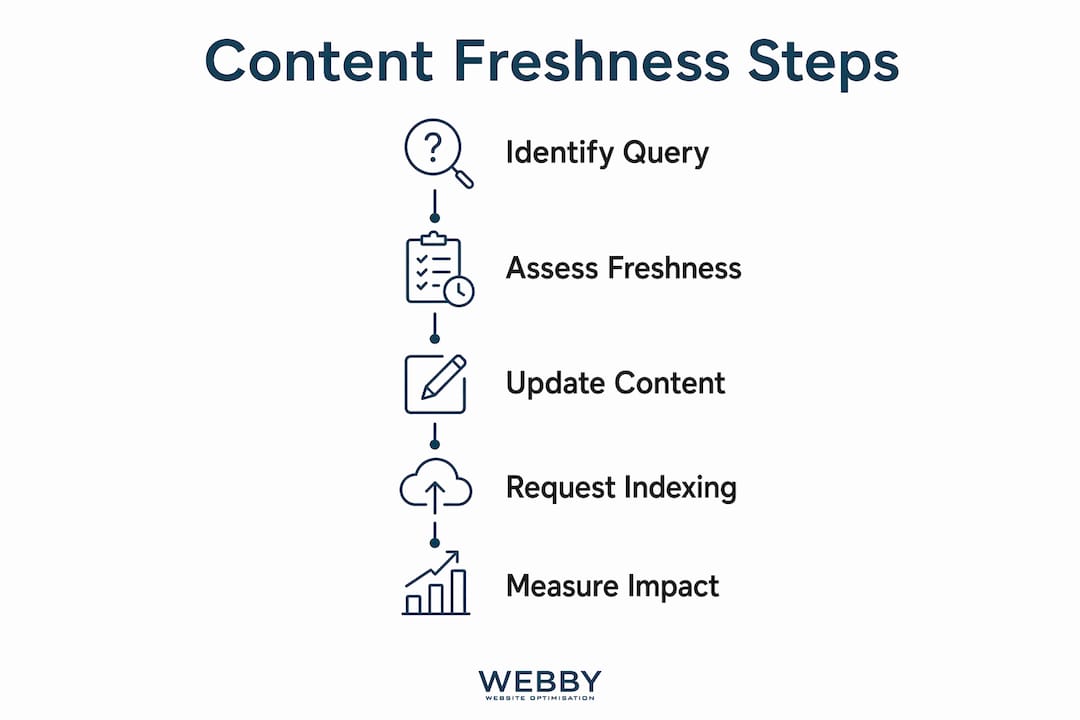
- Identify: Pull the prioritization checklist monthly. Flag pages with declining impressions, QDF-sensitive queries, or known outdated content.
- Triage: Score each flagged page on traffic value, business value, and QDF sensitivity. Assign update tier (light, meaningful, major rewrite).
- Draft: Content owner executes the update using the task list above. No date changes without substantive edits.
- Review: SEO reviewer confirms
dateModifiedschema is updated, URL is unchanged, internal links are current, and the update passes the “meaningful” threshold (more than 10% word count change as a minimum proxy). - Approve: Subject-matter approver signs off on factual accuracy, especially for pricing, legal, or medical content.
- Publish: Developer or CMS operator publishes and requests indexing via Search Console URL Inspection.
- Monitor: Analytics monitor logs the update date in the tracking spreadsheet and checks 30-day and 60-day performance snapshots.
Pre-publish checklist:
- Substantive content changes made (not just date or formatting)
- Outdated statistics replaced with sourced, current figures
- Tool and product names verified as current
dateModifiedschema updated;datePublishedleft unchanged- URL slug unchanged
- Internal links checked and updated
- Images and screenshots current
- CTA and conversion elements accurate
- Editorial note added at top of post for major revisions (“Updated [month year]: added section on X”)
- URL Inspection request submitted in Search Console
Role matrix:
| Role | Responsibility |
|---|---|
| Content owner | Drafts the update, executes the task list |
| SEO reviewer | Verifies schema, URL integrity, internal links, and update depth |
| Subject-matter approver | Confirms factual accuracy for sensitive content types |
| Developer / CMS operator | Publishes and submits for indexing |
| Analytics monitor | Logs update and tracks 30/60-day performance |
For local service businesses, website maintenance is the operational backbone that makes this workflow sustainable. Without a scheduled maintenance cadence, content decay goes undetected until rankings have already slipped.
What the research says about semantic freshness and AI citations
The evidence on content freshness has shifted significantly with the rise of AI-powered search. Two findings stand out as particularly important for practitioners.
First, the divergence between organic rankings and AI citations is real and growing. AI-cited content is 25.7% fresher than organic results, based on Ahrefs’ analysis of 17 million citations. The practical implication: a page can hold a stable organic position while being systematically excluded from AI-generated answers simply because it has not been updated recently enough. These are now two separate visibility channels that require separate maintenance logic.
“Updating website content doesn’t just get your brand cited more often in AI, it gets it mentioned more accurately. When you republish content, you can make sure AI assistants have the right information about things like your pricing, USPs, features, and benefits.” — Ahrefs, Republishing Content for SEO & AI
Second, semantic freshness outweighs temporal freshness for AI retrieval. AI systems evaluate semantic currency via vector representations, meaning they assess whether the meaning and framing of your content aligns with current understanding of the topic, not just whether the date is recent. This is why a date-only change produces no measurable AI citation lift, while a genuine terminology and data refresh can re-enter a page into AI citation pools even if its organic rank shifts only slightly.
The Seer Interactive study on AI visibility found that high-volume cited pages tend to be older pages that are regularly maintained, with a median of under six months since their last update. That is the “always-on” model: not a one-time refresh spike, but a sustained maintenance cadence that keeps pages within the recency window AI platforms prefer.
Prioritization framework for AI citation:
- Spike strategy: update a historically strong page that has lost citation share. A substantive refresh can re-enter it into AI citation pools within weeks.
- Sustained maintenance: for pages that consistently appear in AI answers, schedule updates every 3–6 months to stay within the recency window, even when organic rankings are stable.
The data-driven approach recommended by Seer Interactive is to let performance and citation data dictate update schedules rather than arbitrary calendars. Track which pages are gaining or losing AI citation share, and prioritize those over pages that simply feel old.
Common mistakes that make freshness updates backfire
Freshness tactics can hurt rankings when executed carelessly. These are the patterns that cause the most damage.
Date-only changes without content updates. Google’s quality systems can detect when dateModified changes without corresponding content changes. Google’s December 2025 core update specifically penalized superficial date manipulations for recency-sensitive queries. The corrective action: never update dateModified in schema or the visible “Last updated” date unless you have made substantive content changes.
Over-updating stable evergreen content. A page that has held a top-3 ranking for two years on a non-QDF query does not need a refresh. Touching it introduces risk: changed framing can disrupt the semantic match that earned the ranking, and frequent minor edits signal instability to Google’s quality systems. Leave it alone until performance data says otherwise.
Republishing that changes the URL. Moving a page to a new URL without a proper 301 redirect destroys accumulated link equity. Even with a redirect, some equity is lost. The rule is absolute: keep the URL slug unchanged when refreshing existing content.
Inconsistent schema signals. Updating the visible “Last updated” date on the page while leaving dateModified in schema unchanged, or misaligning dateModified with sitemap lastmod, sends conflicting signals. Google notices. Align all three: visible date, schema dateModified, and sitemap lastmod.
Refreshing pricing, legal, or medical content without approval. These content types carry real-world consequences if updated incorrectly. A pricing page with stale figures misleads customers; a legal or medical page with outdated guidance creates liability. Always route these through a subject-matter approver before publishing. This article provides general SEO guidance, not legal or compliance advice; confirm current requirements with a qualified professional for your specific situation.
Pro Tip: When you make a major revision, add a brief editorial note at the top of the post: “Updated [month year]: added section on X, updated statistics.” This signals genuine update to Google’s quality systems and tells returning readers what changed, which improves engagement signals.
Key Takeaways
Content freshness is a query-level signal, not a blanket ranking factor. Prioritize semantic updates over date changes, measure both organic and AI visibility, and build a maintenance workflow that runs continuously rather than reactively.
| Point | Details |
|---|---|
| Triage by QDF first | Only update pages targeting time-sensitive queries; stable evergreen pages need no freshness intervention. |
| Semantic beats temporal | Updating terminology, data, and examples drives ranking and AI citation gains; date-only changes are penalized. |
| AI citations are a separate channel | AI-cited content is 25.7% fresher than organic results; track citation frequency independently from rankings. |
| Measure pre/post with a spreadsheet | Log update date, type, and 30/60-day Search Console snapshots to prove ROI and identify which content types respond best. |
| Webby Website Optimisation | Provides content audits, prioritized refresh programs, and AI citation monitoring for local service businesses. |
A practitioner’s honest take on freshness programs
The gap between how freshness is discussed in SEO circles and how it actually plays out in practice is wider than most guides admit.
The conventional wisdom, “update your content regularly to stay fresh,” is not wrong exactly, but it is dangerously incomplete. Teams that apply it without a triage layer end up burning hours refreshing pages that were never going to benefit, while their highest-value QDF-sensitive pages sit untouched. The instinct to update everything is understandable, but it is the wrong instinct.
What actually works is treating freshness as a maintenance signal, not a publishing target. The pages that consistently appear in AI answers are not the ones that were updated most recently. They are the ones that are updated reliably, on a cadence tied to query sensitivity and citation data. That distinction changes how you staff the work, how you prioritize the backlog, and how you measure success.
There is also a brand dimension that most SEO-focused guides underweight. In an AI-first search environment, every piece of content on your site is a potential source for an AI-generated answer about your business. Stale pricing, discontinued services, or outdated case studies do not just hurt rankings. They actively generate inaccurate AI answers about what you offer. A freshness program is, at its core, a brand accuracy program.
For local service businesses in particular, the SEO benefits of regular site maintenance compound faster than most owners expect. A single well-executed refresh of a high-traffic service page can recover lost leads within 60 days. The businesses that treat content maintenance as a recurring operational task, rather than a one-time project, are the ones building durable search visibility.
How Webby Website Optimisation can help you stay visible
Knowing the playbook and having the capacity to run it are two different problems. For local service businesses managing a full client load, the content audit, triage, and refresh cycle described in this guide is genuinely time-consuming to execute well.
Webby Website Optimisation runs content audits, prioritized refresh programs, and AI citation monitoring specifically for local service businesses. The process starts with identifying which of your pages are losing ground on QDF-sensitive queries and which are already appearing in AI answers but at risk of losing that visibility. From there, the team handles the substantive updates, schema corrections, and Search Console submissions, so you get the ranking recovery without the operational overhead.
If your site has pages that used to generate leads and have gone quiet, a targeted content audit is the fastest way to find out whether freshness is the issue. Explore the website design and development services at Webby Website Optimisation, or reach out directly to book a free high-impact content audit for your site.
Useful sources and recommended reading
These are the primary sources and tools worth bookmarking for implementation and ongoing measurement.
Must-read first:
Ahrefs — Republishing Content for SEO & AI (ahrefs.com/blog/republishing-content): The most comprehensive practitioner guide available on content refreshes. Covers AI citation behavior, the 25.7% freshness gap, and a detailed update checklist. Start here.
Seer Interactive — Content Recency’s Impact on AI Visibility (seerinteractive.com): Primary research on AI citation behavior and the always-on maintenance model. Essential for teams building AI visibility programs.
Raptive — 103,000 Content Refresh Analysis (raptive.com): The largest controlled study on refresh impact available publicly. The matched-control methodology makes the 19-percentage-point lift finding credible.
Reference sources:
- CrawlSense — Content Freshness SEO (crawlsense.ai): Practical QDF detection criteria and schema guidance. Useful for the triage and workflow sections.
- Searchable — Content Freshness Signals (searchable.com): Explains semantic freshness and AI vector evaluation in accessible terms.
- Blacksmith SEO — Google Freshness Systems Playbook (blacksmithseo.com): Detailed QDF mechanics and the AI citation freshness gap data.
Tool shortlist to start with:
- Google Search Console (free, essential for impressions/CTR/position tracking)
- GA4 (organic session and engagement tracking by landing page)
- Ahrefs or SEMrush (keyword rank tracking and competitor SERP monitoring)
- Server log analyzer (crawl frequency verification)
- AI citation tracking platform (monitor AI Overview and third-party AI citation appearances)