
Claim and fully optimize your Google Business Profile before touching anything else. It’s the fastest lever you have for local leads, often showing ranking movement in 2 to 6 weeks. Follow it immediately with tightly focused service pages on your website. Expect organic traction on those pages within 3 to 6 months.
TL;DR:
- A complete Google Business Profile can influence map-pack rankings within 2 to 6 weeks, ahead of any noticeable organic traffic growth.
- Properly optimized service pages focusing on specific services and local intent tend to outperform generic pages and convert better when well-structured.
- Speed, mobile performance, schema markup, and consistent NAP data are crucial for local sites, with poor Core Web Vitals directly affecting lead capture.
- Review volume and recency significantly impact local rankings, making systematic review requests and responses an essential ongoing strategy.
- For most electricians, basic GBP and page updates can be self-managed, but technical fixes and link-building typically require specialized SEO support.
Table of Contents
- Why Local Search and the Map-Pack Matter for Electricians
- Google Business Profile: Exact Setup and Optimization Steps
- On-Page SEO: Building Service Pages That Convert
- Technical SEO Checklist: Mobile, Speed, Schema, and Security
- Content and Keyword Strategy: What to Write and Which Keywords to Target
- Reviews, NAP Consistency, and Local Link Building
- Measuring SEO Progress, Timeline Expectations, and Cost Ranges
- How Webby Website Optimisation Reads a Local Electrician’s Site
- DIY vs. Hiring an SEO Partner: An Honest Take
- Where Webby Website Optimisation Fits Into This Checklist
- Sources
- FAQ
Why Local Search and the Map-Pack Matter for Electricians
The three map-pack listings above the organic results get most of the clicks when someone searches “electrician near me.” Organic rankings below that fold still matter, but they’re competing for whatever attention is left over. Electrician searches carry unusually high buyer intent. Nobody searches “emergency electrician Perth” out of curiosity. They have a tripped circuit or a smoking outlet, and they’re calling the first credible business they find.
Google weighs three main factors for local ranking, and a fourth that increasingly decides who wins ties:
- Proximity — how close your registered business address is to the searcher
- Relevance — how well your profile and website match the search term
- Prominence — your review volume, citation consistency, and overall web presence
- E-E-A-T — experience, expertise, authority, and trust signals across your site and profile
Electrician SEO playbooks consistently point to the same sequence: lock down the technical foundation and your Google Business Profile first. Then build out service pages. Skipping the order rarely works, because Google won’t rank a fast, well-built service page for a business it can’t verify locally.
Google Business Profile: Exact Setup and Optimization Steps
A Google Business Profile that’s merely claimed but never optimized is close to worthless. Here’s the order that actually moves the needle:
- Claim and verify the listing under your legal business name, exactly as it appears on invoices and your license.
- Choose one primary category (“Electrician”) and add secondary categories only if genuinely relevant (e.g., “Solar energy company”).
- Add every service you offer as individual service items, not a single vague line.
- Write the business description around what you do and where you do it, without keyword stuffing.
- Upload fresh photos monthly: van signage, completed panel upgrades, the team on-site.
- Post weekly, even briefly, about jobs completed or seasonal safety reminders.
- Monitor and answer the Q&A tab before a competitor answers it for you.
- Request reviews systematically after every completed job, and reply to every single one.
Google’s own business documentation confirms that a complete, active profile can shift map-pack position within 2 to 6 weeks, well before your website sees any organic movement. Read through our breakdown of Google Business Profile setup for local service owners if you want the full field checklist.
Pro Tip: Add a service item for every single job type you quote, even the small ones like “smoke alarm installation.” Google’s matching algorithm often surfaces the specific service item ahead of your general category when someone searches by task.
On-Page SEO: Building Service Pages That Convert
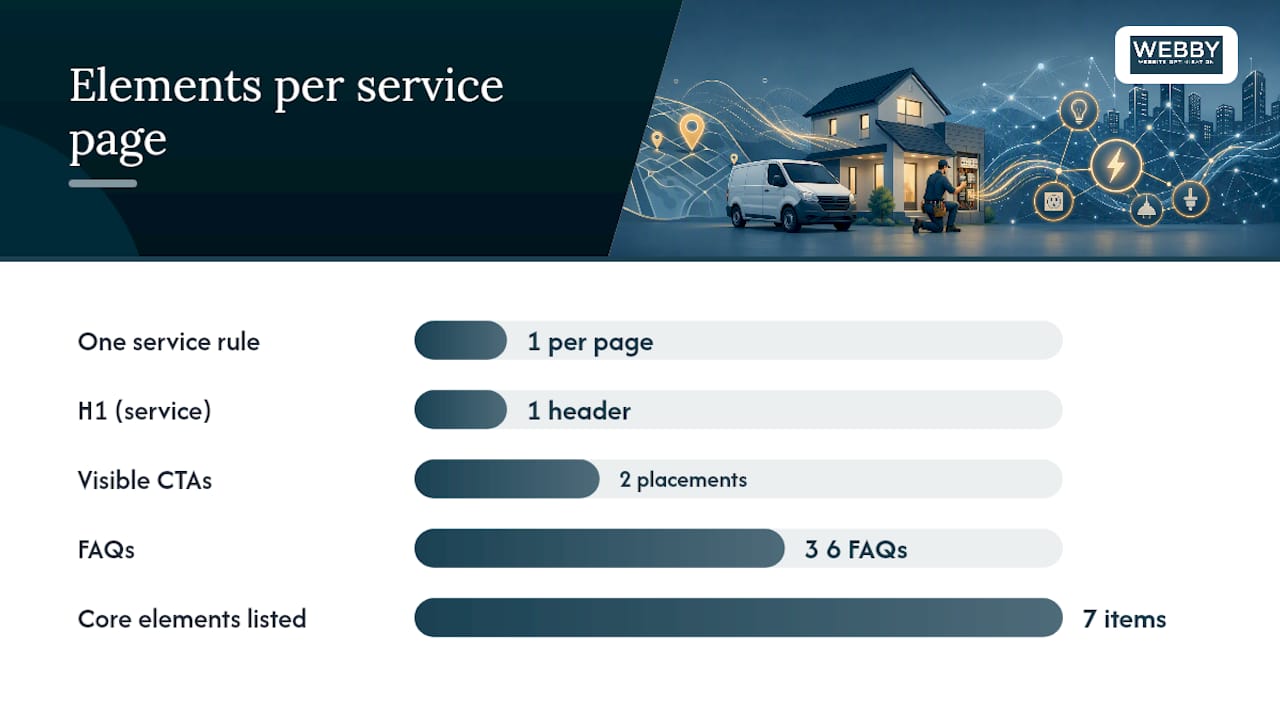
One service, one page. That single rule fixes more electrician websites than any other change. A page trying to cover “electrical repairs, installations, and inspections” all at once dilutes relevance for every one of those searches. Split it.
Each service page needs:
- An H1 that states the service and, where natural, the trade category (e.g., “Switchboard Upgrades”)
- A short intro that names the problem the customer is facing
- A clear scope section describing what’s included and what isn’t
- A realistic timeline for the job
- A price range, even a broad one, because homeowners abandon pages that hide cost entirely
- Three to five FAQs answering the questions a homeowner would actually type into Google
- A visible call-to-action, ideally a phone number and a form, above the fold and repeated at the bottom
Guides built specifically for trade businesses back this structure, noting that content answering direct cost and timeline questions converts better than generic service descriptions. Keep your URLs short and literal: “/switchboard-upgrades” beats “/services/electrical/switchboard-upgrade-service-info.” Then link related pages to each other. Your switchboard page should link to your safety-inspection page, and both should link back to a general “electrical services” hub page, forming a topic cluster search engines can read easily.
Technical SEO Checklist: Mobile, Speed, Schema, and Security
Most homeowners searching for an electrician are on a phone, standing in front of a problem. If your site takes five seconds to load, you’ve lost them to the next listing down.
- HTTPS site-wide — non-negotiable, and most hosts enable it by default now
- Core Web Vitals in the “good” range — particularly Largest Contentful Paint under 2.5 seconds
- Compressed images — the single biggest quick win for speed on trade websites
- Caching enabled at the server or plugin level
- Removed or deferred heavy scripts, especially unused chat widgets and tracking pixels
- An XML sitemap and clean robots.txt submitted through Search Console
- Structured data for LocalBusiness, Service, and FAQ schema types
Industry guides note that poor Core Web Vitals scores cost leads even when a site ranks well, because the visitor bounces before the page finishes loading. You can test your own scores for free using Google’s PageSpeed Insights and the Rich Results Test for schema. If your score sits below 50 on mobile and you don’t know what’s causing it, that’s usually the point where a specialist earns their fee rather than costing you time you don’t have.
Content and Keyword Strategy: What to Write and Which Keywords to Target
Sequence your content the same way you sequence the technical work: highest intent first, informational content second.
- “Service + location” phrases first. “Switchboard upgrade [suburb]” beats “electrical services” every time on conversion rate, even with lower search volume.
- “Cost” queries next. “How much does a switchboard upgrade cost” pages capture homeowners who are close to booking but price-shopping.
- “How-to” and troubleshooting content third. These build authority and often earn backlinks, but they convert slower.
- Case studies and before-and-after write-ups for larger jobs, which double as trust content and link bait for local publications.
Resist the urge to publish constantly. Market-level guides on electrician content strategy found that a handful of well-researched, long-form posts each month outperforms a high volume of thin pages. One genuinely useful 1,200-word cost guide beats four rushed 300-word posts that say nothing a homeowner couldn’t already guess.
Reviews, NAP Consistency, and Local Link Building
Reviews aren’t a nice-to-have. BrightLocal’s consumer research shows reviews are one of the primary factors homeowners weigh when picking a local tradesperson, with both volume and recency mattering more than a single perfect score from two years ago.
- Set up an automated text or email request sent within 24 hours of job completion
- Keep the ask short: one line, one link, no friction
- Reply to every review, good or bad, within a few days
- Run a NAP audit quarterly across Google, Bing, Apple Maps, and major directories to catch mismatched phone numbers or old addresses
- Fix the highest-traffic citations first (Google, Yelp, industry directories) before chasing minor ones
- Pursue backlinks from suppliers, trade associations, and local community sites rather than generic guest-post networks
Local ranking research backs this up directly: review volume, recency, and category accuracy, alongside local backlinks from suppliers and community sites, heavily influence map-pack position. Our local SEO guide for small business covers the audit process in more depth if you want a repeatable checklist.
Pro Tip: Search your business name plus “phone number” on Google right now. If an old number from a previous location shows up in the results, that single mismatch could be quietly capping your map-pack ranking.
Measuring SEO Progress, Timeline Expectations, and Cost Ranges
Track four numbers monthly: phone calls from GBP, GBP profile clicks (direction requests and website clicks), organic sessions landing on service pages specifically, and form or call conversions from those sessions. Ranking position alone tells you very little if it doesn’t translate into calls.
- Weeks 2 to 6: GBP profile activity and map-pack position typically start shifting
- Months 3 to 6: organic traffic to service pages begins showing sustained movement
- Months 6 to 12: competitive keyword terms start settling into stable positions
On cost, expect two common shapes. A one-off audit and fix project addresses the technical backlog and structural issues in a fixed scope. A monthly retainer covers ongoing content, review management, and link outreach, which local trade guides consistently list as the practical, measurable signals worth paying for on an ongoing basis.
How Webby Website Optimisation Reads a Local Electrician’s Site
An audit for an electrical contractor should cover the same ground this checklist just walked through: site speed and Core Web Vitals, Google Business Profile completeness, service page structure, and whether the site actually converts visitors into calls rather than just visitors into bounces.
- Site speed and mobile rendering across your top service pages
- GBP completeness, category accuracy, and review response history
- Service page structure against the one-page-per-service standard
- Conversion elements: phone number visibility, form placement, call tracking
Reading a before-and-after case study properly means looking past the headline ranking jump and checking whether call volume or booked jobs moved with it. A ranking improvement that doesn’t produce more calls is a vanity metric, not a result.
DIY vs. Hiring an SEO Partner: An Honest Take
Most electricians can handle GBP updates, basic review requests, and simple service-page edits in two to four hours a week. Schema markup, major speed fixes, and structured link outreach are where DIY effort typically hits a ceiling and specialist help pays for itself. When evaluating an agency, ask for specific before-and-after metrics, not just ranking screenshots.
— Steve Doig
Where Webby Website Optimisation Fits Into This Checklist
This approach is an alternative to hiring a traditional agency retainer with no clear scope. Every task in this checklist maps to a fixed, priced engagement: the Website Audit at $1,250 diagnoses exactly which technical fixes, GBP gaps, and service-page issues are costing you calls. The Business Website Optimisation Campaign, priced at $3,125, then implements the fixes the audit finds, from Core Web Vitals to service-page restructuring.

For ongoing work like content publishing, review management, and local link building, Search Engine Optimisation covers the monthly retainer side of the equation. Start with the audit. It tells you exactly which of the tasks above are already fine and which are quietly costing you calls every week they go unfixed.
Sources
- Google Business Profile
- BrightLocal local consumer review survey
- SEO for Electricians: The Complete 2026 Guide | Market Minds Global
- Local SEO for Electricians in 2026: The Complete Blueprint | LLaMaRush
- SEO for Electricians: Blueprint to Local SEO Strategies
FAQ
How Much Should I Expect to Pay for SEO?
Costs vary widely by scope, but one-off audits and optimization projects typically run in the low thousands, while ongoing SEO is usually billed monthly. Webby Website Optimisation’s Website Audit is $1,250 one-off, and the Business Website Optimisation Campaign runs $3,125 one-off for a full implementation pass.
What Is the 80/20 Rule in SEO?
Prioritizing those over minor blog posts or secondary pages tends to produce faster, more measurable results.
What Is an SEO Contractor?
An SEO contractor is a specialist or agency hired to handle technical fixes, content strategy, and ranking improvements on a project or retainer basis, rather than as a full-time employee. For electricians, this usually covers technical audits, schema implementation, and link outreach that fall outside day-to-day DIY capacity.