
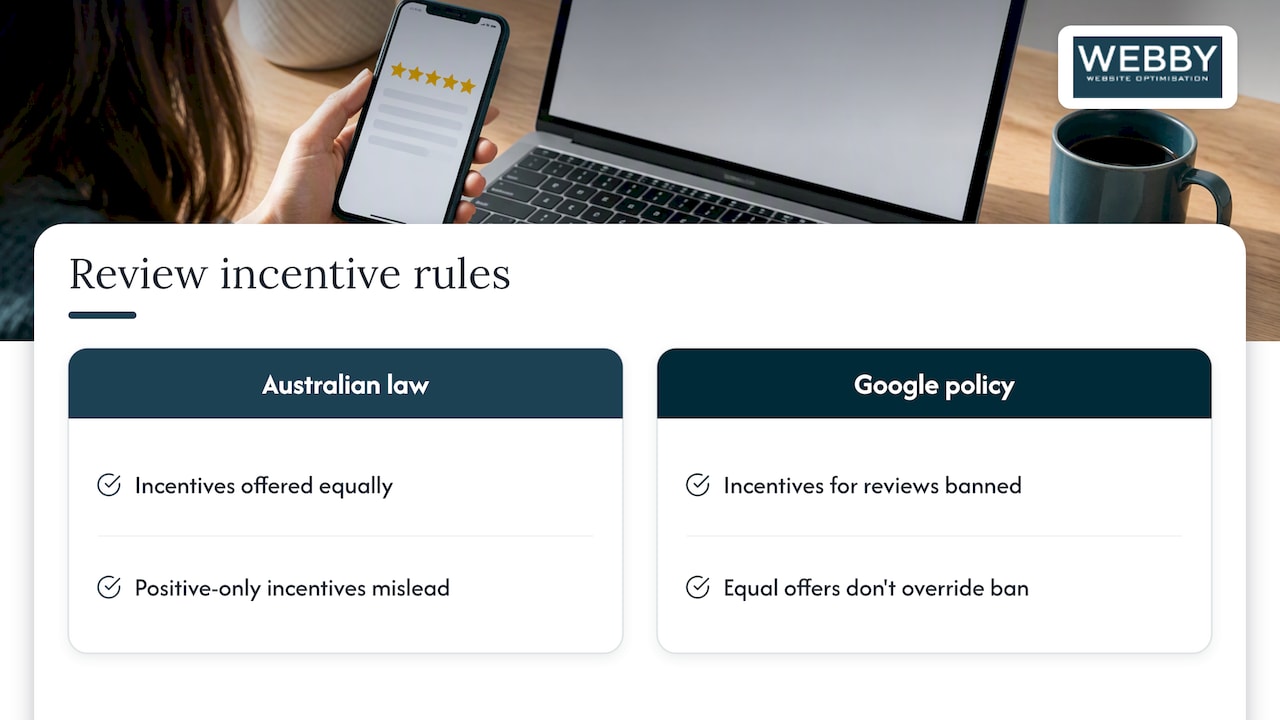
In practice, you should not offer any reward for a Google review. Australian law lets you offer an incentive for reviews in general, but only if it is the same for positive and negative feedback and is disclosed. Google’s own policy is stricter and bans incentives on Google Business Profile altogether. The safe route for an Australian business is to ask every customer for a review, make it easy, and give nothing in return.
This guide explains where the law ends and Google’s rules begin. It also covers what happens when a business gets it wrong, and how to build a steady flow of genuine reviews without a discount, a prize or a free coffee.
TL;DR
- Google prohibits incentives, including free or discounted goods or services, in exchange for posting, changing or removing reviews.
- Under Australian Consumer Law, fake or misleading reviews are prohibited, and rewarding only positive reviews is misleading.
- Even where an incentive is lawful elsewhere, it must be offered regardless of whether the review is positive or negative, and it should be disclosed.
- Asking every customer, using a direct review link or QR code, and replying to every review is the compliant way to grow your count.
- Breaking the rules can mean removed reviews, platform penalties and regulator attention, and it wipes out the trust you were trying to build.
Table of Contents
- The short answer: two rulebooks, and the stricter one wins
- What Google’s policy says
- What Australian law says
- Quick reference: what is and is not safe
- What can go wrong if you offer incentives
- How to get more genuine Google reviews without incentives
- Non-monetary ways to say thank you
- Spotting suspicious activity on your own profile
- Our perspective
- Turn reviews into leads with a site that backs them up
- FAQ
- Sources
The short answer: two rulebooks, and the stricter one wins
Two sets of rules apply to you when you ask for Google reviews in Australia.
- Australian Consumer Law (ACL), enforced by the ACCC and state regulators. It cares about whether reviews mislead consumers.
- Google’s content policies. These govern what stays on your Business Profile, whatever the law says.
A lot of confusion online comes from mixing them up. Some articles say incentivised reviews are legal in Australia, and that is partly true as a general statement about the ACL. Others say they are banned, which is true of Google. Both can be correct at once. The practical result is that the Google rule decides what you can do on Google, so a reward-for-review scheme on your Business Profile is off the table.
What Google’s policy says
Google’s guidance for business owners is direct. Google strictly prohibits incentives, including free or discounted goods or services, for posting or changing reviews, or for removing negative ones, and treats reviews gained this way as fake and misleading content.
That covers more than most owners expect. Here is how it plays out for a typical local service business:
- A discount off the next job in return for a five-star review: prohibited.
- A prize draw entry for anyone who leaves a review: prohibited.
- A gift card, voucher or free product after the review is posted: prohibited.
- A promise to remove a customer’s complaint in exchange for compensation: prohibited.
- Loyalty points tied to leaving a review: prohibited.
The ban does not depend on whether the reward is large. A $5 coffee voucher and a week of free service sit under the same rule.
A real example from Queensland
A Queensland real estate agent ran a promotion offering a chance to win one week’s free rent for a five-star Google review. After concerns it could breach Google’s policies, the agent cancelled the promotion and apologised. The same report notes that offering incentives for Google reviews can breach Google’s Deceptive Content and Behaviour policy, potentially leading to removal of content or other penalties.
The lesson is that this is not a technicality only small operators trip over. Established businesses with marketing teams get it wrong, and when they do, the story becomes the review scheme rather than the service.
What Australian law says
The ACL is about misleading consumers. It does not name Google, but it applies to any review you write, arrange or encourage.
According to business.gov.au, the ACL prohibits businesses from creating or arranging fake or misleading reviews, and that includes incentivising only positive reviews. It also reminds businesses to check the laws of other countries where they sell, such as US FTC rules if you have customers there.
The ACCC adds detail on what counts as misleading. A review is misleading if it is written by someone who has not used the product or service, or if it hides a connection to the business, such as being an employee or a family member.
Why “positive only” is the line
The core idea is simple. A star rating tells a future customer how past customers felt. If you reward the happy ones and not the unhappy ones, the average no longer reflects reality.
The ACCC’s position is that if an incentive is offered for a review, it must be provided regardless of whether the feedback is positive or negative. The Western Australian Government makes the same point, saying incentives must be offered equally to all customers rather than only to those likely to give positive feedback.
That explains why you will see a top-ranking page say incentives are fine if offered for positive and negative reviews alike. That is a fair summary of the consumer law position. It does not override Google’s policy, which bans the incentive itself.
Disclosure
Where an incentive is used on a platform that allows it, the ACCC recommends that businesses tell the platform about the incentive program, including the details of the offer, so the platform can make appropriate disclosures. The OECD makes a related point: undisclosed incentives make it harder for consumers to assess reviews and decide what to buy.
Google Business Profile has no mechanism for disclosing a reward-for-review scheme, because it does not permit one. So for Google, the disclosure question answers itself: do not run the scheme.
Quick reference: what is and is not safe
| Tactic | Google Business Profile | Australian Consumer Law risk |
|---|---|---|
| Ask every customer for a review | Allowed | Low |
| Send a direct review link or QR code | Allowed | Low |
| Reply to every review | Allowed | Low |
| Discount or voucher for a review | Prohibited | Higher, and must be neutral and disclosed |
| Reward for five-star reviews only | Prohibited | Misleading conduct |
| Prize draw for reviewers | Prohibited | Higher, must be neutral and disclosed |
| Paying for or writing reviews yourself | Prohibited | Fake review, misleading conduct |
| Staff or family posting reviews without disclosure | Prohibited | Undisclosed connection |
| Filtering who gets asked based on satisfaction | Against Google guidance | Can skew the picture |
The last row is review gating, and it catches many well-meaning owners. If you route happy customers to Google and unhappy ones to a private form, you are shaping the public rating in the same way an incentive would. We cover how to spot and fix it in our guide to auditing and fixing review gating for Australian businesses.
What can go wrong if you offer incentives
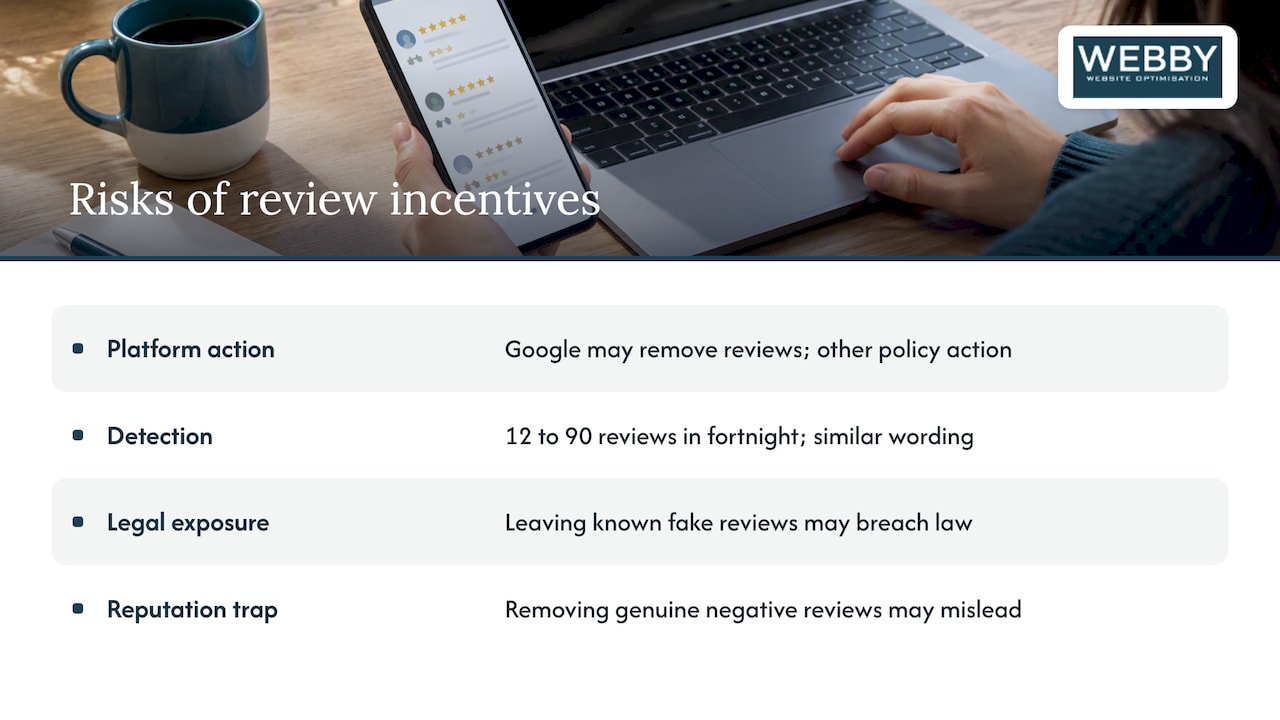
The risks stack up in three layers.
Platform action. Google can remove the reviews, and it can take other action against content that breaches its policy. You lose the reviews you worked for, and the pattern can make later reviews look suspect.
Detection through patterns. The ACCC notes that a dramatic, unexpected spike in reviews can point to incentive-driven misleading reviews, and that platforms may remove reviews when an incentive clearly and dramatically manipulated the results. A plumber who goes from 12 reviews to 90 in a fortnight, all five stars with similar wording, is the kind of case that draws attention.
Legal exposure. The same ACCC guide says that businesses or platforms that fail to remove or correct reviews they know are fake may be in breach of Australian law. If you discover that an agency, an employee or an enthusiastic relative has posted fake reviews on your behalf, leaving them up is a problem of its own.
There is a related trap on the other side. Managing your reputation is fine, but ACCC guidance highlights that removing negative reviews that were genuinely written can itself mislead consumers. Do not use any trick to bury criticism. Respond to it instead.
If you have already run an incentive
Stop the scheme now. Then take these steps:
- List which reviews came through the incentive, using your records of who was offered it.
- Do not ask customers to edit or delete reviews in return for anything, since that is also an incentive.
- Flag the issue honestly to whoever ran the campaign, whether that is staff or an outside provider, and make sure no fake or undisclosed-connection reviews remain.
- Reset your process to the compliant approach below.
If you are unsure how exposed you are, get advice from a lawyer who handles Australian consumer law. The ACCC and your state consumer protection agency also publish guidance for businesses.
How to get more genuine Google reviews without incentives
Most small service businesses do not have a review-incentive problem. They have a review-request problem: happy customers simply are never asked. Google’s guidance for business owners is to ask customers to review using a Google link or QR code and to reply professionally and politely. Here is how that works in a trade or service business.
Ask at the moment of peak satisfaction
The best time is right after you have solved the problem. An electrician who has just restored power, a physio whose client walks out pain-free, or a cleaner who has finished a bond clean all have a natural moment. Ask in person first, then send the link by SMS or email within a few hours while the job is fresh.
Make the link one tap
Use the direct review link from your Business Profile rather than telling people to search for you on Google. Put it in:
- the SMS or email that follows a job
- the invoice or receipt footer
- a QR code on the van, counter or printed quote
- your email signature
Every extra step costs you reviews. For the detail on timing and wording, see our walkthrough on getting Google reviews quickly with compliance first.
Ask everyone, not just the happy ones
This is the habit that keeps you inside the rules and also makes your rating more credible. Google advises valuing all reviews, and a mix of positive and negative feedback often feels more trustworthy to readers. A run of identical five-star comments looks manufactured, while a 4.7 with a few honest critical reviews and thoughtful replies looks real.
Reply to every review
Replies cost nothing and show future customers how you handle problems. Thank people by name where appropriate, mention the specific job, and keep it short. For negative reviews, stay calm, acknowledge the issue, and offer to resolve it offline. We have a full guide on responding to negative Google reviews.
Build the process into the job
Reviews are an operational habit, not a campaign. Make one person responsible, add the request to your job-completion checklist, and track how many customers you ask each month versus how many respond. A steady trickle of reviews is both safer and more convincing than bursts.
Keep your profile in good shape
Reviews work best on a complete, accurate profile with correct categories, hours, services and photos. If yours is thin, start with our explainer on Google Business Profile for local service owners.
Non-monetary ways to say thank you
You can show appreciation without tying it to a review. The test is whether the gift depends on the review being left. A few safe patterns:
- Thank customers for their business at the time of the job, whether or not they ever review.
- Reply publicly to the review you receive with a genuine thank-you.
- Use feedback to improve and tell customers what changed.
- Share the reviews you have (with permission) on your site so customers see the value of leaving them.
Avoid anything that creates an expectation, such as “leave us a review and we will give you something”. Once the reward is linked, it is an incentive. If you want to run a customer-appreciation offer, keep it entirely separate from any request for feedback and apply it to all customers.
Spotting suspicious activity on your own profile
Sometimes the risk comes from outside: a competitor posts fake negatives, or an overeager contractor buys reviews on your behalf. Check your profile monthly for:
- sudden clusters of reviews in a short window
- reviews from accounts with no other history
- comments describing services you do not provide
- repeated phrasing across different reviewers
If you manage multiple locations or work with an outside provider, it helps to have someone independent check the pattern. When choosing a provider for that, SEO agencies in Australia can be compared by specialty and market, which helps you find one that has a documented approach to monitoring reviews. Ask any provider you hire to confirm in writing that they will never buy, write or incentivise reviews for you.
Our perspective
We see the same pattern across local service businesses. The owners who are worried about review incentives usually have a perfectly good business and a weak system for asking. They do the job well, the customer is pleased, and nobody sends the link.
Our view is that the rules actually help you. Google and the ACCC are both pointing at the same thing: a rating should reflect what your customers really think. If your service is good, an honest process will produce a strong profile without needing a reward. It also produces a profile that survives scrutiny, and that matters when a competitor or a platform looks closely at it.
The practical work is unglamorous. Make the review link easy, ask every customer, reply to everything, and make sure your website and Business Profile give people a reason to trust what they read. We build that kind of foundation for local service businesses, from technical SEO and fast WordPress sites to local search campaigns, because reviews convert best when the site they send people to is clear and quick.
If you take one thing from this article, let it be that a slow, honest accumulation of reviews is a long-term asset. A shortcut is a liability waiting to be found.
Steve Doig
Turn reviews into leads with a site that backs them up
Reviews get people to look at you. Your website decides whether they call. If you want an honest look at how your site, local SEO and Google presence are working together, our Website Audit is a one-off $1,250 AUD review of what is helping and what is holding enquiries back.

If you would rather talk it through first, you can claim a free website audit and we will point to the biggest opportunities for your local search visibility.
FAQ
Can I offer a discount for a Google review in Australia?
No. Google prohibits incentives such as free or discounted goods or services in exchange for reviews. Australian consumer law adds that any incentive must not favor positive feedback, but the Google ban is the stricter limit, so a discount for a review should not be used on your Business Profile.
Can you pay people to give you Google reviews?
No. Paying for reviews is treated as fake and misleading content by Google. Under Australian Consumer Law, arranging fake or misleading reviews is prohibited, and a review from someone who has not used your service or who hides a connection to you is misleading.
Can I reward only customers who leave five-star reviews?
No. Rewarding only positive reviews is the clearest example of misleading conduct, because it distorts your rating. The ACCC says any incentive must apply whether the feedback is positive or negative, and Google bans the reward either way.
What can I do to get more Google reviews legitimately?
Ask every customer, send a direct Google review link or QR code, and reply politely to every review. Build the request into your job-completion process so it happens consistently, and do not filter who you ask based on how happy you think they are.
Can customers earn money for leaving Google reviews?
Not through your business, and not legitimately on Google. Any scheme that pays or rewards people for posting reviews conflicts with Google’s policy against incentivised reviews. Be cautious of any third party that offers to supply reviews for a fee.
Sources
- Tips to get more reviews, Google Business Profile Help
- Online reviews, business.gov.au
- Online reviews for product and services, ACCC
- Online reviews: a guide for business and review platforms, ACCC
- From the Commissioner: The good, the bad and the fake, WA Government
- Good practice guide on online consumer ratings and reviews, OECD
- Real estate agent sorry for competition offering free rent for 5-star Google reviews, ABC News
- SEO agencies in Australia