
To rank in the map pack, you need a verified, accurate Google Business Profile with the right primary category, a steady flow of genuine reviews, and a website that backs up what the profile says. Google decides who appears using three things: relevance, distance and prominence. You can influence two of them directly. Distance is the one you can’t change, so you work around it.
This guide walks through each factor, shows what to fix first, and flags the mistakes that get profiles suspended. It is written for Australian service business owners, whether you run a plumbing company in Fremantle or a physio clinic in Melville.
TL;DR
- The map pack (also called the local pack or 3-pack) is ranked on relevance, distance and prominence, according to Google’s own guidance.
- Start with a verified profile, one precise primary category, and complete details: address or service area, hours, services and attributes.
- Prominence grows with genuine reviews, links to your site and wider mentions. Reply to every review.
- Never stuff keywords into your business name or description. It can get your profile suspended.
- There is no fixed number one spot. Results shift with where the searcher is standing, so track several locations.
Table of Contents
- What the map pack is and why it matters
- The three ranking factors, in plain words
- Step 1: Create, claim and verify your profile
- Step 2: Choose the right primary category
- Step 3: Fill in every field, accurately
- Step 4: Build prominence with reviews, links and mentions
- Step 5: Work around distance
- Step 6: Track your visibility
- Mistakes that can sink your profile
- Our perspective
- How we can help
- FAQ
- Sources
What the map pack is and why it matters
The local pack is a block of local business listings that usually appears above the regular organic results when someone searches with local intent, such as “electrician near me” or “accountant Fremantle”. It can include a map and business details, while organic results link straight to websites, as Search Engine Land explains.
Three things make it valuable for a service business:
- It sits at the top of the page, often above your own website listing.
- It carries a phone number, a directions button, reviews and photos, so people can call without ever visiting your site.
- The searcher is usually close to buying. Someone typing a trade plus a suburb wants a quote this week, not a lecture.
One point trips up many owners: the map pack is not the same as the Google Maps app, and neither is the same as the organic results. They draw on related data, but you can rank well in one and poorly in another. If you want a deeper look at how Maps itself behaves, our guide to Google Maps ranking factors covers it.
The three ranking factors, in plain words
Google states that local results are based mainly on relevance, distance and prominence. Its help page defines each one.
| Factor | What it means | How much control you have |
|---|---|---|
| Relevance | How well your profile matches what the person searched for | High |
| Distance | How far your business is from the searcher, or from their inferred location if none is given | Low |
| Prominence | How well known your business is, based partly on links, reviews and general information about you | Medium to high, over time |
Relevance: say clearly what you do
Relevance is about matching the query. Google says it improves when your profile is complete and detailed. In practice that means a correct category, services listed, a clear description, and a website whose pages say the same things.
Distance: you can’t move, but you can be precise
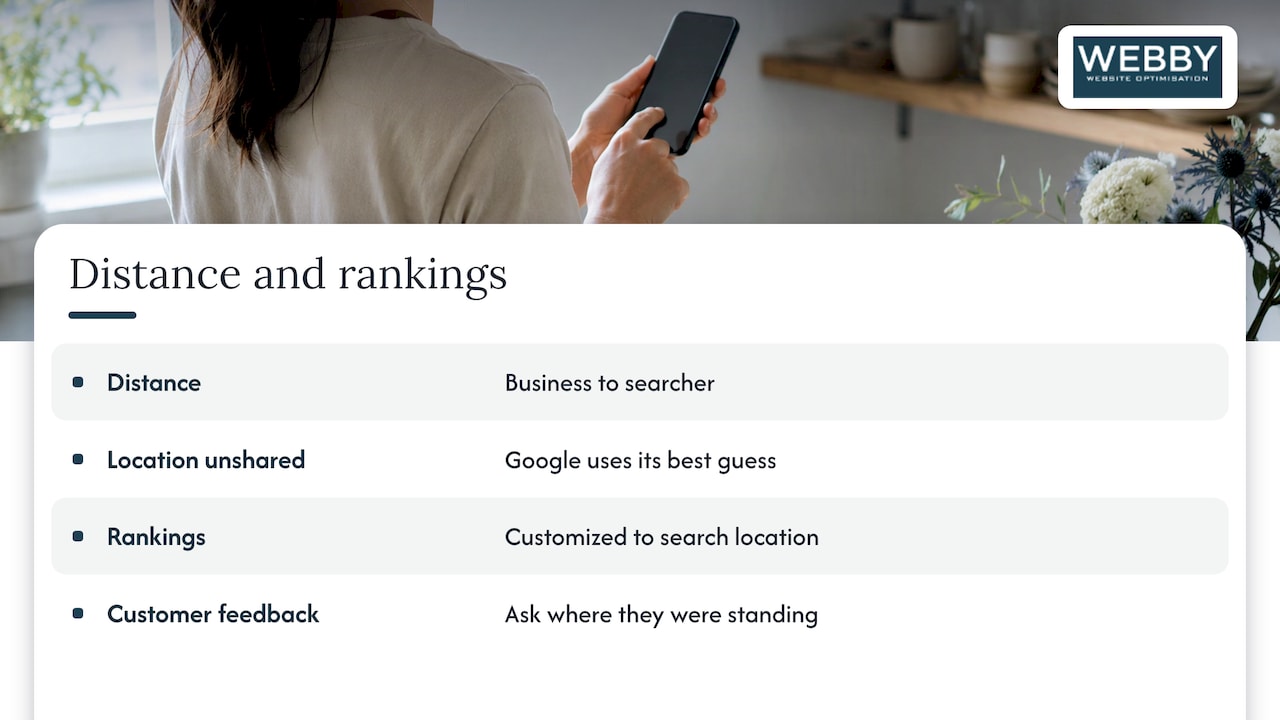
Distance is measured between your business and the searcher. If the searcher hasn’t shared their location, Google uses its best guess. You can’t change that, and it explains why a competitor three streets away may beat you for someone standing near them while you win for someone near you.
This also means there is no permanent first place. Rankings are customized to the user’s location at the moment of the search, as the Search Engine Land guide notes. When a customer tells you they couldn’t find you, ask where they were standing.
Prominence: be known, and be seen to be known
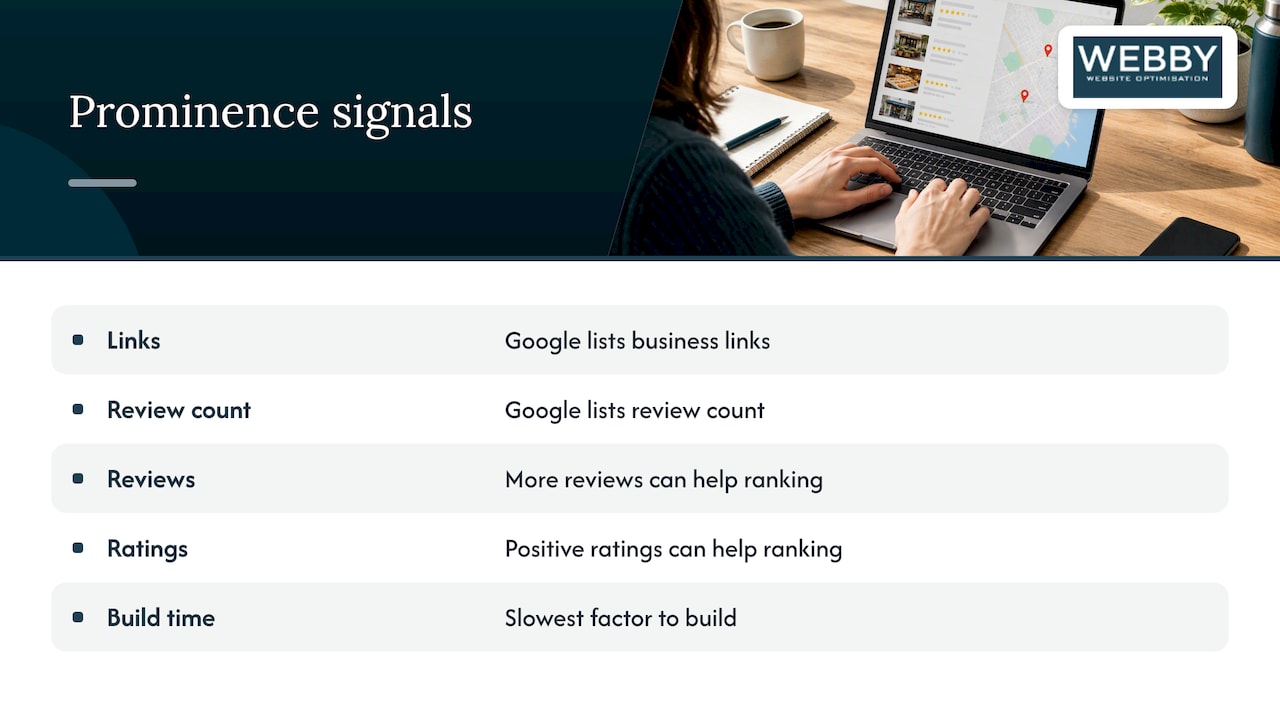
Prominence is partly about how well known a business is. Google lists information such as links to your business and your review count, and says more reviews and positive ratings can help your local ranking. It is the slowest factor to build and the hardest for a newcomer to fake, which is exactly why it rewards businesses that do honest work consistently.
Step 1: Create, claim and verify your profile
Everything else depends on having a verified profile. Here is the path for an Australian business.
- Check you are eligible. Google requires a business to make in-person contact with customers during its stated hours. Its eligibility guidelines list online-only businesses and lead generation companies as ineligible. A tradie who travels to customers is generally treated as a service-area business.
- Search before you create. Only one profile per business is allowed, and duplicates cause problems on Maps and Search, per Google’s representation guidelines. Your business may already have a listing that you can claim.
- Enter your details exactly as they appear in the real world. Use your name as it appears on your signage, invoices and website. Add the address, service area, hours and category in their own fields, not in the name.
- Verify. Only the owner or an authorized representative may verify and manage the profile. Follow the method Google offers you and keep access in the owner’s own Google account, not a contractor’s personal one.
- Set the service area honestly. If you work from home and visit customers, hide the address and list the suburbs you actually serve. Service-area businesses can’t list a virtual office unless it is staffed during business hours.
If your business isn’t appearing at all, work through our 10 point checklist for getting found on Google Maps. For a fuller walkthrough of the profile itself, see Google Business Profile explained for local service owners.
Step 2: Choose the right primary category
If you change only one thing, change this. Practitioners describe the primary category as one of the most influential local ranking factors, and recommend looking at which categories your best-ranking competitors use. That advice appears in Square’s Australian guide to setting up a profile.
A few rules that work:
- Be specific. “Emergency plumber” and “Plumber” are different categories and can pull different searches.
- Use as few categories as describe your core business. Google’s guidelines say to choose the fewest it takes. Add secondary categories only for services you genuinely offer.
- Treat it as an experiment. The same Square guide suggests tracking your rankings and testing more specific categories, since the best match for a niche service is sometimes not the obvious one. Change one thing at a time and note the date.
There are thousands of categories to choose from. Our category audit guide shows how to review yours.
Step 3: Fill in every field, accurately
Google’s advice is to complete your profile with accurate, detailed information: address, hours, category and relevant attributes. Go through the list below and tick each item off.
- Business name: your real-world name only. No suburbs, services or slogans added. Google says unnecessary information in the name is not permitted and can lead to suspension.
- Hours: correct, including public holiday changes. Wrong hours lose both customers and trust.
- Phone and website: a local number and a link to the most relevant page, usually your homepage or a location page.
- Services: list each service you provide, using the words customers use.
- Description: write for people. Describe what you do, who you do it for and where. Keep it natural, because keyword stuffing in descriptions can result in Google penalizing rankings, as Tourism Australia’s Google listing guide warns.
- Photos: real photos of your team, vehicles, work and premises. Skip stock images.
- Attributes: tick the ones that apply, such as online appointments or wheelchair accessibility.
Step 4: Build prominence with reviews, links and mentions
Plan on prominence taking months. These are the levers that move it.
Reviews
More reviews and better ratings can help your ranking, and they help people choose you once you show up. Make asking part of your job process:
- Ask at the moment of peak satisfaction, when you hand over the finished work.
- Send a direct review link by text or email so it takes under a minute.
- Reply to every review, positive or negative, politely and specifically. A calm reply to a bad review shows future customers how you handle problems.
- Never pay for reviews or write them yourself. It is against Google’s rules and customers spot it.
Links and mentions
Google names links to your business as an input to prominence. For a local business, the useful ones are real ones:
- Your local chamber of commerce or business association
- Suppliers, manufacturers and trade bodies that list approved installers
- Sponsorships of local sports clubs and community events
- Local news or community blog coverage of a job or an event you took part in
- Consistent listings in the main Australian directories, with the same name, address and phone number everywhere
Your website
Your profile points to your website, and the site needs to confirm the story. Create a page for each core service and each area you serve, with genuine detail: photos of local jobs, pricing guidance where you can, and the suburbs you cover. Our guide to service area business SEO shows the three pages that matter most, and our piece on near me optimization covers how to appear when locals search with that phrase. A fast, mobile-friendly site with a visible phone number also helps convert the visits you earn. The broader picture is in local SEO for small business.
Step 5: Work around distance
You can’t relocate your business to the middle of a suburb, but you can improve your odds.
- Make your address precise. If you have a shopfront, check that the map pin is on the right spot.
- Match your service area to reality. Listing fifty suburbs you never visit doesn’t make you rank in them. List the ones you serve.
- Build location pages on your website. A page about your work in Fremantle or Melville, with proof, supports relevance for those searches even when your office is elsewhere.
- Earn local reviews. Reviews that mention the suburb and the service give Google useful context, and give readers confidence.
- Accept the limit. For some searches, a competitor sitting closer will win. Aim to win the searches you are best placed for, then widen out.
Step 6: Track your visibility
Because results depend on the searcher’s location, one search from your office tells you little. Track like this:
- Pick five to ten core searches, such as your service plus your main suburbs.
- Check them from several points in your service area, ideally using a grid-based rank tracking tool, or ask friends in different suburbs to check.
- Use the performance data inside your profile to see how many people call, request directions or visit your site.
- Record results monthly, along with any change you made, so you know what worked.
Calls and enquiries are the real measure. A profile that ranks third but gets more calls than your old first place is doing its job.
Mistakes that can sink your profile
- Stuffing the name. “Perth Best Cheap Plumber 24/7” is a fast route to a suspension. Google’s guidelines specifically exclude taglines and extra information from names.
- Creating duplicate profiles for the same business, or for each suburb you serve without a real location there.
- Using a fake or virtual address. Service-area businesses can’t list a virtual office unless it is staffed during business hours.
- Letting an agency or contractor own your profile. Only the owner or an authorized representative should verify and manage it, and the owner should always keep access.
- Ignoring edits. Customers and others can suggest changes. Check your profile regularly so details haven’t been altered.
- Going silent. A profile with no new reviews, photos or updates for a year looks abandoned next to an active competitor.
Our perspective
After working with local service businesses around Perth, Fremantle and Melville, we see the same pattern. The owners who win the map pack aren’t doing anything exotic. They have a clean profile, a precise category, a steady stream of honest reviews and a website that answers the questions customers ask.
The mistake we see most often is treating the profile and the website as separate jobs. They work as one system. The profile earns the click, the website earns the enquiry, and if either is weak, you are paying for visibility you can’t convert. That is why our approach to local SEO starts with the profile and the site together, then builds out service and location pages around real jobs.
Our advice is to fix the foundations first, measure from several locations, and be patient. Prominence can’t be rushed, but it compounds. Every review and every genuine local link makes the next one easier to win.
Steve Doig
How we can help
If you would rather have a specialist check your profile and site against the factors above, start with our Website Audit, a one-off 1,250 AUD review of what is holding your site back. If you want us to work on the ranking itself, our Search Engine Optimisation service covers local search for service businesses, and there is a dedicated SEO Perth page for businesses in the metro area.
You can also claim a free website audit to see where your site stands before you decide on anything else.
FAQ
How long does it take to rank in the map pack?
It depends on how competitive your trade and suburb are, and on where your profile starts. Fixing a wrong category or missing details can change results within weeks, while building reviews and local links is a matter of months. Treat it as an ongoing habit, not a one-off job.
Do I need a shopfront to appear in the map pack?
Not always. Service-area businesses that travel to customers can be eligible, but they need to make in-person contact with customers during stated hours, and can’t list a virtual office unless it is staffed. If you work from home, you can hide your address and list the suburbs you serve.
Can I pay to be in the map pack?
The organic map pack can’t be bought. Ads can appear in the same area of the results page, labelled as ads, but your organic position depends on relevance, distance and prominence. Running both can make sense, but they are separate systems.
How many reviews do I need?
Google doesn’t set a number. It says more reviews and positive ratings can help your local ranking, so the practical target is to keep earning them steadily. Look at the businesses ranking above you and aim for a similar volume and recency.
Sources
- Tips to improve your local ranking on Google
- What Is the Google Local Pack? How to Rank in the 3-Pack
- Business eligibility and ownership guidelines
- Guidelines for representing your business on Google
- How to Set Up & Optimise Google My Business
- How to Create a Google Listing Guide