
Build an intent-ordered retargeting stack, match every ad and landing page to the visitor’s decision stage, and put 15–25% of your paid media budget into retargeting before you scale prospecting. That’s the whole playbook in one sentence. Here’s how to execute it:
Quick-action checklist:
- Install Meta Pixel plus Conversions API and Google Tag Manager with GA4 within the first 24 hours
- Create three priority audiences: cart abandoners (1–7 days), product/pricing-page viewers (1–14 days), and all engaged visitors (15–30 days)
- Launch high-intent creative for cart abandoners within 72 hours of setup
Budget guideline: Allocate a significant portion of your total ad spend to retargeting — more than the typical default many brands use. Watch ROAS first; a healthy retargeting layer generally delivers substantially higher ROAS than cold prospecting.
Table of Contents
- Why retargeting converts better than cold prospecting
- How to segment visitors into an intent-prioritized audience stack
- What to say and show for each segment
- Which platforms to use and the technical setup checklist
- What the post-click experience must do to close the sale
- KPIs, reporting windows, and a simple A/B experiment template
- Practical US privacy steps that affect retargeting
- How Webby Website Optimisation implements retargeting for service and e-commerce sites
- How to manage frequency and timing to avoid ad fatigue
- Common pitfalls and how to troubleshoot retargeting campaigns
- Key Takeaways
- The case for post-click obsession
- Webby Website Optimisation can audit your retargeting setup
- Useful sources
Why retargeting converts better than cold prospecting
Retargeting works because the audience already knows you. They visited, showed intent, and left without converting. That gap between interest and action is exactly where retargeting operates.
The Stanford GSB research on retargeted advertising found that a substantial portion of a campaign’s first-week impact occurs on day one, and about half within two days of the visit. Waiting a week to serve your first retargeting ad means you’ve already missed the highest-conversion window.
There’s also a defensive angle most businesses overlook. Retargeting shortens the time competitors have to reach your visitors after they leave. A visitor who sees your ad shortly after leaving your site is less likely to be targeted by competitor ads first.
The budget-inversion argument follows directly: prove the retargeting funnel profitable at 15–25% of spend, then scale prospecting. Scaling cold traffic before your retargeting layer is optimized is the most common way to inflate CPA unnecessarily.
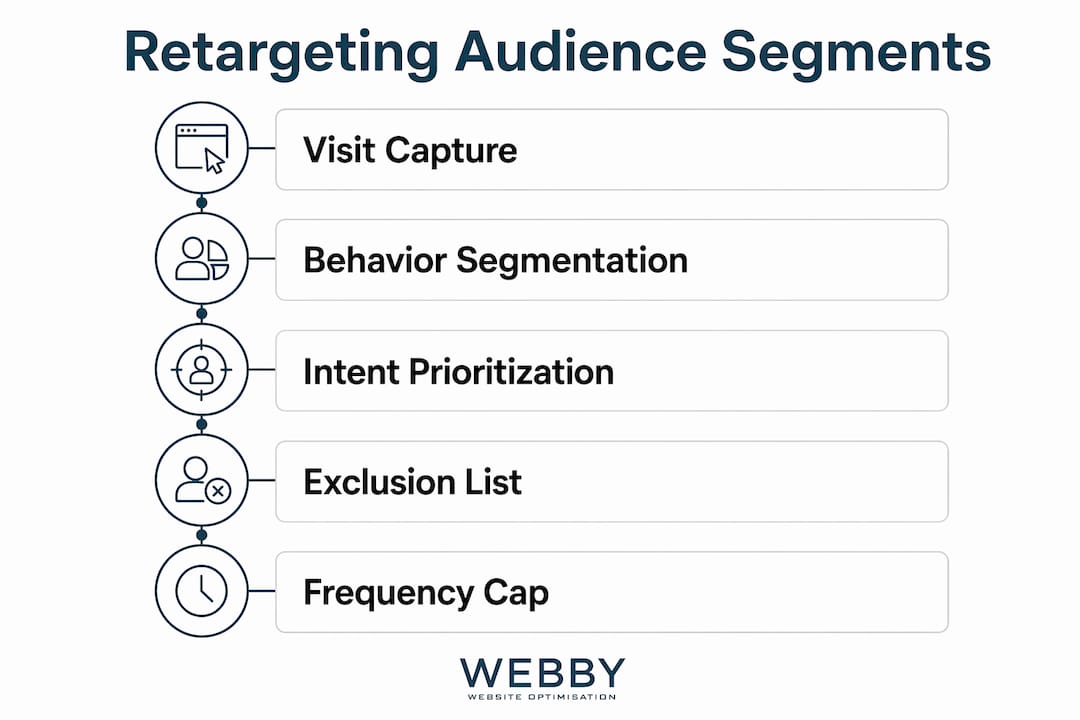
How to segment visitors into an intent-prioritized audience stack
Segment by behavior and recency. A cart abandoner and a blog reader are not the same prospect, and treating them identically wastes budget on the wrong message.

| Audience Segment | Time Window | Intent Level | Budget Share |
|---|---|---|---|
| Cart / checkout abandoners | 1–7 days | Very high | — |
| Product / pricing page viewers | 1–14 days | High | 15–25% |
| Multiple-page / long-session visitors | 7–30 days | Medium | 15–25% |
| Blog / content readers | 15–30 days | Low–medium | 15–25% |
Trigger events to track in GA4 and Meta:
ViewContent(product or service page)AddToCartandInitiateCheckoutPurchase(for exclusion lists)PageViewon pricing, contact, or booking pages
Exclusions to set immediately:
- Recent purchasers (exclude for 30–60 days minimum)
- Visitors who bounced in under 5 seconds
- Internal pages: careers, investor relations, login
A sequential, intent-based audience stack with exclusions and frequency caps is the proven best practice for keeping budget focused on visitors most likely to convert. For service businesses, understanding why segmenting prospects matters is equally critical — a pricing-page visitor who didn’t call needs a different message than someone who read a single blog post.
Pro Tip: When your retargeting audiences are small (under 1,000 users), widen time windows to 30–45 days and rotate creative every 7–14 days to prevent fast audience exhaustion.
What to say and show for each segment
Match the message to where the visitor is in their decision. The single biggest cause of wasted retargeting spend is running one creative for every audience.
Cart abandoners (very high intent): Lead with urgency and remove friction. Example copy: “You left something behind. Complete your order today — free shipping ends tonight.” Use dynamic product ads that show the exact item left in cart.
Product / pricing page viewers (high intent): Lead with benefits and social proof. Example: “Still comparing options? Here’s what 200+ customers say about .” Carousel ads showing reviewed products work well here.
Blog / content readers (low–medium intent): Lead with education and brand credibility. Example: “Not sure if [service] is right for you? Read how [outcome] happened for businesses like yours.” Use UGC-style creative or short video.
Rotate creative every 7–14 days. Retargeting audiences exhaust quickly; if weekly frequency exceeds roughly 8 impressions, pause and refresh the creative before restarting.
Pro Tip: Sequence your creative: serve a product-benefit ad first, then a social-proof ad, then a direct offer. This mirrors how a real sales conversation progresses and reduces the “why is this brand following me everywhere” feeling.
Which platforms to use and the technical setup checklist
Prioritize Meta Ads (Facebook and Instagram) and Google Ads remarketing. Add YouTube and programmatic display as budget allows.
Technical checklist:
- Meta: Install Meta Pixel on all pages, then layer in the Conversions API for server-side event forwarding. Browser pixels alone lose 15–30% of conversion data due to privacy controls; server-side CAPI restores a significant portion of that signal.
- Google: Deploy Google Tag Manager to manage all tags, connect GA4 with remarketing audiences enabled, and link Google Merchant Center with a product feed for dynamic ads.
- Email/SMS retargeting: Klaviyo (e-commerce) and Mailchimp both support behavior-triggered sequences. Shopify merchants can connect Klaviyo directly to product and cart events for abandoned-cart flows.
- AdRoll and Criteo: Both platforms support cross-channel retargeting with built-in product feed integration — useful for e-commerce businesses wanting display reach beyond Meta and Google.
Sync exclusion and conversion lists across platforms daily. A customer who converts on Google should be excluded from Meta retargeting within 24 hours. A customer data platform (CDP) or manual list uploads both work; the key is doing it consistently to prevent audience leakage.
Dynamic funnels using first-party data are more resilient than static 30-day audiences after recent privacy updates. Build your retargeting infrastructure around owned data from the start.
What the post-click experience must do to close the sale
The ad gets the click. The landing page closes the sale. Most retargeting campaigns fail at this step because the post-click page ignores the objection the visitor had when they left.
| Landing Page Element | What It Must Accomplish |
|---|---|
| Headline | Mirror the ad’s specific promise or offer |
| Social proof (reviews, case studies) | Build trust and reduce perceived risk |
| Price / fee clarity | Remove the “I don’t know what this costs” objection |
| Single, prominent CTA | Eliminate decision paralysis |
| Guarantee or return policy | Reduce commitment anxiety |
A cart abandoner clicking a “complete your order” ad should land on a pre-filled cart page, not the homepage. A pricing-page visitor clicking a “see our packages” ad should land on the pricing page with a comparison table visible above the fold. Optimized service pages that resolve the specific objection consistently outperform generic landing pages.
Pro Tip: Tag each audience segment with a UTM parameter (e.g., utm_audience=cart_abandoner) and build separate landing-page variants per segment. This lets you A/B test headline and offer changes without contaminating results across segments.
KPIs, reporting windows, and a simple A/B experiment template
Track ROAS, CPA, conversion rate, CTR, and frequency. For sales-focused retargeting, ROAS and conversion rate are the two that matter most.
Recommended reporting windows: Use 1–7 day attribution for high-intent segments (cart abandoners); use 7–30 day windows for mid-intent audiences where the decision cycle is longer.
A/B experiment template:
- Hypothesis: “Changing the headline from [generic offer] to [specific objection resolution] will increase conversion rate by X%.”
- Variant design: One control, one variant; change a single element per test.
- Sample size: Run until each variant has at least 100 conversions or 2 weeks of data, whichever comes first.
- Success criteria: Variant beats control on conversion rate with at least 95% confidence.
- Rollout: Pause the loser, scale the winner, and document the insight for the next test.
Pro Tip: Use server-side conversions (CAPI or Google’s Enhanced Conversions) as your primary attribution source. Browser-pixel-only attribution can undercount conversions by 15–30%, which makes profitable campaigns look unprofitable and leads to premature budget cuts.
Practical US privacy steps that affect retargeting
Compliance checklist for US-based businesses:
- Deploy a cookie consent banner that gates third-party cookies for California visitors (CCPA applies to businesses meeting specific thresholds — confirm with legal counsel)
- Maintain an opt-out list and update it within 24 hours of a consumer request
- Set a data retention policy (most platforms default to 180 days; review and document yours)
- Enable server-side Conversions API or Google Enhanced Conversions to reduce reliance on browser cookies
- Upload first-party email lists to Meta and Google as a parallel audience signal
For detailed legal guidance, consult the California Privacy Protection Agency and your platform’s official privacy documentation. Privacy settings reduce pixel visibility, which is why first-party data and server-side event forwarding are now operational necessities, not optional upgrades.
How Webby Website Optimisation implements retargeting for service and e-commerce sites
Webby Website Optimisation follows a four-phase process: audit tracking, build the intent stack, align creative and landing pages, then test and scale.
Phase timeline:
- Week 1–2 (Setup): Audit existing pixel and GA4 implementation for gaps, install CAPI, build three to five priority audiences, and confirm product feed or service-page event tracking.
- Week 3–4 (Launch): Deploy intent-matched creative per segment, configure landing-page variants, and set frequency caps and exclusion lists.
- Week 5–8 (Optimization): Run A/B tests on headlines and offers, review ROAS and CPA weekly, and scale budget to winning segments.
A diagnostics call with Webby evaluates tracking gaps, audience health, and quick wins — typically identifying at least one fixable issue that’s suppressing conversion data before any ad spend changes.
Pro Tip: Before launching any retargeting campaign, verify that your GA4 conversion events are firing correctly using GA4’s DebugView. A misconfigured event is the most common reason retargeting audiences stay small.
How to manage frequency and timing to avoid ad fatigue
Frequency is where retargeting goes from helpful to annoying. Cap impressions at 3–5 per week per user for most segments. If weekly frequency climbs above 8 impressions, pause the campaign and refresh creative before restarting.
Timing matters as much as frequency. The Stanford GSB research confirms that the first 24–48 hours after a site visit are the highest-value window. Serve your first retargeting ad within hours of the visit, not days. For high-value purchases with longer decision cycles, extend the window to 14–30 days but reduce frequency after day 7.
Rotate creative every 7–14 days in small audiences. When the same person sees the same ad more than a few times, CTR drops and negative feedback rises. A simple rotation: product benefit ad in week one, social proof ad in week two, direct offer in week three.
Common pitfalls and how to troubleshoot retargeting campaigns
Retargeting everyone with the same ad is the most expensive mistake. A pricing-page visitor and a blog reader need different messages. Fix: segment by page visited and intent level before writing a single line of copy.
Audience leakage happens when converted customers keep seeing ads for products they already bought. Fix: upload your customer list to Meta and Google as an exclusion, and automate daily updates.
Audiences too small to exit the learning phase stall campaigns before they optimize. Fix: widen time windows, combine similar segments (product viewers plus pricing-page visitors), or use broad-match audiences with intent signals layered on top.
Pixel misconfiguration is the silent killer. Events fire on the wrong pages, or Purchase events fire without order value, making ROAS calculations meaningless. Fix: audit with GA4 DebugView and Meta’s Events Manager before spending a dollar on ads.
Over-relying on browser pixels in 2026 means blind spots from ad blockers and iOS privacy changes. Fix: implement server-side Conversions API alongside the browser pixel for a two-layer tracking setup.
Key Takeaways
The most effective way to retarget website visitors for sales is to build an intent-ordered audience stack, serve matched creative within 48 hours of the visit, and allocate 15–25% of paid media to retargeting before scaling cold prospecting.
| Point | Details |
|---|---|
| Install two-layer tracking first | Deploy Meta Pixel plus CAPI and GA4 before building any audience or launching ads. |
| Segment by intent, not just recency | Cart abandoners, product viewers, and blog readers need distinct creative and CTAs. |
| Act within 48–72 hours | About half of retargeting’s first-week impact occurs shortly after the visit, especially within the first two days. |
| Cap frequency at 3–5 per week | Rotate creative every 7–14 days; pause if weekly impressions exceed 8 per user. |
| Webby Website Optimisation | Provides tracking audits, intent-stack setup, landing-page CRO, and pixel plus CAPI implementation for service and e-commerce sites. |
The case for post-click obsession
Most retargeting guides spend 90% of their advice on ad creative and platforms. The post-click page gets a paragraph, maybe two. That’s backwards.
A service client once ran a well-segmented Meta campaign with strong CTR — and a 0.4% landing-page conversion rate. The ad promised a free consultation; the landing page opened with a generic hero image and a contact form with eight fields. The fix wasn’t the ad. It was cutting the form to three fields and adding a single sentence about what happens on the call. Conversion rate tripled.
An e-commerce client had the opposite problem: a clean product landing page, but dynamic ads showing products the visitor had already purchased. Fixing the exclusion list and refreshing creative to show complementary products recovered the ROAS within two weeks.
The principle is the same in both cases: align the creative, the landing page, and the measurement to the visitor’s specific intent. When all three are in sync, retargeting becomes the highest-efficiency channel in the account. When even one is misaligned, you’re paying for clicks that were never going to convert.
Webby Website Optimisation can audit your retargeting setup
Retargeting campaigns that stall usually have one of three problems: broken tracking, generic creative, or a landing page that doesn’t resolve the visitor’s objection. Webby Website Optimisation fixes all three. The team audits your pixel and CAPI implementation, builds intent-segmented audiences, and aligns your website design and development with the specific messages your retargeting ads are serving.
A discovery call covers tracking gaps, audience health, and the quick wins most likely to move ROAS in the first 30 days. No long-term commitment required to get started. Book your free audit at webby.net.au and get a clear picture of what’s suppressing your conversions before spending another dollar on ads.
Useful sources
- Stanford GSB: Retargeted Advertising, Sooner Is Better Than Later — Open this for the research on immediacy windows and the defensive value of early retargeting.
- Hawky.ai: Retargeting Ads Guide — Use for ROAS benchmarks (3–5x) and the two-layer tracking (pixel plus CAPI) setup rationale.
- Traffiy: Meta Ads Retargeting Guide — Practical playbook for intent-stack audience building and frequency management on Meta.
- itsdeep: How to Set Up a Retargeting Campaign That Works — Frequency caps, creative rotation schedules, and audience exhaustion guidance.
- Digitenzy: Retargeting Ads Strategy 2026 — Budget allocation guidance (15–25%) and the case for dynamic funnels over static 30-day audiences.
- Weboin: How to Retarget Website Visitors Effectively — Audience segmentation taxonomy, message strategy by segment, and the generic-ad trap explained.
- California Privacy Protection Agency — Primary source for CCPA compliance requirements; combine with your legal counsel for your specific business situation.