
At its heart, search engine optimisation (SEO) for a small business is all about getting your website in front of the right people. It’s the art and science of making your business more visible on search engines like Google, specifically for the people who are already looking for what you offer. Think of it as the difference between hoping customers stumble upon your shop and setting up right in the middle of a busy marketplace.
These services are designed to attract organic traffic—that is, visitors who find your website naturally through a search, not because you paid for an ad. It’s exactly how a local bakery in Melbourne gets found when someone nearby searches for the “best sourdough in Carlton.”
Your Guide to SEO Services for Small Business Growth
For many Australian business owners, the term 'SEO' can feel a bit intimidating, wrapped up in technical jargon. But its goal is actually very straightforward: to connect your business with the customers actively searching for your products or services. It’s the digital version of having the best location in a shopping centre, making sure a steady stream of interested shoppers finds their way to you.
This guide is here to pull back the curtain on search engine optimisation services for small business owners. We want to help you see SEO not as just another business cost, but as a genuine investment in your growth. A great SEO strategy does much more than just improve your rankings; it builds credibility with customers, establishes your authority in your field, and creates a reliable, long-term source of leads and sales.
Understanding the Pillars of SEO
A solid SEO strategy isn't just one thing; it's several key components working in harmony. You can think of it like building a house—you need a strong foundation, solid walls, a good address, and a great reputation for it all to work.
To give you a clearer picture, every comprehensive SEO service is built on these essential pillars. Here's a quick summary of what they are and why they matter.
Quick Look at Key SEO Service Components
| SEO Component | Primary Goal | Example Tactic |
|---|---|---|
| Technical SEO | Make it easy for search engines to find, crawl, and understand your site. | Improving your website’s loading speed. |
| On-Page SEO | Align your website's content with what your target customers are searching for. | Writing clear page titles and product descriptions with relevant keywords. |
| Local SEO | Connect your business with customers in your geographical area. | Optimising and managing your Google Business Profile. |
| Content & Off-Page SEO | Build trust and authority for your brand. | Creating helpful blog posts and earning links from other respected websites. |
Each of these elements plays a crucial role. A technically sound website with poor content won't rank, and fantastic content on a site Google can't crawl is invisible. They all have to work together.
An effective SEO strategy is a long-term asset. While paid ads stop delivering traffic the moment you stop paying, strong organic rankings can continue to bring in free, high-quality traffic for years.
This guide will walk you through what to expect from a professional SEO service and how each part translates directly into more website traffic, more leads, and ultimately, more sales for your business. Our aim is to give you the confidence and knowledge to make the right decision for your brand.
For a deeper dive into how professional help can truly reshape your online footprint, we recommend reading an ultimate guide to search engine optimization services for small business.
Why Local SEO Is a Goldmine for Australian Businesses
For any Australian small business, local search engine optimisation isn't just a box to tick on a marketing list. It's your most direct connection to customers in your neighbourhood who are ready to buy.
Picture this: someone in your suburb pulls out their phone and searches for 'WordPress support near me'. A smart local SEO strategy is what puts your business right at the top of their screen, catching their eye at the exact moment they need you. This is the power of local intent.
Think of it like a digital version of the local community noticeboard, but you get the prime spot every single time. When someone searches with local intent, they aren't just browsing—they're looking for a nearby solution right now. For any business with a shopfront or a specific service area, getting this right is a complete game-changer.
Capturing High-Intent Local Searches
The real magic of local search is in the quality of the lead. When a customer uses phrases like "near me" or adds a suburb or city to their search, they're sending a loud, clear signal: they are close to making a decision. They have a problem, and they believe a local business is the best answer.
This is where professional search engine optimisation services for small business show their worth. The entire goal is to make your business the most visible, trusted, and obvious choice for anyone looking for what you do, right where you do it.
For example, a search for “hairdresser in Fitzroy” is infinitely more valuable to a local salon than a vague search for “hairdressing tips.” The first person is looking to book an appointment. The second is just after information. Local SEO is designed to capture the first person.
The Three Pillars of Local SEO Success
A strong local SEO strategy really comes down to three key pillars. These elements work together to build trust with both Google and your potential customers. Any specialised local search engine optimisation company will zero in on these areas.
Google Business Profile (GBP): This is the cornerstone of your local digital presence. Your GBP is that info box that pops up in Google Maps and local search results, showing your address, hours, phone number, and photos. Keeping this profile complete, accurate, and active is non-negotiable.
Customer Reviews: Great reviews act as powerful social proof. They don’t just convince potential customers you’re the real deal; they also send strong signals to Google’s ranking algorithm that your business is trustworthy and respected.
Local Citations: These are simply mentions of your business's Name, Address, and Phone number (NAP) on other websites and directories like Yelp, TrueLocal, or industry-specific sites. When this NAP information is consistent everywhere, it reinforces your location and legitimacy in the eyes of search engines.
The data paints a very clear picture. By 2026, it's estimated that 46% of all Google searches in Australia will have local intent. And the businesses that land at the top of those local results? They capture a massive 24.4% of all clicks, leaving competitors in the dust.
Simply put, if local customers can't find you online, you don't exist. Optimising for local search is the single most effective way to drive foot traffic, generate phone calls, and increase website visits from the people who matter most—the ones right in your neighbourhood.
A well-oiled local strategy does more than just get your name out there; it plugs you directly into your community. By focusing on these core elements, you stop playing a numbers game and start building a reputation as the go-to expert in your area. That’s what leads to real, sustainable growth.
What Am I Actually Paying For With SEO Services?
When you hire someone for search engine optimisation services for your small business, what are you really getting? "SEO" is a massive term that covers a lot of ground, but it all boils down to a handful of core activities. Knowing what these are helps you understand exactly where your money is going and how it translates into more customers.
Think of it like hiring a pit crew for a race car, where your website is the car. Each person on the crew has a specific job, but they're all working together to make the car faster, more reliable, and ultimately, win the race.
So, what does this "pit crew" actually do? Let's look at the main roles.
Technical SEO: The Engine and Chassis
First up is technical SEO. This is all the "under the bonnet" work that makes sure search engines like Google can find, crawl, and make sense of your website without hitting any roadblocks. Frankly, if your technical SEO is a mess, even the most amazing content and design won't matter because no one will ever see it.
It's like building a beautiful house on a shoddy foundation. No matter how incredible it looks inside, the whole thing is at risk. Technical optimisation is about pouring a solid concrete slab first, so everything you build on top of it is stable and secure.
This isn't glamorous work, but it's non-negotiable. It typically includes:
- Improving Site Speed: Making sure your website loads lightning-fast. Slow sites frustrate visitors and are a huge turn-off for Google.
- Mobile-Friendliness: Ensuring your site works perfectly on a phone. A huge chunk of your customers are searching on mobile, and if your site is a pain to use, they're gone.
- Creating a Sitemap: This is literally a map of your website that you hand to search engines, showing them where all your important pages are.
- Securing Your Site (HTTPS): Using an SSL certificate to encrypt your site (the little padlock in the browser bar) protects your visitors' data and is a clear signal to Google that your site is trustworthy.
This groundwork is the first and most critical step. It clears the way for search engines to properly see and reward all the other great work you're about to do.
On-Page SEO: The Signage and Interior Design
Once the technical foundation is solid, the focus shifts to what's happening on your actual web pages. This is on-page SEO, and it’s all about optimising your content and structure to make it crystal clear what each page is about.
If technical SEO is the foundation, on-page SEO is the clear signage and logical layout of your building. It helps people—and search engines—find exactly what they're looking for once they're "inside." Key activities here include:
- Keyword Research and Targeting: This is about discovering the exact words and phrases your potential customers are typing into Google. A good SEO will then strategically weave these into your page titles, headings, and content.
- Content Optimisation: Writing high-quality, genuinely helpful content that answers the searcher's question is the name of the game. This is how you prove to Google that you're an authority worth ranking.
- Title Tags and Meta Descriptions: These are the headlines and short summaries that appear in the search results. Crafting compelling ones is crucial for convincing someone to click on your link instead of your competitor's.
On-page optimisation is where strategy meets creativity. It’s about aligning what your customers are searching for with the solutions you provide on your website, creating a seamless and satisfying user journey.
For many small businesses, a huge part of this is local SEO, which focuses on getting found by customers in your immediate area. The key pillars of a strong local presence are shown below.
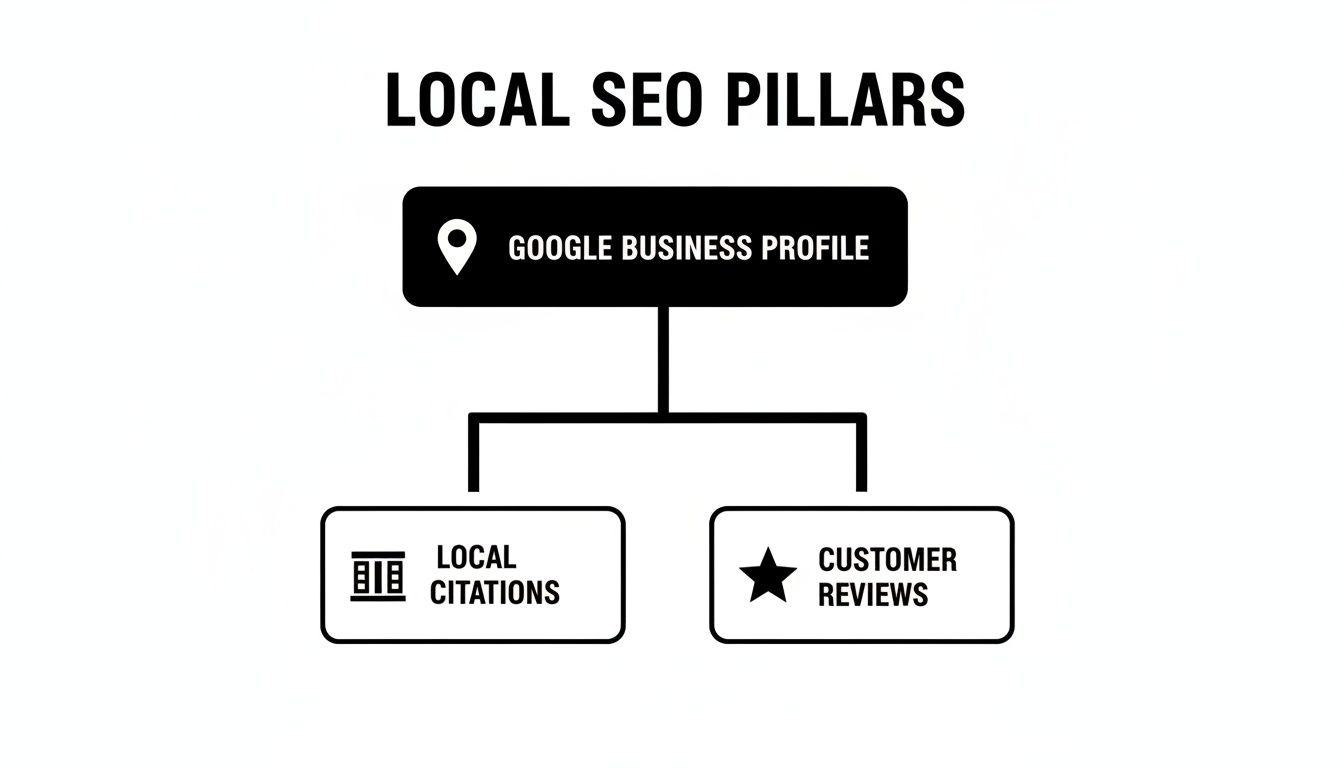
As you can see, a well-managed Google Business Profile is the absolute centrepiece of local success. It's supported by consistent business listings across the web (citations) and a steady stream of positive customer reviews. Together, these build a powerful local signal that both search engines and customers trust.
The Unseen Advantage of Technical SEO for WordPress Sites
If your website is your digital shopfront, think of technical SEO as its foundations, wiring, and plumbing. It’s all the invisible work happening behind the walls to make sure everything runs smoothly for your customers. For the millions of Aussie small businesses running on WordPress, this behind-the-scenes work is absolutely crucial.
A slow-loading page, a broken link, or an out-of-date plugin can quietly sabotage your search rankings. They turn potential customers away before they even get a chance to see what you offer. That’s why professional search engine optimisation services for a small business almost always start here—by checking the technical health of your site to build a solid platform for growth.
Building a Fast and Secure Foundation
Before Google’s algorithm even looks at your fantastic content or glowing reviews, it first checks if your site is accessible, fast, and secure. Think of it as a basic health and safety check. If you fail this initial test, trying to rank becomes a real uphill battle.
This is especially true for WordPress sites, where themes, plugins, and hosting setups all play a massive part in performance. A good SEO service will roll up their sleeves and focus on a few core technical elements.
- Site Speed and Performance: How fast your pages load is a huge ranking factor. Even a one-second delay can cause a significant drop in conversions. Experts will dive into optimising images, streamlining code, and ensuring you’re on fast hosting to make your site snappy.
- Mobile-Friendliness: With so much of today's web traffic coming from smartphones, your website absolutely has to look and work perfectly on any screen size. Google now uses mobile-first indexing, which means it ranks you based on the mobile version of your site.
- Site Security (HTTPS): That little padlock in the browser bar isn’t just for show. It tells visitors—and Google—that your site is secure and protects their data. Google actively rewards secure sites with better visibility in search results.
Technical SEO is really about making sure your website speaks Google’s language. It removes any technical roadblocks that stop search engines from crawling, indexing, and ultimately, recommending your site to people.
Regular maintenance isn't just an IT chore; it's a fundamental part of good SEO. And it's an area where many businesses fall behind. In fact, a staggering 67% of small businesses have never performed a technical SEO audit, leaving major performance issues to fester unresolved.
Structuring Your Site for Success
Beyond just speed and security, a clean site structure is vital. It helps both your visitors and search engines find their way around your content without getting lost. This means creating a logical hierarchy and providing clear signposts.
A professional service will take care of these key structural components:
- XML Sitemap: This is essentially a map of your website, listing all your important pages to guide search engine crawlers.
- Robots.txt File: This simple file gives instructions to search engines, telling them which parts of your site they should and shouldn't look at.
- Internal Linking: A smart internal linking strategy helps spread authority throughout your site and guides visitors to other relevant content, keeping them engaged for longer.
For WordPress users, this is where a skilled provider can be a complete game-changer. They’ll handle the proactive plugin updates, daily security scans, and performance tweaks that form the bedrock of good technical SEO. If your site feels sluggish, you can learn more about how professionals tackle these issues in our guide to WordPress speed optimisation services.
Setting Realistic Expectations for SEO Pricing and Results
Let's get straight to the two questions every small business owner asks: "How much does this actually cost?" and "When will I see a return on my money?" When it comes to search engine optimisation, the answers aren't a simple price tag, but they're not a mystery either.
The best way to think about SEO is not as a one-off expense but as a long-term investment in your digital real estate. It's a lot like building a physical shopfront. First, you have the construction phase, then you need to attract customers, and after that, there’s ongoing work to keep the place looking great and functioning perfectly. The costs and timeline for results follow this same journey.
Understanding SEO Pricing Models
SEO pricing isn't standardised across the board, and for good reason—every business is different. As you work out a realistic budget, it helps to understand the common SEO service pricing models you’ll come across.
Monthly Retainers: This is the most common setup by far. You pay a set fee each month for a consistent package of services like technical audits, content creation, link building, and reporting. In Australia, retainers usually start around $1,500 per month and can climb much higher depending on how competitive your industry is.
Project-Based Fees: Got a specific, one-time goal in mind? Maybe you need a deep technical audit of your site or a proper local SEO setup. A project-based fee is perfect for these targeted tasks, but it won't give you the ongoing momentum needed for long-term growth.
Hourly Consulting: Some experts charge by the hour, with rates often falling between $100 to over $300. This model works best if you need strategic advice or some hands-on training for your team, rather than a fully managed campaign.
A quick word of caution: be very wary of anyone promising real SEO results for just a few hundred dollars a month. Proper, effective SEO takes expertise, time, and resources. Rock-bottom prices are almost always a red flag for low-quality work that could end up hurting your website more than helping it.
A Realistic Timeline for Seeing SEO Results
SEO is a marathon, not a sprint. While you might see a few quick wins early on, true, lasting results take time to build. Pushing a website up the Google rankings is like trying to turn a massive ship—it demands consistent effort over time before you see a real change in direction.
SEO is about building momentum. The initial months are spent building a strong foundation, and the real growth comes from consistently executing the strategy over time. Results don't just appear; they compound.
Here’s a rough timeline you can expect from a professional SEO campaign:
Months 1–3: The Auditing and Fixing Phase: The first step is always a deep dive to find and fix any technical problems holding your site back. This means tackling site speed, fixing broken links, and optimising your site’s structure. This is also when all the foundational keyword research and content planning happens.
Months 3–6: The Growth and Ranking Phase: With a solid technical foundation in place, the focus shifts to creating genuinely helpful content and building your website's authority. You’ll start to see the first signs of progress here, like rankings for less competitive keywords and a slow but steady rise in organic traffic.
Months 6+: The Maintenance and Growth Phase: By this point, you should be seeing a tangible impact on your traffic, leads, and sales. The strategy then pivots to defending your new rankings, going after more competitive keywords, and constantly refining your approach based on what the data is telling you.
Measuring What Truly Matters
The data from local SEO campaigns, in particular, can show a very clear return on investment. For instance, some strategies can deliver a +15% click-through rate (CTR) from on-page changes within weeks, while consistent review management can boost your reviews by +40%. For many businesses, a smart way forward is to start with a foundational campaign to prove the concept works. Once the data confirms a positive ROI, you can confidently scale up your investment. You can find more details in this excellent guide on local business growth.
How to Choose the Right SEO Partner for Your Business

Picking a provider for search engine optimisation services for your small business is a massive decision. Get it right, and your partner becomes an engine for growth, reliably bringing new customers through your door. Get it wrong, and you can burn through your marketing budget and see your online presence go backwards.
The good news is that finding a great SEO expert isn't a roll of the dice. It's about knowing what to ask and what to look for in their answers. Think of it exactly like hiring a crucial team member: you need to vet their experience, understand their process, and make sure they’re the right fit for your business goals.
Key Questions to Vet Potential Providers
Before you even think about signing a contract, you need to have a proper chat. Go into that conversation armed with a few non-negotiable questions. Their answers will tell you everything you need to know about their expertise and how they operate.
Can you show me examples of your work with businesses like mine? You’re looking for case studies or real-world results from companies in your industry or of a similar size. Just because they had success with a national retailer doesn't mean they understand the needs of a local service business.
What does your strategy actually look like? A solid partner won’t just say they’ll "do SEO." They should be able to walk you through a clear, customised plan that's based on a real analysis of your business, your ideal customers, and what your competitors are doing.
How will you report on success? The answer should be all about the metrics that matter to your bottom line—things like organic traffic growth, more phone calls or form fills, and actual sales. If they start talking a lot about "impressions" without tying it to a business outcome, that's a warning sign.
Major Red Flags to Watch Out For
Let's be honest: the SEO industry has a few cowboys. Learning to spot the warning signs early will save you a world of headaches and wasted money down the track.
If an offer sounds too good to be true, it always is. Real, sustainable SEO is a long-term investment. Anyone promising you the world overnight isn't being straight with you about how search engines actually work.
Keep your guard up if a potential partner does any of the following:
Guarantees #1 Rankings: Nobody can guarantee a number one spot on Google. Ever. The algorithms are far too complex and change all the time. This is probably the biggest and most common red flag in the industry.
Is Vague or Secretive About Their Methods: A professional you can trust will be an open book about their strategy. If they start talking about "proprietary techniques" or a "secret sauce" they can't explain, it often means they're using risky "black-hat" tactics that could get your website penalised by Google.
Offers Unbelievably Cheap Packages: Proper SEO takes serious time, skill, and resources. Rock-bottom pricing is a sure sign that corners are being cut. It could mean the work is outsourced to low-quality freelancers or, worse, they're using automated, spammy software that will do more harm than good.
Choosing your SEO partner is all about doing your homework. For a deeper dive into this critical process, you might find our guide on finding the right SEO company for your small business helpful. By asking these tough questions and keeping an eye out for red flags, you can find a team that is genuinely committed to helping you grow.
Frequently Asked Questions About Small Business SEO
Diving into search engine optimisation can feel a bit overwhelming, and it's natural to have questions. As a small business owner, you just want clear answers to help you make the right call. So, let's tackle some of the most common queries we get about search engine optimisation services for a small business.
We've cut through the jargon to give you straight answers, helping you move forward with confidence.
How Long Does SEO Take to Show Results?
This is always the first question, and the only honest answer is: it’s a long game. SEO isn't about flicking a switch for instant traffic; it's about building a solid foundation for sustainable growth.
While every business is different, here’s a realistic timeline you can expect:
- Months 1-3: This is the setup phase. We’re doing the crucial behind-the-scenes work—technical audits, fixing site errors, and digging deep into keyword research. You might see a few small ranking bumps, but this is all about preparing for takeoff.
- Months 4-6: Now things start to get exciting. As your content finds its footing and authority-building efforts kick in, you should see a noticeable climb in keyword rankings and a steady increase in organic traffic.
- Months 6+: By this point, your investment should be paying off with more leads, enquiries, and sales. From here, the focus shifts to defending your new positions and finding fresh opportunities for growth.
Can I Do SEO Myself?
Absolutely, you can! There are tons of guides and tools out there if you want to learn the ropes. The real question isn't can you, but should you? Good SEO is a huge time commitment and requires a deep understanding of ever-changing search engine rules.
We see it all the time. A business owner will try DIY SEO, only to realise the hours they’re spending on keyword research and technical fixes are hours taken away from actually running their business.
For most people, hiring a professional simply makes more financial sense. It frees you up to focus on what you're best at, knowing your SEO is being handled by someone whose only job is to get you results.
What's the Difference Between SEO and Paid Ads?
Both SEO and paid ads (like Google Ads) are designed to get you in front of customers, but they go about it in completely different ways.
Think of it this way:
- Paid Ads (PPC): This is like renting a billboard on the busiest highway. You pay for the premium spot at the top of the search results, and you get traffic immediately. But as soon as you stop paying the rent, your billboard comes down.
- SEO (Organic Search): This is like building your own shop in the perfect location. It takes time, effort, and a solid plan to build it, but once it's established, the visitors you attract come to you for free. You own the asset, and it builds genuine, long-term credibility.
The best marketing strategies often use a mix of both. Paid ads can bring in quick business while your SEO strategy gathers momentum and builds a foundation for the future.
Ready to stop worrying about your website and start seeing real results? The team at Webby Website Optimisation offers expert WordPress help and support to keep your site fast, secure, and climbing the search rankings. Discover our flexible support plans today.
If this post raised some questions feel free to ask me a question
Trackbacks/Pingbacks