
Picking the right SEO company for your small business is one of the most important decisions you'll make. A great partner does more than just chase rankings; they connect their work directly to your bottom line, making sure your investment brings in real leads and sales for your Australian business.
Your Guide to Finding the Right SEO Partner

Let's be honest, finding a good SEO partner feels overwhelming, especially when you're busy running the show. This guide is written for Australian small business owners who use WordPress and need results—not confusing reports and empty promises.
We're cutting through the jargon to focus on what actually matters. The goal here is to give you a straightforward, practical framework so you can make a decision you feel good about.
Define What Success Looks Like First
Before you even think about searching for an SEO company, you need to know what a "win" looks like for your business. We'll walk you through how to turn your business goals into SEO outcomes you can actually measure. For example, a plumber in Perth will have a very different goal (more phone calls) than a Melbourne-based online shop that wants to boost national sales.
When you tie your core business objectives to specific metrics from day one, you ensure every dollar spent on SEO is a direct investment in your growth and profitability.
This simple first step saves you from wasting time and money on generic packages that don't fit what you're trying to achieve. We'll even dig into what you can realistically expect in the first 90 days and how to set achievable milestones along the way.
What You'll Learn in This Guide
Think of this as your complete roadmap for the entire process. By the end, you'll have real clarity on:
- How to map your specific business goals to SEO results.
- The essential services your WordPress site actually needs.
- Common pricing models and how to spot the red flags.
- A practical checklist for vetting and choosing the right partner.
Ultimately, this article will give you the confidence to find an SEO company that gets the Australian small business scene and can build a strategy that delivers sustainable growth for your WordPress website.
Map Your Business Goals to SEO Outcomes
Before you even think about shortlisting an SEO company for small businesses, the first and most important job is to get brutally honest with yourself. What does "success" actually look like for your business? So many businesses fall into the trap of chasing vague goals like "more traffic," which is a surefire way to end up disappointed and out of pocket.
Real growth happens when you connect what your business needs to survive and thrive—more sales, more leads, more bookings—to specific SEO outcomes. Taking the time to do this thinking upfront means you won't waste money on a generic strategy that doesn't deliver. It also means you can walk into any conversation with a potential SEO partner and tell them exactly what you need them to do.
From Business Goals to SEO Metrics
Think about how your business actually makes money. Is it the phone ringing off the hook? Lead forms being submitted through your website? Or is it the "cha-ching" of an online sale? Each of these drivers points to a very different SEO focus. Your task is to translate your high-level business objectives into tangible metrics an agency can actually work towards.
For instance, a local electrician in Brisbane has no use for a million website visitors from Perth. Their world revolves around getting more local service calls.
- Business Goal: Increase local service bookings by 20% this quarter.
- SEO Outcome: Get to the top of Google for searches like "emergency electrician Brisbane" or "lighting installation Fortitude Valley."
- Key Metric: The number of phone calls coming directly from the Google Business Profile and the website's contact page.
See how clear that is? It sets a proper benchmark for success. Now, let's look at a completely different scenario: a Melbourne-based ecommerce store that sells handmade jewellery.
- Business Goal: Grow online sales by 30% over the next six months.
- SEO Outcome: Rank nationally for product-focused keywords like "handmade silver earrings Australia" and "unique artisan necklaces."
- Key Metric: The number of organic ecommerce transactions, average order value, and the conversion rate from search traffic.
By drawing these lines between your goals and SEO work from day one, you turn SEO from a fuzzy marketing cost into a predictable engine for business growth. It’s the difference between asking for “more traffic” and asking for “more qualified leads that actually become paying customers.”
Articulating Your Vision
With this clarity in hand, you're in the driver's seat. You're ready to properly interview any SEO company for small businesses that comes your way.
Instead of just listening to their pitch, you can ask pointed questions. "Our main goal is to drive more qualified leads in the Sydney area. What would your strategy be for our Google Business Profile and local landing pages?" This forces them to get specific and show you they understand your world. If you skip this prep work, you're far more likely to end up with an agency that sends you pretty reports full of vanity metrics that do nothing for your bottom line.
Must-Have SEO Services for Your Small Business
When you start looking for an SEO company for small businesses, you'll quickly realise the services on offer are all over the map. Some agencies will try to dazzle you with flashy add-ons that sound great but don't actually deliver much value. For an Australian small business, particularly one running on WordPress, the key is to focus on the foundational services that genuinely move the needle.
These are the essentials that form the bedrock of any solid SEO campaign. Without them, you're just building your online presence on shaky ground. Let’s break down the absolute non-negotiables you should be looking for in any potential SEO partner.
The Technical SEO Foundation
I like to think of technical SEO as the plumbing and wiring of your website. It doesn't matter how amazing your content is if your WordPress site has deep-seated technical problems preventing Google from seeing it properly. Any credible agency has to start here.
This always begins with a thorough audit to uncover and fix issues that stop search engines from crawling and indexing your site. The key technical jobs should always include:
- Site Speed Optimisation: Making sure your pages load fast. Slow sites are a huge turn-off for users and get penalised by Google.
- Mobile-Friendliness: Checking that your site works flawlessly on smartphones and tablets—it's not optional anymore.
- Crawlability and Indexing: Sorting out sitemaps and fixing crawl errors so Google can actually find all your important pages.
- Secure Connection (HTTPS): Ensuring your site is secure is a basic requirement for building user trust and for ranking well.
Local SEO and Google Business Profile
For any Aussie business with a physical shopfront or a local service area, local SEO isn't just a "nice to have"—it's absolutely critical. This is how you pop up when someone down the road searches for "plumber near me" or "cafe in Carlton." The absolute centrepiece of this is your Google Business Profile (GBP).
A massive 46% of all Google searches have local intent, meaning people are looking for something nearby. What’s shocking is that 58% of small businesses don't focus on local search at all, leaving a huge gap for you to fill.
Any SEO company that doesn't immediately talk about optimising your Google Business Profile, building local citations, and managing your reviews simply doesn't get the Australian small business market. It's that important.
Strategic Content and On-Page Optimisation
Once your site’s technical health is in order, the focus can shift to what your customers actually see: your content. A great SEO partner does more than just churn out blog posts; they create a proper content strategy that ties directly back to your business goals.
This involves creating genuinely valuable and informative content that answers your customers' questions and establishes you as an expert in your field. From your homepage to your services and blog, every single page needs on-page optimisation. This means strategically placing keywords in titles, headings, and body copy to clearly signal what the page is about to search engines. For a closer look, check out our guide on essential https://www.webby.net.au/blog/seo/seo-services-for-small-businesses/.
It also helps to know what tools are powering these services. Getting familiar with the Best SEO Software for Small Business can give you a peek behind the curtain at an agency’s capabilities. A good partner will use these tools for deep keyword research, rank tracking, and competitor analysis, ensuring your strategy is driven by data, not guesswork.
Decoding SEO Pricing and Spotting Red Flags
Alright, let's get down to the brass tacks: what's this actually going to cost? Talking about SEO pricing can feel like navigating a minefield. You'll see prices all over the map, which makes it tough to know what's fair and what's a rip-off.
The most important shift in thinking is to see SEO not as a monthly expense, but as an investment. You're building a predictable, long-term channel for attracting new customers, and that has real value.
Common SEO Pricing Models Compared
Most SEO companies structure their fees in a few standard ways. You'll most often come across a monthly retainer, but it's worth understanding the others so you know what you're looking at when you get a proposal.
I've put together a quick comparison table to break down the common pricing models you'll encounter. This should help you figure out which approach makes the most sense for your business right now.
| Model | Typical Cost (AUD) | Pros | Cons | Best For |
|---|---|---|---|---|
| Monthly Retainer | $1,200 – $5,000+ | Consistent, ongoing work; builds long-term momentum; predictable budgeting. | Requires a minimum commitment (usually 6-12 months); results are gradual. | Businesses committed to sustainable, long-term growth. |
| Project-Based | $2,000 – $10,000+ | Fixed price for a defined scope (e.g., site audit, migration); clear deliverables. | Not for ongoing growth; can be a one-and-done fix for a larger problem. | Specific, one-off needs like a technical audit or a new website launch. |
| Hourly Consulting | $150 – $400+ | Pay-as-you-go flexibility; great for specific questions or training. | Costs can add up quickly; lacks a cohesive long-term strategy. | Getting a second opinion, ad-hoc advice, or in-house team training. |
Ultimately, for a small or medium business looking for real growth, a monthly retainer is almost always the way to go. It allows an agency to build momentum, react to algorithm changes, and become a true partner in your business. Project-based and hourly work have their place, but they won't build you a lead-generating machine.
How Much Should SEO Cost in Australia?
So, what's a realistic budget? For a quality Australian agency that can deliver tangible results, a small business should expect to invest somewhere between AUD 1,200 and AUD 2,500 per month.
Anything less than that, and you have to start asking serious questions about what's being left out. An investment in that range gives an agency enough runway to handle proper technical SEO, develop a smart content strategy, and build your site's authority. As this excellent breakdown of SEO costs in Australia shows, a strategic spend pays dividends. Some of their clients with a AUD 2,000 monthly investment are seeing visitor acquisition costs as low as AUD 1.42 – that’s a powerful return.
What you get for that money matters. A cheap plan might just be some basic on-page tweaks and an automated report. A proper investment, however, should get you a dedicated strategist, deep technical work, a custom content calendar, and a partner who actually picks up the phone.
Critical Red Flags to Watch Out For
Knowing what to look for is only half the battle; knowing what to run away from is just as important. A bargain-basement price can be tempting, but in the world of SEO, it almost always means they're cutting corners in ways that can get your site penalised by Google.
Here are the warning signs I tell every business owner to look out for.
I cannot stress this enough: if an agency "guarantees" you a number one ranking on Google, end the conversation. No one can promise that. Not even people who work at Google. A true professional talks about best practices, sustainable growth, and measurable results—not impossible fantasies.
Keep your eyes peeled for these other major red flags. If you spot one, it's a sign to dig deeper or walk away.
- "Secret Sauce" Strategies: If an agency is cagey about what they’re actually doing, that's a problem. A good partner will be completely transparent about their methods for improving your site, creating content, and earning links. You should always know what you're paying for.
- Long, Iron-Clad Contracts: Be very wary of anyone demanding a 12 or 24-month lock-in from day one. Confident agencies will prove their value over a shorter initial term, like 3-6 months, before rolling onto a month-to-month agreement. They bet on their results to keep you, not a contract.
- A Cookie-Cutter Approach: Did they send you a proposal without first asking about your business, your customers, or your goals? If so, you're not getting a strategy; you're getting a generic, one-size-fits-all package that probably won't work.
- Focus on Vanity Metrics: An impressive-looking report full of "impressions" and "clicks" means nothing if it doesn't lead to business. A savvy agency ties every metric back to what actually matters: phone calls, form submissions, and sales.
Alright, you've got your business goals mapped out and a budget in mind. Now for the crucial part: finding the right SEO partner to bring those goals to life. This isn't just about hiring a supplier; it's about starting a partnership. You're moving from the drawing board to the interview room, and it's time to get serious.
The initial consultation is your chance to really dig in. A slick, generic sales pitch just won't cut it. You need an agency that has done its homework on your business and can talk specifics about your WordPress site and your position in the market. Walk into that meeting prepared with questions designed to cut through the fluff.
Key Questions for Your Shortlist
When you’re sitting across from a potential agency, their answers will reveal everything about their expertise, their process, and how transparent they really are. Don’t hold back—this is your investment on the line.
I’ve found these questions to be particularly telling:
- WordPress Chops: "Can you show me a few WordPress sites you've ranked? What were the specific technical SEO challenges you had to solve on that platform?"
- Link Building Philosophy: "How do you approach earning backlinks for your clients? Walk me through your process for making sure every link is high-quality and actually relevant to my industry."
- Reporting & Communication: "Could I see a sample of your monthly report? More importantly, how will you connect the work you’re doing directly to my main goal of getting more qualified leads?"
The point here is to get past hypotheticals and see hard evidence of their work. This is also the perfect time to get a feel for the team. Can you see yourself collaborating with them? Or do they feel like a distant, disconnected vendor? A great partner is as invested in your success as you are; they aren't just there to cash a cheque.
Analysing Case Studies and Reviews
Every agency will push their case studies, but you need to look at them with a healthy dose of scepticism. Zero in on examples that mirror your own business. If you’re a local tradie, a case study about a national e-commerce giant isn't all that useful. You need to see proof they can help a business like yours.
Look for the story behind the numbers. A great case study doesn't just show a graph pointing up and to the right. It explains the initial problem, the strategy they built to solve it, and the real, tangible impact it had on the business.
This whole vetting phase can feel overwhelming, but breaking it down makes it manageable.
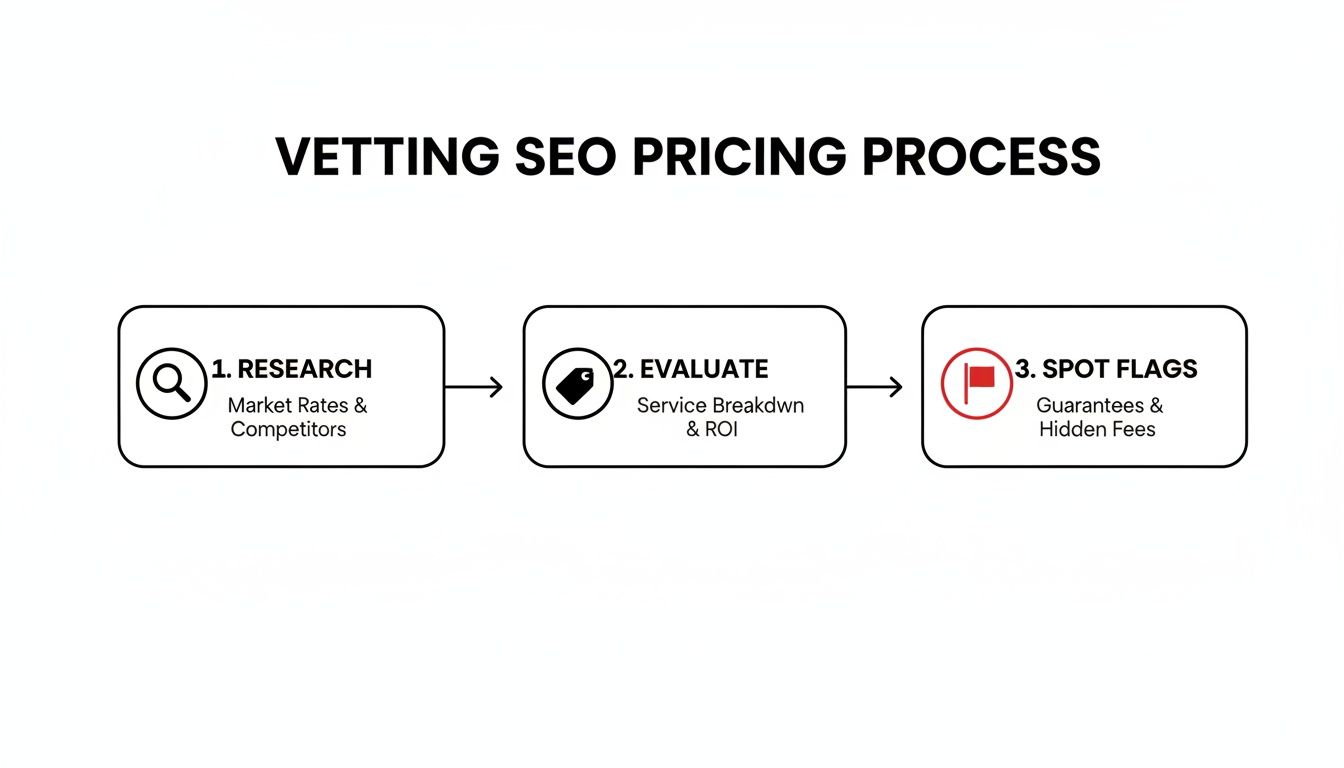
As the graphic shows, it boils down to three simple stages: do your research, evaluate what you find, and keep an eye out for any red flags.
And make no mistake, this is an investment worth making. The Australian SEO software market alone is projected to hit USD 5.2 billion by 2030, with small and medium businesses driving the fastest growth. This isn't just a trend for big corporations anymore; SEO is a fundamental and accessible strategy for businesses just like yours.
Finally, think about the bigger picture. An SEO partner who also gets the ins and outs of WordPress maintenance and security is worth their weight in gold. It means they can make sure your site's technical foundations are rock-solid before they start building your search visibility. This integrated approach creates a much more resilient and sustainable path to growth. For businesses targeting a specific geographic area, having an expert who truly understands the local market is a game-changer. You might find our guide on picking a specialised local search engine optimisation company particularly helpful here.
Got Some Lingering Questions? Let's Clear Them Up
Even after you've done all your homework, it’s completely normal to have a few last-minute questions before you hire an SEO company. In fact, it’s smart. Asking these questions now will give you the final piece of confidence you need to make the right choice.
Let's walk through some of the most common queries I hear from business owners just like you.
"How Long Until I Actually See Results from SEO?"
This is always the first question, and for good reason. You're making an investment and you want to know when it will pay off. While you’ll see early signs of life, a proper SEO strategy that genuinely affects your bottom line—think more leads and sales—realistically takes about four to six months to gain serious traction.
Think of the first 90 days as laying the critical groundwork. Your agency will be deep in the trenches, handling things like:
- A thorough technical audit of your WordPress site to find what’s holding it back.
- Digging into keyword research and sizing up your competitors.
- Starting the initial on-page optimisation and content creation.
Within three to four months, you should start seeing positive leading indicators, like some of your important keywords climbing the ranks and a noticeable uptick in organic traffic. If any company promises you instant page-one rankings, be very sceptical. Real, sustainable SEO is about building trust and authority with search engines, and that simply doesn't happen overnight.
"What’s the Difference Between Local and National SEO?"
This is a crucial distinction, and the right answer depends entirely on who and where your customers are.
Local SEO is all about getting your business found by people in a specific geographic area. It's for the cafe in Fitzroy, the dental clinic in Adelaide, or the landscaper serving Sydney's Northern Beaches. The strategy here is hyper-focused on location-based searches, like "emergency plumber Perth." This means heavily optimising your Google Business Profile, actively managing reviews, and building citations on local directories.
National SEO, on the other hand, is for businesses that aren't tied to a physical location, like an e-commerce store or a consultant who can serve clients anywhere in Australia. The aim is to rank for much broader keywords, such as "buy handmade leather boots online," where the searcher's physical location isn't the main factor.
A good SEO partner won't just pick one; they'll analyse your business model and often recommend a smart hybrid of both.
"What KPIs Should I Actually Care About?"
It's easy to get distracted by big numbers that sound impressive but don't actually mean much for your business. "Impressions" are nice, but they don't pay the bills. The Key Performance Indicators (KPIs) you track need to tie directly back to your business goals.
Forget fixating only on rankings. The most important KPIs are the ones that measure business impact. You want to see how SEO is generating tangible value, not just how visible you are.
Here are the metrics that truly matter:
- Organic Traffic: How many people are finding your site through search engines without you paying for the click?
- Keyword Rankings: Are you moving up for the high-intent keywords that your ideal customers are actually searching for?
- Click-Through Rate (CTR): Of all the people who see you in search results, what percentage is compelled to click through to your website?
- Conversion Rate: This is the big one. What percentage of those organic visitors are taking the action you want them to, like filling out a form, calling you, or making a purchase?
- Google Business Profile Actions: If you're a local business, this is non-negotiable. You need to be tracking calls, requests for directions, and website clicks coming directly from your profile.
"Do I Still Need SEO if I'm Already Running Google Ads?"
Yes, you absolutely do. It's a common mistake to see SEO and Google Ads (PPC) as an either/or decision. The truth is, they're two sides of the same coin and are incredibly powerful when they work together.
SEO is your long game. It builds lasting authority, credibility, and a stream of organic traffic that you don't have to pay for with every single click. It's a sustainable business asset. Google Ads, by contrast, gives you immediate, highly targeted traffic and allows you to quickly test which keywords and messaging convert the best.
When you show up in both the paid and organic search results, you dominate the screen. This synergy builds incredible brand trust and allows you to capture a much larger share of clicks. A robust digital strategy uses both to create a powerful presence. And to really boost your organic side, our detailed on-page SEO checklist is a great place to start.
At Webby Website Optimisation, we don't just execute SEO tasks; we build genuine partnerships centred on your specific business goals. If you're looking for a team that truly gets the challenges facing Australian small businesses on WordPress, let's have a chat about how our tailored support can drive real, measurable growth for you. Explore our WordPress help and support plans to see how we can get started.