

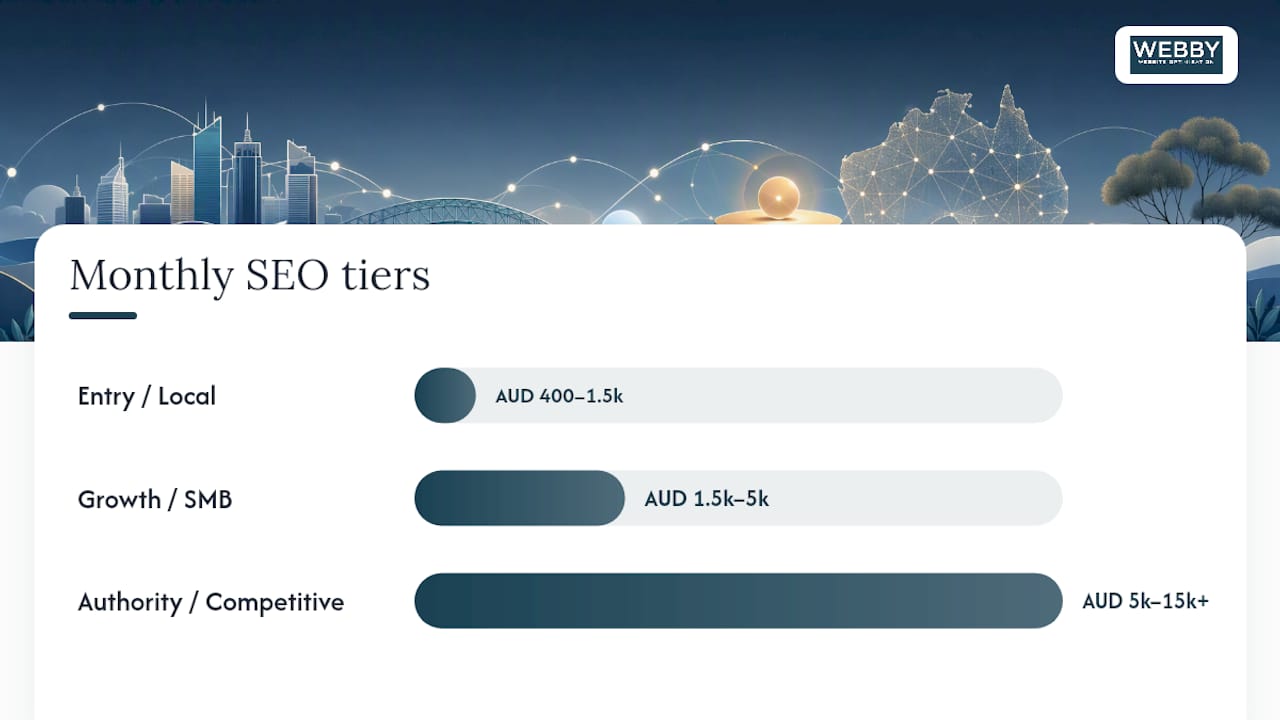
Australian SEO services typically run AUD 400–15,000+ per month, with most small and medium businesses landing somewhere in the AUD 1,500–5,000 range on a monthly retainer. Hourly consulting sits around AUD 100–300/hr, and fixed-price project work is common for audits and site migrations. The three dominant models are monthly retainers, project fees, and hourly consulting. Performance-linked pricing exists but is uncommon and can carry additional risks.
Here is where the three main tiers sit:
| Tier | Monthly Range (AUD) | What It Typically Buys |
|---|---|---|
| Entry / Local | $400–$1,500 | Basic technical fixes, local citations, light content, monthly reporting |
| Growth / SMB | $1,500–$5,000 | Technical SEO, regular content, link building, local optimization, detailed reporting |
| Authority / Competitive | $5,000–$15,000+ | Full technical management, aggressive content and link programs, multi-location, e-commerce |
Pro Tip: Take any monthly retainer and multiply it by 12 before you approve the budget. A $2,000/month retainer is a $24,000 annual commitment. Then divide that figure by a reasonable hourly rate (AUD 150–200) to see how many hours you are actually buying. At $2,000/month, that is roughly 10–13 hours of work per month. If the proposal promises more than that scope can realistically cover, ask the agency to explain the math.
Key Takeaways
Australian SEO pricing ranges from AUD 400 to AUD 15,000+ per month, and the only reliable way to compare quotes is to convert every retainer into implied hours and an annual commitment before approving any budget.
| Point | Details |
|---|---|
| Core pricing bands | Entry $400–$1,500/mo, Growth $1,500–$5,000/mo, Authority $5,000–$15,000+/mo in Australia. |
| Hours arithmetic | Divide the monthly fee by AUD 150–200 to see how many hours you are actually buying. |
| Annual commitment check | Multiply any monthly retainer by 12 before budget sign-off; $2,000/month is $24,000/year. |
| Top red flags | Guaranteed rankings, vague deliverables, 12-month lock-ins, and no hours disclosure. |
| Recommended next step | Webby Website Optimisation offers a free audit covering technical crawl, quick wins, and a 90-day plan for Perth service businesses. |
Table of Contents
- What do Australian SEO monthly retainers actually include?
- How do agencies and consultants charge for SEO?
- What factors drive SEO pricing in Australia?
- What do deliverables actually look like at different price points?
- How long does SEO actually take to show results?
- How do you evaluate agency proposals and spot red flags?
- A sample package for a small Australian service business
- How AI and 2026 changes affect what you pay for
- What should you do right now?
- Hourly and project-based price examples
- Is in-house SEO cheaper than hiring an agency in Australia?
- What contract terms should you watch for?
- How should you budget for SEO across the year?
- Do SEO prices differ between Australian cities?
- Webby Website Optimisation: transparent SEO for Perth service businesses
- Sources
What do Australian SEO monthly retainers actually include?
Monthly retainers are the backbone of SEO pricing in Australia, and the tier you choose shapes everything from how often your site gets touched to whether link building is even on the table.
Entry / Local tier: AUD 400–1,500/month
This range suits sole traders, single-location service businesses, and anyone competing in a low-competition local market. At $800/month, expect a technical audit in month one, a handful of on-page fixes, Google Business Profile optimization, and basic citation building. Content is usually one short article per month, if it is included at all. Reporting is typically a monthly PDF with keyword rankings and traffic. Link building at this price is minimal or absent.
Growth / SMB tier: This is where many Australian SMBs with genuine growth goals budget. Retainers in this tier generally cover ongoing technical monitoring, several pieces of content monthly, a structured internal linking strategy, and a modest link-building program. Reporting is more dynamic with conversion tracking, and agencies often conduct quarterly strategy reviews.
Authority / Competitive tier: AUD 5,000–15,000+/month
National campaigns, e-commerce sites with hundreds of product pages, and businesses in high-competition verticals (finance, legal, health, real estate) live here. At $8,000/month, you are funding a full content team, aggressive digital PR and link acquisition, technical SEO at scale (crawl budget management, schema, Core Web Vitals), and multi-location local SEO. Reporting includes attribution modeling and revenue impact analysis.
E-commerce / Enterprise tier: Large product catalogs, international target markets, and complex site structures tend to require more investment. Services at this level typically address advanced technical SEO challenges like faceted navigation, canonicalization, and feed optimization.
Deliverable callout: A retainer priced around $3,000 per month that promises “unlimited content” and “hundreds of links per month” is likely unrealistic. The hours affordable at this price point generally cannot support such a volume of quality SEO work.
How do agencies and consultants charge for SEO?
Four models dominate the Australian market. Each suits a different situation, and choosing the wrong one costs you money or flexibility.
Monthly retainer is the most common structure. You pay a fixed fee each month for an ongoing scope of work. Predictable for budgeting, but you need to verify what is actually included each month and whether unused hours roll over.
Hourly consulting works well for specific advice, audits, or training your in-house team. At AUD 100–300/hr, a senior consultant can review your site, diagnose problems, and hand you a prioritized fix list. The risk: scope creep if you do not set a clear hour cap upfront.
Fixed-price project suits defined scopes: a technical audit, a site migration, a local SEO setup. You know the cost before work starts. The downside is that SEO rarely fits neatly into a box, and agencies sometimes underprice projects to win the work, then cut corners.
Performance-linked pricing ties fees to outcomes (rankings, traffic, leads). Sounds attractive, but it creates perverse incentives. Agencies may chase easy wins, avoid competitive terms, or use tactics that deliver short-term gains and long-term penalties.
| Model | Predictability | Risk Allocation | Best For |
|---|---|---|---|
| Monthly retainer | High | Shared | Ongoing campaigns, growth goals |
| Hourly consulting | Low | Client-side | Audits, training, specific advice |
| Fixed-price project | High | Agency-side | Migrations, audits, one-off setups |
| Performance-linked | Variable | Agency-side | Rarely recommended; high-trust relationships only |
Pro Tip: Start with a fixed-price audit before committing to a retainer. A $500–$1,500 technical audit gives you a prioritized fix list and tells you whether the agency actually understands your site. It also lets you evaluate their thinking before you sign a six-month contract.
Pro Tip: When comparing retainers, ask each agency how many hours per month the retainer covers and what their effective hourly rate is. This helps clarify the actual work volume included beyond vague deliverable descriptions.
What factors drive SEO pricing in Australia?
No two sites cost the same to optimize. These are the variables that move price up or down, and roughly how much each one matters.
| Pricing Driver | Impact | Example Scenario |
|---|---|---|
| Competition level | High | A plumber in Perth pays less than a mortgage broker in Sydney |
| Site size and technical debt | High | A 500-page site with crawl errors costs more to fix than a clean 20-page site |
| E-commerce complexity | High | Product feeds, faceted navigation, and inventory pages multiply the scope |
| Goals: local vs national | Medium | National campaigns require broader content and link programs |
| Content needs | Medium | A site with no existing content needs more investment upfront |
| Link-building intensity | High | Competitive niches need more links, from stronger sites, more often |
| In-house capability | Medium | A client with an in-house writer reduces content costs |
| Tools and licenses | Low–Medium | Crawl tools, rank trackers, and reporting platforms add $100–$500+/month |
Additional costs often excluded from base retainers:
- SEO platform subscriptions (crawl, rank tracking, content tools): these agency tool costs are sometimes billed separately as line items
- Content production: some agencies charge per article on top of the retainer
- Digital PR and outreach: link-building campaigns may be quoted separately
- Google Ads or paid amplification: never included in an SEO retainer
- Website development: technical fixes that require developer time are often billed at a separate rate
A $2,000/month retainer that excludes content creation and link building is closer to a $1,000/month retainer in real terms. Always ask what is and is not included before comparing quotes.
What do deliverables actually look like at different price points?
Deliverable names on proposals can be misleading. “Technical SEO” on a $700/month package means something very different from “technical SEO” on a $5,000/month package. Here is what each discipline typically covers at different price points.
Technical SEO
- Entry: one-time audit, fix of critical errors (broken links, missing meta tags, basic speed issues)
- Growth: monthly crawl monitoring, Core Web Vitals tracking, structured data implementation
- Authority: crawl budget management, log file analysis, JavaScript rendering, international hreflang
Content
- Entry: one short blog post per month, basic on-page optimization of existing pages
- Growth: two to four pieces per month, pillar and cluster content strategy, internal linking
- Authority: full editorial calendar, topic authority mapping, content pruning and consolidation
Link building
- Entry: local citations, Google Business Profile, directory listings
- Growth: two to four earned links per month from relevant Australian sites, digital PR pitching
- Authority: proactive digital PR, data-led campaigns, high-authority editorial placements
Local SEO
- Entry: Google Business Profile setup and basic optimization
- Growth: review management, local citation audit and cleanup, local landing pages
- Authority: multi-location management, hyperlocal content, local schema
Reporting
- Entry: monthly keyword ranking report
- Growth: live dashboard (Google Analytics 4, Search Console), monthly strategy call
- Authority: attribution modeling, revenue impact reporting, quarterly business reviews
For a practical breakdown of core SEO services for small businesses, the scope at each level becomes clearer when you map deliverables against your actual business goals.
Pro Tip: Ask any agency to show you a sample monthly report from an existing client (anonymized). If they cannot produce one, or if it is just a screenshot of keyword rankings, that tells you everything about the depth of their work.
How long does SEO actually take to show results?
SEO does not deliver results on a linear timeline, and any agency that promises page-one rankings in 30 days is selling you something that will not hold. Here is a realistic picture of what each phase looks like.
Phase 1: Foundation (months 0–3)
Technical issues are fixed, Google Analytics 4 and Search Console are properly configured, baseline keyword tracking is established, and the content and link strategy is documented. You will not see significant traffic movement yet. What you should see: a clean crawl report, resolved indexing errors, and a clear 90-day plan.

Phase 2: Growth (months 3–9)
Content starts to rank for lower-competition terms. Organic traffic begins a gradual upward trend. Link acquisition builds domain authority incrementally. Local rankings improve for service-area terms. This is where most SMBs start to see measurable lead uplift, though it varies significantly by competition level.
Phase 3: Authority (months 9–18+)
Competitive head terms start to move. The site becomes a recognized resource in its niche. Traffic compounds as older content gains authority. Conversion rates improve as the right audience finds the right pages.
| Milestone | Realistic Timeframe | Risky to Promise |
|---|---|---|
| Technical fixes complete | 4–8 weeks | “Done in a week” for a large site |
| First content rankings | 2–4 months | Page 1 in 30 days |
| Measurable traffic uplift | 3–6 months | Guaranteed traffic increase |
| Lead generation improvement | 4–9 months | Specific lead volume guarantees |
| Competitive head-term rankings | 9–18+ months | Top 3 rankings in 90 days |
Stat callout: Advertised Australian SEO retainers range from AUD 400 to AUD 15,000+ per month. The gap between those numbers reflects not just service volume but timeline expectations. A $700/month package cannot compress a 12-month authority-building program into three months.
How do you evaluate agency proposals and spot red flags?
Choosing an SEO agency is a procurement decision, not a gut-feel call. Use this framework to compare proposals objectively.
Questions to ask in every agency conversation:
- How many hours per month does this retainer include?
- Who specifically will work on my account, and what are their qualifications?
- What does your reporting cover, and how often will we meet to review it?
- What does success look like at 3, 6, and 12 months?
- What is your link-building approach, and can you show examples of links you have earned for similar clients?
- What are your contract terms, minimum commitment, and notice period?
- Do you use any tools or platforms billed separately from the retainer?
Red flags that should stop a conversation:
- Guaranteed rankings for specific keywords
- Vague deliverable lists (“full SEO service,” “complete optimization”)
- No mention of hours or effective hourly rate
- Lock-in contracts of 12+ months with no performance review clause
- Offshore link farms or “500 links per month” promises
- No case studies or references from Australian clients in your industry
Contract clause tips:
- Scope definition: deliverables should be listed specifically, not described generically
- Reporting cadence: monthly minimum, with a live dashboard preferred
- Termination notice: 30–60 days is standard; anything longer warrants negotiation
- Content ownership: confirm all content created belongs to you, not the agency
- Exit data: specify that you receive all analytics access, keyword data, and reports on exit
Evaluation matrix for comparing proposals:
| Criterion | What to Score | Weight |
|---|---|---|
| Hours transparency | Are hours disclosed and reasonable for the price? | High |
| Deliverable specificity | Are tasks listed concretely, not generically? | High |
| Reporting quality | Sample report provided, dashboard access offered? | Medium |
| Team credentials | Named team members, Australian experience? | Medium |
| Contract flexibility | Short notice period, no punitive exit clauses? | High |
| Awards or recognition | Verified agency credentials or case studies? | Low–Medium |
Checking APAC Search Awards winners is one quick way to verify whether an agency has been recognized for measurable campaign results in the region.
A sample package for a small Australian service business
Client profile: A plumbing business in Perth with a 15-page WordPress site, no existing content strategy, and a goal of generating 10–15 additional leads per month within six months. Current organic traffic: fewer than 200 sessions per month. Budget: AUD 2,000–2,500/month.
At mid-range hourly rates, about a dozen hours is a typical implied workload for a mid-level monthly retainer. This arithmetic helps verify whether the budget aligns with expected deliverables.
6-month milestones:
- Month 1: Technical audit complete, GBP fully optimized, baseline tracking live
- Month 2: First two content pieces published, citation cleanup underway
- Month 3: Initial ranking movement on local service terms, first links acquired
- Month 4–5: Organic traffic trending upward, GBP call and direction clicks increasing
- Month 6: Measurable lead uplift from organic, content cadence established, strategy review
First 30/60/90 days: what to ask for
- Day 30: Completed technical audit with prioritized fix list, keyword strategy document, and content calendar
- Day 60: First content pieces live, GBP optimized, baseline report showing starting positions
- Day 90: First links acquired, crawl errors resolved, initial ranking movement visible
Pro Tip: If an agency cannot deliver a completed technical audit and a written content strategy within the first 30 days, that is a sign of poor onboarding, not a sign that SEO takes time. Foundation work should be fast. Ranking results take time. Those are different things.
Webby Website Optimisation works with exactly this type of client: local service businesses in Perth and surrounding areas that need a practical, transparent SEO program without enterprise-level pricing.
How AI and 2026 changes affect what you pay for
AI has not made SEO cheaper. It has shifted where the cost sits.
Content production is faster with AI-assisted drafting, but the human editing, fact-checking, and brand-voice alignment that makes content actually rank and convert still requires senior time. Agencies that pass raw AI output to clients without editing are cutting a corner that will show up in your results within six months.
New line items that appear in 2026 proposals because of AI:
- AI-assisted content drafts plus senior editorial review (billed as a combined deliverable).
- SERP feature optimization: featured snippets, People Also Ask, AI Overviews
- Content testing and iteration (A/B testing headlines, meta descriptions, content formats)
- New reporting metrics: AI Overview impressions, zero-click visibility, entity coverage
The scope of technical SEO has also expanded. Structured data, entity optimization, and ensuring your content is cited in AI-generated answers are now legitimate deliverables, not extras.
Pro Tip: Accept AI-driven efficiencies in content drafting and keyword research. Insist on human-led work for link building, strategy, and editorial review. An agency that uses AI to produce 20 articles per month at your price point is not giving you 20 articles worth of value. They are giving you 20 first drafts.
What should you do right now?
Three steps, in order.
-
Request or run a technical audit. Before you talk to any agency about a retainer, get a baseline picture of your site’s technical health. Ask for a crawl report, a Core Web Vitals assessment, and a list of indexing issues. A reputable agency will provide this as part of an initial consultation or for a fixed fee of $500–$1,500.
-
Convert every quote to hours and annual cost. Take the monthly fee, divide by AUD 150–200, and see how many hours you are buying. Then multiply the monthly fee by 12. That is your real budget commitment. If the implied hours do not match the promised deliverables, ask the agency to reconcile the gap.
-
Compare proposals with the evaluation matrix. Score each proposal on hours transparency, deliverable specificity, reporting quality, team credentials, and contract flexibility. The cheapest quote rarely wins on this matrix.
Audit request template: four things to ask for
- A written scope of work listing specific monthly deliverables (not generic descriptions)
- The number of hours included per month and the effective hourly rate
- Expected outcomes at 3, 6, and 12 months (framed as ranges, not guarantees)
- Exit terms: notice period, data handover process, and content ownership confirmation
Hourly and project-based price examples
Hourly SEO consulting in Australia typically runs AUD 100–300/hr depending on seniority and specialization. A junior SEO or offshore consultant sits at the lower end; a senior strategist or technical specialist with a track record in competitive Australian markets commands $200–$300/hr.
Project-based pricing is common for:
- Technical SEO audit: AUD 500–$3,000 depending on site size. A 20-page local business site might cost $500–$800. A 500-page e-commerce site can run $2,000–$3,000+.
- Site migration: AUD 1,500–$8,000+. Migrations are high-risk and require careful redirect mapping, crawl validation, and post-launch monitoring.
- Local SEO setup: AUD 500–$1,500 as a one-time project covering GBP optimization, citation building, and on-page local signals.
- Content strategy and keyword research: AUD 800–$2,500 for a documented strategy with keyword mapping, content gaps, and a 12-month editorial calendar.
Project work suits businesses that want a defined output without an ongoing commitment. The limitation is that SEO is not a one-time fix. A technical audit without ongoing implementation is a document, not a result.
Is in-house SEO cheaper than hiring an agency in Australia?
Sometimes. But the comparison is rarely as straightforward as it looks on a spreadsheet.
That puts the true annual cost at AUD 80,000–$110,000+. For that budget, you could run a very strong agency retainer and still have money left for content production and paid amplification.
The real advantage of in-house is context. An employee who lives inside your business understands your customers, your sales cycle, and your product nuances in a way an agency account manager rarely does. That context produces better content briefs and faster feedback loops.
The real advantage of an agency is breadth. A good agency brings a technical SEO specialist, a content strategist, a link-building team, and a data analyst to your account. Replicating that team in-house at SMB scale is not realistic.
A hybrid model often makes the most sense for growing Australian SMBs: an in-house marketing coordinator manages the relationship and produces content, while an agency handles technical SEO, link building, and strategy. That split typically runs AUD 50,000–$70,000 for the coordinator plus AUD 1,500–$3,000/month for the agency, which is competitive with a fully in-house team at scale.
For guidance on finding the right SEO company for your small business, the decision between in-house and agency often comes down to how much strategic capacity you already have internally.
What contract terms should you watch for?
Most Australian SEO agencies use one of three contract structures: month-to-month, three-month minimum, or six-to-twelve-month lock-in. Here is what each means in practice.
Month-to-month gives you maximum flexibility but sometimes comes with a higher monthly rate. It is the right choice when you are testing a new agency or when your business has seasonal cash flow.
Three-month minimum is reasonable. SEO needs at least three months to show meaningful foundation progress, and a three-month term gives the agency enough runway to deliver early milestones without locking you in long-term.
Six-to-twelve-month lock-in is where you need to read the fine print. Some contracts include automatic renewal clauses, penalty fees for early exit, or vague performance benchmarks that are impossible to enforce. Before signing, confirm:
- The exact notice period required to cancel (30–60 days is standard)
- Whether there are exit fees or minimum payment obligations
- Who owns the content, links, and data produced during the contract
- What happens to your Google Analytics and Search Console access on exit
Cancellation policies vary widely. Some agencies retain ownership of content produced during the engagement, which means you lose that work if you leave. Always get written confirmation that all content, reports, and data belong to you.
How should you budget for SEO across the year?
SEO spending is not flat. Budget for three distinct phases and plan for fluctuations.
Months 1–3 (foundation): Expect higher upfront costs if the agency charges a setup or onboarding fee (common at AUD 500–$2,000). Technical fixes may also require developer time billed separately.

Months 4–9 (growth): Your base retainer is the primary cost. Watch for content production costs if these are billed separately. Some agencies charge per article ($150–$500 per piece depending on length and research depth) on top of the retainer.
Months 10–18+ (authority): If results are strong, this is the time to scale. Increasing content volume, expanding link-building programs, or adding new service-area pages all cost more.
Seasonal considerations: Retail and hospitality businesses should plan for increased SEO investment in the six to eight weeks before peak seasons (Christmas, school holidays, EOFY). Content and link campaigns need lead time to rank, so the work happens before the season, not during it.
Annual budget check: Before sign-off, always confirm the annual commitment. A $2,500/month retainer plus $300/month in tools plus $400/month in content production is $3,200/month, or $38,400/year. That is the number that needs budget approval, not $2,500.
Do SEO prices differ between Australian cities?
Yes, but less than you might expect. The bigger variable is competition level within your industry, not geography.
Sydney and Melbourne agencies generally charge at the higher end of each tier, reflecting higher overheads and a deeper pool of competitive clients. A growth-tier retainer in Sydney might run $2,500–$4,000/month for the same scope that costs $1,800–$3,000/month in Perth or Adelaide.
Perth is worth noting specifically. SEO costs in Perth tend to be slightly lower than east-coast equivalents, but the market is competitive for trade and service businesses. A plumber or electrician in Perth competes with dozens of well-optimized local businesses, which means the competition variable often offsets any geographic pricing discount.
Regional and rural markets generally see lower pricing because competition is lower and local citation building is less complex. A business in Bunbury or Ballarat competing for local service terms needs less link-building intensity than the same business in a capital city.
The practical takeaway: do not assume a Sydney agency is better because it charges more, and do not assume a regional agency is worse because it charges less. Evaluate on deliverables, hours, and demonstrated results, not postcode.
What the numbers actually tell you about choosing SEO in Australia
Many business owners focus on monthly fees without considering the actual hours of work those fees represent. Retainers with the same fee can purchase widely differing amounts of work depending on the agency’s effective hourly rate. It’s important to ask agencies directly about these details to understand true value.
The other thing most guides miss: the first three months of any SEO engagement are the most important, and they are also the period where agencies are most likely to under-deliver. Foundation work is unglamorous. Fixing crawl errors, setting up tracking, and writing a content strategy does not produce a dramatic ranking chart. Agencies that skip this phase to chase quick wins are setting you up for a results plateau at month six.
If I were a small business owner in Perth choosing an SEO partner today, I would start with a fixed-price audit from two or three agencies, compare the quality of their thinking, and then choose a retainer based on who gave me the most useful audit. That process costs $1,000–$3,000 upfront and saves you from a 12-month contract with the wrong partner.
One more thing worth negotiating: ask for a month-to-month arrangement after an initial three-month foundation period. Most agencies will agree if they are confident in their work. The ones who insist on a 12-month lock-in from day one are telling you something about how confident they are in their own results.
Webby Website Optimisation: transparent SEO for Perth service businesses
Perth service businesses often pay for SEO packages that look comprehensive on paper but deliver thin results because the hours simply do not add up. Webby Website Optimisation takes a different approach: fixed, transparent scopes with hours disclosed upfront, so you know exactly what you are getting before you sign anything.
For local service businesses in Perth, Fremantle, and Melville, Webby’s free audit covers a technical crawl of your site, a prioritized list of quick wins, a Google Business Profile assessment, and a 90-day action plan. No vague promises, no 12-month lock-in pitch on the first call.
A free audit from Webby includes:
- Full technical crawl with prioritized fix list
- Core Web Vitals and speed assessment
- Google Business Profile review
- Keyword gap analysis for your service area
- A written 90-day plan with realistic milestones
Contact Webby Website Optimisation at Webby to request your free audit and get a clear picture of what your site needs and what it will cost.
Sources
If this post raised some questions feel free to ask me a question