
A growth-focused website is a business asset built to generate measurable leads and revenue through conversion architecture, analytics, and continuous improvement — not just to exist online. If your site looks polished but your phone isn’t ringing, it’s functioning as a brochure, not a growth engine. Growth-driven design launches a strategic site around 60 days on average, compared to 108 days for traditional redesigns (as of 2026, per industry research).
Three things to check right now:
- Clear primary CTA: Does every key page have one obvious next step (call, form, quote request)?
- Conversion tracking: Are you measuring which pages and traffic sources produce actual leads?
- Page speed: Does your site load in under 3 seconds on mobile?
If any of those are missing, you’re leaving measurable pipeline on the table. Treating the website as a living asset with ongoing monthly cycles of analysis and improvement is what separates growth-oriented sites from static ones.
Table of Contents
- What a growth-focused website actually is (and how it differs from a brochure site)
- Core elements every growth-focused website must include
- How to tell if your current website is growth-focused
- The growth-driven lifecycle: launch fast, measure, and improve continuously
- Why most websites never become growth-focused
- Practical next steps: a 30/90/180-day action plan for small businesses
- Key Takeaways
- The part most SMBs get wrong about growth-focused websites
- Ready to build a website that actually generates leads?
- Useful sources
What a growth-focused website actually is (and how it differs from a brochure site)
Most small business websites were built to answer one question: “What do you do?” A growth-focused website answers a different question: “Why should I act right now, and what should I do next?”
The core difference is intent. A brochure site informs. A growth-focused site converts. Conversion architecture assigns a single primary goal to each page, tied directly to where a buyer is in their decision process. Every headline, image, and button exists to move that visitor one step closer to a meaningful action.
Three contrasts worth knowing:
- Goal-driven vs. vanity metrics: Brochure sites celebrate page views. Growth sites track leads, cost per lead, and revenue attribution.
- Mapped pages vs. vague site maps: Every page on a growth site has a defined role in the buyer journey. A brochure site’s “About” page exists because every site has one.
- Continuous testing vs. periodic redesigns: Growth sites run monthly improvement cycles. Brochure sites get rebuilt every three years when the owner gets frustrated.
Pro Tip: Don’t try to build the perfect site before launch. Start with the essential 20% of features that deliver roughly 80% of user value, then validate with real data before adding anything else.
Core elements every growth-focused website must include
Growth-oriented web design isn’t a single feature — it’s a system. Here’s what that system looks like in practice.
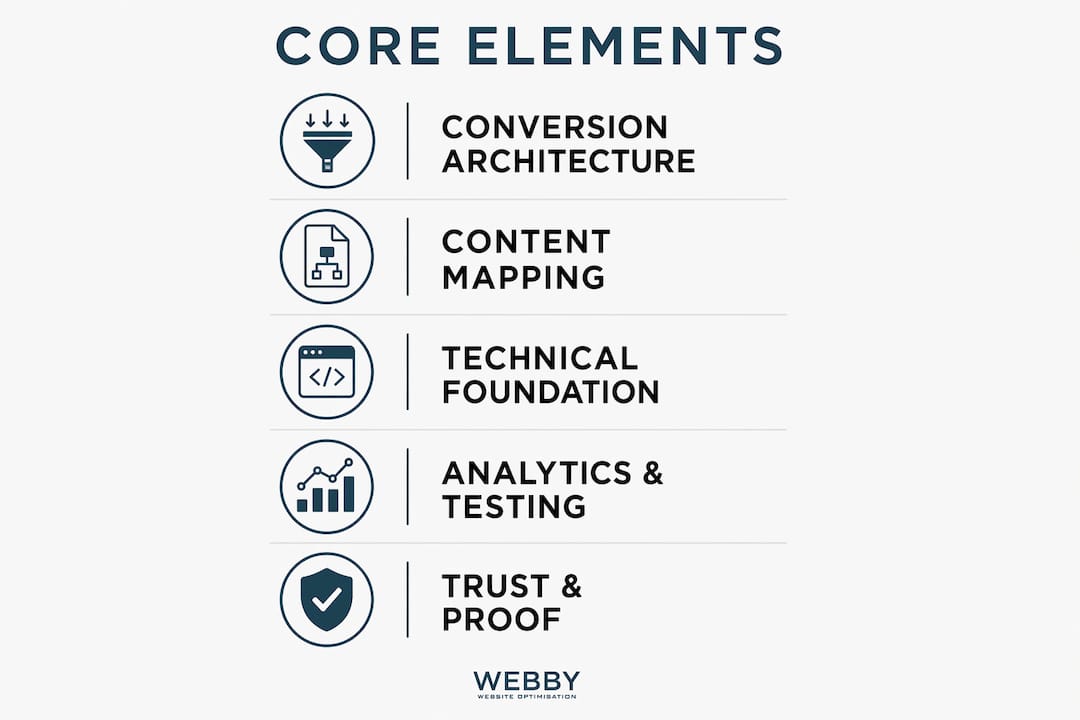
Conversion architecture means each page has one primary action. Your homepage drives visitors to a consultation or quote form. Your service pages answer the specific objections buyers have at that stage. Progressive disclosure — showing the right information at the right moment rather than dumping everything upfront — reduces friction and keeps visitors moving forward.
Content mapped to intent separates research-stage content (blog posts, FAQs, comparison guides) from conversion-stage content (service pages, case studies, pricing). FAQ schema markup helps your answers appear in Google’s featured snippets and AI-generated responses, which matters more every month.

Technical foundation is non-negotiable before anything else. Core Web Vitals, mobile-first indexing, descriptive anchor text, and structured markup affect both user experience and how search and AI engines surface your content. Fix these before you redesign anything visual.
Analytics and testing close the loop. Event tracking, conversion funnels, heatmaps, and session recordings (tools like Microsoft Clarity or Hotjar work well here) tell you where visitors drop off and what to test next. A/B testing even one element per month compounds quickly.
Trust and proof need to be specific. Original case data — real client results, specific numbers, before-and-after comparisons — outperforms generic testimonials in the era of AI-generated content. Visitors can smell a stock quote from a mile away.
| Element | Practical Benchmark |
|---|---|
| Conversion rate (B2B service) | 1–3% average |
| Page load time (mobile) | Under 3 seconds |
| Launch pad build time | 60 days |
| A/B test cadence | At least one test per month |
Pro Tip: Prioritize technical hygiene and one clear CTA before investing in content or design polish. A fast, focused page with one goal consistently outperforms a beautiful page with five.
How to tell if your current website is growth-focused
Run this quick audit before spending another dollar on ads or content.
Checklist:
- Every key page has a single, visible CTA above the fold
- Google Analytics (or equivalent) is tracking goal completions, not just sessions
- You know your baseline conversion rate by channel (organic, paid, referral)
- At least one page is mapped specifically to a buyer who is ready to purchase
- You’ve run at least one A/B test in the last 90 days
Key metrics and sample targets:
| Metric | Starter Target | Strong Performance |
|---|---|---|
| Website conversion rate | 1–2% | 3%+ |
| Leads per month (organic) | Baseline established | Month-over-month growth |
| Traffic-to-lead velocity | Measured | Improving quarter over quarter |
| A/B test frequency | Monthly | Bi-weekly |
The math on compounding is worth pausing on. A site converting at 1% that improves to 1.5% over six months has added 50% more leads from the same traffic. No ad spend required. Small, strategic wins like a rewritten headline or a repositioned form produce exactly this kind of compounding effect.
First test to run this week: Pull your top three landing pages in Google Analytics. Check the conversion rate on each. The lowest-performing page with the most traffic is your first test candidate — rewrite the headline and CTA, then measure for two weeks.

The growth-driven lifecycle: launch fast, measure, and improve continuously
The biggest shift in thinking is this: a growth-focused website is never finished. It’s a product, not a project.
The launch pad approach gets you live with the essential 20% of features that deliver most of your user value, then uses real visitor behavior to decide what to build next. This matters because assumptions about what users want are almost always wrong until data proves otherwise.
Here’s how the ongoing cycle works:
- Plan: Review analytics, session recordings, and heatmap data to identify the highest-friction point in your funnel.
- Build: Design and implement one focused change — a new CTA, a rewritten hero section, a simplified form.
- Learn: Measure the result against your baseline for two to four weeks. Document what worked and why.
- Repeat: Feed the learning into the next cycle’s planning.
Growth-driven design launches a strategic site much faster than the average timeline for traditional redesigns. That’s not just faster — it means you’re collecting real user data six weeks earlier and making decisions based on evidence instead of guesswork.
Pro Tip: Use Microsoft Clarity (free) to record sessions and generate heatmaps before committing to any design change. Ten session recordings will show you more than a week of analytics reports.
Why most websites never become growth-focused
The obstacles are rarely technical. They’re organizational.
- One-off redesign mentality: The site gets rebuilt, everyone celebrates, and then nothing changes for three years. By month six, it’s already outdated.
- Vanity metrics as success signals: Traffic goes up, the team is happy, but leads are flat. Pageviews don’t pay invoices.
- Missing measurement from day one: If conversion tracking wasn’t set up at launch, you have no baseline. You’re optimizing blind.
- No one owns optimization: Design is the agency’s job. Content is marketing’s job. Testing falls through the gap between them.
- Over-building before validation: Spending months on features users don’t want, because no one checked with actual users first.
Pro Tip: Budget for ongoing optimization the same way you budget for rent. A fixed monthly allocation — even a modest one — spent on testing and iteration will outperform a single large redesign spend over a 12-month horizon.
Practical next steps: a 30/90/180-day action plan for small businesses
You don’t need a full rebuild to start moving toward a growth-focused site. Here’s a phased plan that works for most SMBs.
Days 1–30 (quick wins): Install Google Analytics 4 with goal tracking. Add or rewrite the primary CTA on your homepage and top service page. Run a Google PageSpeed Insights check and fix the top three speed issues. Identify your single highest-traffic, lowest-converting page.
Days 31–90 (launch pad): Build or refine one focused landing page per month, mapped to a specific buyer intent. Run one A/B test per month on your highest-traffic page. Map your existing content to buyer journey stages — research, consideration, decision — and fill the biggest gap. Check out small business marketing resources for content ideas that align with each stage.
Days 91–180 (compounding): Build an optimization backlog ranked by potential impact versus effort. Integrate your CRM with your contact forms so every lead is tracked from source to close. Start reporting on revenue attribution — which pages and channels are actually producing customers, not just clicks. Review marketing strategies for small business to connect your website improvements to broader growth goals.
Pro Tip: For low-cost testing, use Google Optimize or a simple two-URL split test with UTM parameters before investing in dedicated A/B testing software. Validate the hypothesis first, then invest in the tool.
Key Takeaways
A growth-focused website drives measurable leads and revenue through conversion architecture, continuous testing, and analytics — not through aesthetics alone.
| Point | Details |
|---|---|
| Definition | A growth-focused website is built to generate leads and revenue, not just to inform visitors. |
| Launch pad mindset | Build the essential 20% of features first, then validate with real user data before adding more. |
| Top metrics to track | Conversion rate (target 1%+), leads per month, and A/B test frequency (at least monthly). |
| Treat it as a living asset | Budget for ongoing monthly optimization cycles rather than periodic full rebuilds. |
| Webby Website Optimisation | Webby Website Optimisation builds and optimizes growth-focused sites for local service SMBs, from launch pad builds to ongoing conversion work. |
The part most SMBs get wrong about growth-focused websites
The conventional wisdom says: build a great website, then drive traffic to it. That framing puts all the pressure on the launch and almost none on what happens after.
What actually moves the needle is the opposite sequence. Launch something functional and focused, then let real user behavior tell you what to fix. The businesses that see compounding results aren’t the ones with the most polished sites at launch — they’re the ones running a test every month, reading their session recordings, and making one small, evidence-backed change at a time.
There’s also a persistent myth that growth-focused web design is expensive or complex. It doesn’t have to be. A single well-structured landing page with a clear CTA, proper tracking, and a fast load time will outperform a sprawling, beautifully designed site with no measurement in place. The professional website design benefits that actually matter aren’t visual — they’re structural and measurable.
The hardest part isn’t the technology. It’s committing to the process: treating your website as a product that gets better every month, not a project that gets finished and forgotten.
Ready to build a website that actually generates leads?
Most SMB websites look fine and do almost nothing. Webby Website Optimisation builds growth-focused websites for local service businesses — sites structured around your buyer’s journey, tracked from day one, and built to improve every month rather than sit static.
Whether you need a fast launch pad website or want to turn your existing site into a measurable lead source, the starting point is a straightforward audit of what’s working and what’s costing you leads right now. For businesses that need to move quickly, the website built in a day option gets you a focused, conversion-ready site without a months-long build process. Book a free audit with Webby Website Optimisation and get a clear picture of where your site stands.
Useful sources
- Growth-Driven Design: The Smarter Way to Build B2B Websites
- Growth-focused web design
- What is a Growth-Driven Website Design?
- Website growth strategy
- How to build a marketing-first website that attracts, converts & scales
- 2026 website growth blueprint: UX and SEO strategies for small brands
- How to Build a High Converting Website in 2026
- What is a Growth-Engine Website?
- Turn website visitors into leads: a local service guide
- Webby Website Optimisation