
So, you’re wondering how much to budget for a new website. It’s one of the first questions we get, and the honest answer is: it varies. For a professional small business website in Australia, you're generally looking at a range from $3,000 to $10,000.
What drives that cost? It all comes down to the complexity of the build, the features you need, and whether you start with a pre-existing template or go for a completely custom design from the ground up.
What Does a Professional Website Actually Cost in Australia
Before we get into the nitty-gritty, let's set some realistic expectations. Many business owners are surprised by the wide range of quotes they receive. Think of it like buying a car—you could get a reliable pre-owned model, a brand-new family sedan, or a high-performance luxury vehicle. Each serves a different purpose at a very different price.
This guide is here to give you a clear, no-nonsense overview of what to expect when investing in a professional WordPress site. Whether you need a simple online brochure or a sophisticated e-commerce platform, we'll give you a realistic picture of the costs involved so you know what you’re paying for.
A Look at Typical Price Points
Here in Australia, a quality website built for a small business typically falls somewhere between AUD $3,000 and $10,000. This is a great starting point for businesses in Perth and beyond looking for a solid online presence.
This range usually covers the essentials: a clean design, responsive layouts for mobile viewing, and basic on-page SEO. For example, a standard 6–10 page WordPress site often lands between $5,000 and $10,000, as other Australian agencies have noted in their own cost breakdowns.
You might see freelancers advertising lower rates, but a professional agency often justifies the higher end of the spectrum. Why? Because they're not just building pages; they're providing a complete service that includes strategy, security setup, performance optimisation, and ongoing support.
Your website is your hardest-working employee, and it’s always on the clock. Since 75% of users judge a business's credibility by its website design alone, investing in a professional build isn't just an expense—it's a critical investment in your brand's reputation.
Understanding the Investment
Getting your website right from the start pays off massively in the long run. A well-designed site isn't just a pretty face; it’s a powerful tool that can deliver a strong return on investment through better search rankings and more customer leads. To see what a comprehensive build looks like, you can explore our approach to https://www.webby.net.au/services/website-design-development/.
To get another perspective on budgeting, this guide on how much a website should cost in Australia is a great resource. Ultimately, knowing these price ranges helps you budget wisely and steer clear of cheap DIY solutions that often end up costing more in fixes and lost opportunities as your business grows.
The Three Main Ways Web Designers Charge
When you start shopping around for a new website, you'll quickly discover there’s no single price tag. Web designers and agencies charge for their work in a few different ways, and knowing the difference helps you find the right fit for your project and your wallet. It's a bit like hiring a builder: you can agree on a fixed price for the whole house, pay them by the hour, or keep them on a retainer for ongoing jobs.
Each model has its place, and the best one for you really depends on how clear your project plan is and what you need in the long run. Let's break down the three common pricing structures you'll find in Australia.
1. Fixed-Price Projects
This is the most common and straightforward way to buy a website. A fixed-price project is exactly what it says on the tin: you and the designer agree on a specific scope of work for a single, all-in price. Think of it like a set menu at a restaurant—you know exactly what you're getting and precisely what you'll pay.
This approach works brilliantly when you have a solid idea of what you want and a clear list of must-haves. The agency will give you a detailed proposal that spells out every deliverable, from the number of pages and specific features right down to the project timeline.
- Best for: Businesses with a well-defined scope and a firm budget.
- Pros: You get complete cost certainty. No surprise invoices, as long as the project doesn't change from what was agreed upon.
- Cons: It’s not very flexible. If you suddenly decide you need a new feature halfway through, that's a new quote and will likely push back your launch date. This is what we call "scope creep."
2. Hourly Rates
Charging by the hour is more like a taxi meter—you pay for the exact time your designer spends on the job. This offers a ton of flexibility and is perfect for tasks where the scope is a bit hazy or hard to pin down from the start. It’s a common model for website repairs, small updates, strategy sessions, or ongoing development where things might change as you go.
Plenty of Australian freelancers and agencies offer hourly rates, especially for smaller jobs or ad-hoc support. The key to making this work is trust and good communication, so you should expect regular timesheets or updates on how the hours are being used.
An hourly model can be super efficient for specific, targeted tasks. For a full website build, though, it can be a bit risky without a clear budget cap. Costs can climb quickly if the project grows bigger than you first planned.
3. Monthly Retainers
Think of a monthly retainer as your subscription to ongoing website success. With this model, you pay a set fee each month for an agreed-upon block of hours or a specific list of services. It’s the ideal setup for businesses that know they'll need continuous support, maintenance, and help with growing their online presence after the site goes live.
This isn’t just about having someone on call to fix things when they break; it's about forming a proactive partnership.
A retainer can cover all sorts of important jobs:
- Regular Maintenance: Keeping your WordPress software, theme, and plugins updated and secure.
- Performance Tweaks: Making sure your site stays quick and runs smoothly.
- Content Updates: Adding new blog posts, team photos, or service pages.
- SEO & Analytics: Ongoing work to improve your search engine rankings and reporting on your traffic.
- Small Development Jobs: Adding a new button here or a small feature there.
This model shifts the relationship from a one-off contractor to a long-term technical partner who's genuinely invested in your growth. It’s peace of mind, plain and simple, knowing an expert is consistently looking after your most valuable digital asset.
What Actually Drives Your Website Design Cost?
Ever wondered why one website quote comes in at $5,000 while another, which looks pretty similar on the surface, is $25,000? The gap isn't random. It’s all about what's going on "under the bonnet" – the specific, measurable factors that add genuine value and functionality to your site.
Getting your head around these key drivers is the first step to setting a realistic budget and having a productive chat with a web design agency.
Think of it like building a house. A standard three-bedroom home has a baseline cost. But start adding a custom-designed kitchen, an extra bathroom, imported marble benchtops, and a full smart home system, and the price tag will climb. Websites are exactly the same. The more custom features you add, the more it shapes the final price.
This infographic breaks down the common ways agencies structure their pricing, which usually ties directly back to the complexity of the project.
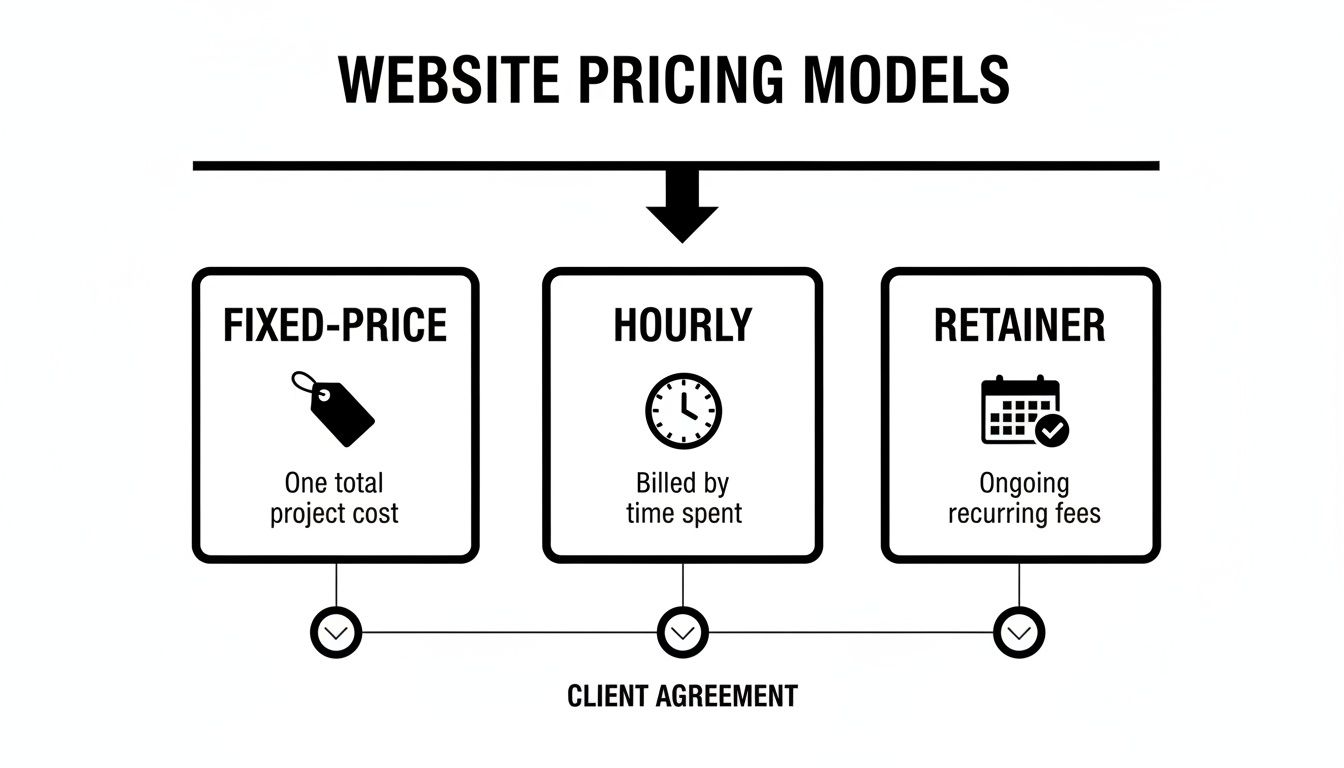
Whether it’s a Fixed-Price, Hourly, or Retainer model, the choice often depends on the very factors we’re about to dive into.
Project Scope: The Foundation of Your Quote
The most direct influence on your quote is the sheer size of the project. It's simple, really: a bigger site with more pages and unique sections just takes more time and resources to design, develop, and fill with content.
Here’s what we mean by scope:
- Number of Pages: A basic five-page "brochure" site (think Home, About, Services, Blog, Contact) is going to cost far less than a 30-page corporate site with detailed service breakdowns, individual team profiles, and an extensive project gallery.
- Unique Page Layouts: Are all your service pages going to look the same, just with different text? Or does each one need a completely unique design to properly showcase what you do? More custom layouts mean more design and development hours.
- Content Creation & Migration: Are you handing over all the final text and images, ready to drop in? Or do you need help with professional copywriting, sourcing high-quality images, or moving hundreds of old blog posts from your previous site? These are all time-consuming tasks that add to the scope.
Design Complexity: From Template to Tailor-Made
Design is so much more than just making things look pretty. It’s about creating a memorable and effective user experience that reflects your brand. The level of customisation you need here is a massive factor in the final cost.
A website built from a pre-made template is like buying a suit off the rack. It’s quick, it’s affordable, and it does the job. But it probably won’t be a perfect fit.
A fully custom design, on the other hand, is like getting a suit tailor-made. It’s crafted from scratch just for your brand, built to meet your specific business goals, and designed to make a lasting impression.
While templates can get you online fast, a custom design almost always delivers a better user experience and a much stronger brand identity. Investing in a unique look directly impacts how customers see your business’s credibility.
This is where the expertise of a skilled designer truly shines. They’re not just picking colours; they’re creating custom graphics, clever interactive elements, and intuitive user journeys that guide visitors towards a specific goal. That kind of bespoke work requires strategy, creativity, and technical know-how, which is naturally reflected in the price.
E-commerce Functionality: The Online Storefront
If you’re planning to sell products or services directly from your website, you're stepping into the world of e-commerce. This adds a whole new layer of complexity and, therefore, cost. It’s not just about adding a "Buy Now" button; it's about building a secure, reliable, and user-friendly online store.
The investment for an e-commerce site will scale based on things like:
- Number of Products: A shop with 10 simple products is worlds away from setting up a store with 1,000 products, each with different variations like size and colour.
- Payment Gateway Integration: We need to securely integrate trusted payment systems like Stripe, PayPal, or Afterpay.
- Shipping and Inventory: Do you just need a simple flat-rate shipping option, or a complex system that calculates live rates based on weight and location? Does the site need to sync with your inventory management software?
- Customer Accounts: Allowing customers to create accounts to see their order history and save payment details is a great feature, but it adds significant development work.
Each of these features transforms your website from a simple information hub into a dynamic, interactive sales platform. Building it properly requires a larger investment to get it right from the start.
How to Read a Quote and Compare Design Packages
Getting your first website design quote can feel like trying to read a foreign language. You’re faced with a wall of line items, technical jargon, and different package options, making it tough to know if you're getting a fair price. How do you even know what good value looks like?
Let’s demystify the whole process. I’ll show you how to break down a proposal line by line, compare different packages, and spot the red flags that point to a vague plan. The goal is to help you find a transparent partner who’s setting you up for success, not for a surprise bill down the track.
Understanding What a Good Quote Includes
A professional, detailed quote is more than just a price tag; it's a blueprint for your project. It should give you absolute clarity on what you’re paying for.
Be wary of vague, one-line quotes like "Website Design - $5,000". That’s a massive red flag. It leaves far too much room for misunderstandings about what’s included and what’s going to cost you extra later on.
A solid quote will always have a clear breakdown of everything involved. You should be looking for specific line items that outline each phase of the project.
Here are the key things to look for:
- Design & Development Phases: The quote should map out the entire journey, from the initial strategy and wireframing sessions through to the visual design mockups, development, and testing.
- Number of Pages & Unique Templates: It needs to state exactly how many pages are included (e.g., Home, About, Services, Contact) and how many unique page layouts will be designed from scratch.
- Content Integration: Does the price cover loading all your supplied text and images onto the pages? Or does it include migrating content from an old site? This needs to be spelled out.
- SEO Foundations: A good partner will always include the essential on-page SEO setup, like optimising your title tags, meta descriptions, and images right from the start.
- Training & Handover: You absolutely should get training on how to use your new website’s backend so you can make simple updates yourself without having to call a developer.
Getting a feel for the typical structure of a project is a great first step. To see how we map out our projects from start to finish, you can learn more about the Webby design and development process in our detailed guide.
Comparing Different Design Packages
To help you make sense of website design pricing, it’s useful to see what you can generally expect at different investment levels. Most designers and agencies bundle their services into packages designed for businesses at different stages of growth. While the specifics will vary, they usually follow a logical progression of features and complexity.
To give you a clearer picture, I've put together a table comparing typical package structures, from a simple starter site to a complex, custom-built solution. This should help you benchmark the quotes you receive and figure out which one aligns best with your business goals.
Comparing Sample WordPress Design Packages
Here’s an overview of what to expect from different website design packages to help you choose the right fit for your business needs and budget.
| Feature | Basic Business Package | Advanced E-commerce Package | Custom Solution Package |
|---|---|---|---|
| Ideal For | Startups, local services | Growing online retailers | Established businesses with unique needs |
| Design Approach | Premium template customisation | Customised e-commerce design | Fully bespoke, from-scratch design |
| Pages Included | 5-10 pages (e.g., Home, About) | 15-25 pages + unlimited products | Unlimited, based on strategic requirements |
| Key Functionality | Contact form, blog, gallery | Secure payments, shipping, accounts | Custom features, API integrations, portals |
| SEO Setup | Basic on-page essentials | Advanced product & category SEO | Comprehensive technical & content strategy |
| Post-Launch Support | 14-30 days of email support | 30-60 days of priority support | Dedicated retainer & growth plan |
This table gives you a solid baseline for comparison. Remember, the goal is to find the package that doesn't just fit your budget today, but also supports where you want your business to be tomorrow.
When you're comparing quotes, try to look beyond the final number. A cheaper quote might seem appealing at first, but it could be missing critical elements like mobile optimisation, security setup, or any post-launch support. Fixing those things later will almost certainly cost you more. A transparent, detailed proposal is a sign of a professional who is genuinely committed to your project’s success.
Planning for Ongoing Website Costs After Launch
Popping the champagne on your website launch is a fantastic feeling, but it’s the start of the race, not the finish line. For your new digital home to keep performing, attracting customers, and staying safe, you need to budget for what comes next.
Too many business owners get fixated on the upfront design price, only to be surprised by the recurring costs needed to keep the site running well. Factoring these in from day one means you’ll have a realistic, sustainable budget for your online presence. Let's look at the essential investments you’ll need to make after your site goes live.
Secure Hosting: The Foundation of Your Website
Think of your website as your shiny new shopfront and the domain name as its street address. Well, website hosting is the piece of land it’s built on. It’s the physical server space where all your website’s files and data live, making sure people can visit it 24/7.
You simply can't have a website without hosting, but the quality can vary wildly. While cheap, shared hosting exists, a proper managed hosting plan gives you serious advantages that are well worth the investment.
- Better Performance: These servers are specifically tuned for platforms like WordPress, which means your site will load much faster.
- Enhanced Security: The provider actively scans for threats, sets up firewalls, and handles all the tricky security stuff for you.
- Automatic Backups: Your site is copied regularly, so if the worst happens, you can restore it in a flash.
- Expert Support: You get direct access to tech experts who know what they’re doing when server issues pop up.
For any serious business, good hosting isn't negotiable. A slow or offline website will cost you sales and hurt your reputation, not to mention your search engine rankings.
Maintenance Plans: Your Digital Insurance Policy
A website isn't a brochure that you can just print and forget about. It's more like a car; it needs regular tune-ups to keep running smoothly and securely. This is exactly what a website maintenance plan does—it's your insurance policy against hackers, bugs, and performance slowdowns.
A solid maintenance plan takes care of several critical tasks that protect your investment.
Neglecting website maintenance is one of the costliest mistakes a business can make. Outdated software is the number one backdoor for hackers, and a single security breach can lead to days of downtime, lost income, and a badly damaged brand.
A comprehensive plan involves regular updates and checks on all your site's core parts. For businesses that depend on their website, our guide on WordPress help and support dives deeper into how this proactive care prevents major headaches down the road. It’s the best way to get peace of mind.
Other Recurring Costs to Consider
Beyond the big two of hosting and maintenance, a few other ongoing costs might pop up in your budget. These usually depend on the specific tools and growth strategies you’ve chosen for your business.
- Premium Plugin Licences: Many of the best WordPress plugins—for e-commerce, bookings, or fancy forms—require an annual fee to keep getting updates and support.
- SEO and Digital Marketing: If you want to actively grow your traffic, you’ll likely invest in ongoing Search Engine Optimisation (SEO), content writing, or paid ad campaigns.
- Email Marketing Services: Platforms like Mailchimp or Campaign Monitor charge monthly or yearly based on how many subscribers you have.
- Security Subscriptions: You might opt for extra protection, like advanced firewalls or malware scanners, which often have their own annual renewal fees.
Budgeting for these ongoing expenses from the get-go ensures your website remains a powerful, secure, and valuable asset for your business long after launch day.
How to Budget Smartly and Get the Best Value
Building a brilliant website isn't about throwing endless money at it. Smart budgeting is less about finding the cheapest price tag and more about investing shrewdly to get the best possible return for your business. The trick is to tie every dollar you spend directly to a business goal, not just to a wish list of cool features.
First things first: get crystal clear on what you actually need your website to do. Is its main job to make the phone ring? To sell products directly from the site? Or is it to establish you as the go-to expert in your field? Knowing your primary goal helps you filter the absolute must-haves from the nice-to-haves. This clarity is your best friend for keeping initial costs in check while still planning for future growth.
Define Your Priorities: Must-Haves vs. Nice-to-Haves
Before you even think about getting a quote, grab a pen and paper and draw a line down the middle. On one side, list your "must-haves". These are the non-negotiable features your site needs to function from day one. Think of things like a simple contact form, a gallery showcasing your work, or a few pages clearly explaining your services.
On the other side, jot down the "nice-to-haves". This is for the bells and whistles you'd love to add down the track—maybe a sophisticated online booking system, a client login area, or a blog. This simple exercise forces you to focus on what delivers immediate value, keeping your initial website design pricing from spiralling out of control.
The best website projects I've ever seen started with a strong, focused foundation and grew from there. A classic rookie mistake is trying to build everything you can possibly imagine right out of the gate. That just inflates costs and delays your launch. It's much better to start lean, get your site live, and let real customer feedback tell you what to invest in next.
Asking the Right Questions
When quotes start landing in your inbox, it's easy to fixate on the final number. But you need to shift your thinking from the upfront cost to the long-term value. A cheap quote today can become very expensive tomorrow if you're constantly paying for fixes, missing out on sales, or having to add essential features that were overlooked. To budget smartly and get the best value, it's also helpful to understand the costs of different components, like various form builder pricing plans.
Here are a few crucial questions to ask any potential web designer or agency to see what you're really getting for your money:
- How will this website directly help me achieve [your specific business goal]? A true partner should be able to draw a straight line from every feature back to your objectives.
- What’s included in your process besides the design itself? You’re looking for answers that include strategy, initial SEO setup, speed optimisation, and handover training.
- What does your post-launch support look like? Knowing their maintenance and support options helps you plan for ongoing costs and avoid nasty surprises.
By asking these kinds of questions, you change the conversation from "How much will it cost?" to "What return will I get on this investment?". This mindset helps you find a partner who wants to build a growth engine for your business, not just a pretty online brochure. Your website is a long-term asset, and a smart investment from the get-go is the surest way to get it right.
Answering Your Website Pricing Questions
Trying to get a straight answer on website pricing can feel like a maze. There are so many moving parts, and every designer seems to quote differently. To clear things up, we've put together some no-nonsense answers to the questions we hear most from Australian business owners.
What Should a Small Business Website Actually Cost?
For a solid, professional website for a small business here in Australia, you should budget somewhere between $3,000 and $10,000. That's the typical ballpark for a well-built, mobile-friendly site with around 5-10 core pages – think Home, About, Services, Blog, and a Contact page.
Where you land in that range really comes down to the specifics. A clean, simple "brochure" style website using a high-quality template will sit at the lower end. If you’re after a more custom design, unique page layouts, or special features like a slick photo gallery or an integrated booking system, you’ll be moving toward that higher figure.
Why Is There Such a Huge Difference in Quotes?
It’s true. You can find someone on a freelance site to build a site for a few hundred bucks, while a top-tier agency might quote you tens of thousands. The massive gap isn't arbitrary; it boils down to experience, the process they follow, and what’s actually included in the price.
- Experience & Expertise: An agency or designer with a decade of experience and a portfolio of successful projects simply brings more to the table. They’re not just building pages; they're providing strategic advice to make sure your website actually helps grow your business. You're paying for that insight.
- The Process: A cheap quote often means someone is just picking a template and dropping your content in. A proper, professional process involves discovery and strategy, wireframing layouts, custom design work, careful development, and thorough testing. It takes more time, but the end result is infinitely better.
- What's Included: Rock-bottom prices often have hidden gaps. Things like basic SEO setup, proper security hardening, or any kind of training and support are usually missing. A higher price tag generally means you're getting a complete package that sets you up for success from day one.
A cheap website often ends up being the most expensive mistake you can make. When you add up the costs of fixing shoddy work, lost sales from a bad user experience, and eventually having to rebuild it properly, investing in quality from the start is always the smarter move.
Do I Need to Pay for the Whole Thing Upfront?
Absolutely not. In fact, if a designer asks for 100% upfront, you should see that as a red flag. The industry standard is to break the payment down into stages, which protects both you and the developer.
A very common structure is a 50% deposit to get the project started, with the final 50% payable once you've approved the finished site, just before it goes live.
For bigger, more involved projects, this might be broken down even further to align with major project milestones. For instance:
- 40% Deposit: Secures your spot in their schedule and covers the initial design phase.
- 30% Mid-Project: Paid once the design mockups are approved and before the coding begins.
- 30% Final Payment: Due upon completion, right before your new site is launched to the world.
This approach keeps things fair and transparent. You're paying for work as it's delivered, and it helps the agency manage its workflow. Just make sure these payment terms are clearly spelled out in your contract before you sign anything.
Your website is a valuable business asset, and like any asset, it needs regular care to keep performing well. From security patches to speed optimisations, Webby Website Optimisation offers expert WordPress care to protect your investment. Check out our flexible WordPress help and support plans to keep your site secure, fast, and firing on all cylinders.