

When you first start selling on eBay Australia, the fee structure can feel a bit like a maze. But figuring out these costs is the most important step you can take to make sure your online business actually turns a profit. The main culprits are the Final Value Fee, a small fixed order fee, and sometimes an insertion fee just to list your item.
Getting a handle on these core ebay au fees is your first real test as a seller.
Your Quick Guide to Understanding eBay Australia Fees
Think of eBay's fees as a puzzle. It might seem complicated at first, but once you see how the pieces fit together, it all makes sense. The costs aren't just a single charge; they're a mix of different fees that depend on what you sell, the category you list it in, and how you choose to promote it.
My goal here is to give you the practical knowledge you need to see through the complexity. We'll break it all down so you can calculate your real costs and price your products properly, protecting your profit margins from day one.
The Core Fee Structure
For Aussie sellers, the fee system has shifted over the years. Right now, most sellers are on a tiered final value fee model. As of 2026, this is how it works: you'll pay 13.4% on the first AU$4,000 of the total sale price. For any amount above that, the fee drops right down to 2.4%. There's also a cap, so you'll never pay more than AU$440 for a single item.
This structure really matters for small business owners, whether you're in Perth or Sydney. Those initial higher fees can definitely put a squeeze on your margins, especially for popular, lower-priced items.
So, let's look at the main components you’ll encounter with every sale:
- Insertion Fees: This is simply the cost to create a listing. eBay gives you a generous number of free listings each month, but once you use them up, you'll pay a small fee for each new one.
- Final Value Fee (FVF): This is the big one. It's a percentage taken from the total amount the buyer pays, which includes both the item price and any postage and handling charges.
- Fixed Order Fee: A small, flat charge of $0.30 (including GST) that gets added to every single transaction, no matter the sale price.
To give you a clearer picture, we’ve put together a quick reference table of the main fees you'll come across.
Quick Summary of Core eBay AU Fees (2026)
This table offers a high-level look at the primary fees you'll face on eBay Australia. Use it as a quick cheat sheet to help estimate your costs before you list an item.
| Fee Type | What It Is | Typical Rate |
|---|---|---|
| Insertion Fee | The cost to list an item on the platform. | Often $0, as most sellers get 250+ free listings per month. Can be up to $0.55 per listing after that. |
| Final Value Fee (FVF) | A percentage of the total sale amount, including postage. | 13.4% on the first $4,000, then 2.4% on the portion above $4,000 (capped at $440). |
| Fixed Order Fee | A flat fee charged per order, regardless of the item's value. | $0.30 (incl. GST) per order. |
Keep in mind that these are the standard rates. Your final fees can change slightly based on the item category, your store subscription level, and whether you use optional promotional tools.

It’s always a smart move to see how eBay stacks up against other platforms. To get a feel for how different marketplaces compare, an analysis like eBay vs Craigslist: The Ultimate Reseller Showdown can provide some valuable context and help you decide if eBay is the right fit for what you're selling.
The Three Main Fees Every eBay Seller Needs to Know
When you first start selling on eBay Australia, getting your head around the fees can feel a bit overwhelming. But really, it all boils down to three core charges that pop up on almost every sale. Getting to know these is the first step to pricing your items correctly and making sure you’re actually turning a profit.
Think of it like this: eBay charges you for listing your item, for successfully selling it, and a tiny bit for processing the order. Let's break down exactly what these are and how they work.
H3: The Insertion Fee: Your 'Cost to List'
First up is the Insertion Fee. This is simply the cost to put your item up for sale on the marketplace. It's like paying for a classified ad in a newspaper – you pay just to have it listed.
The good news? Most sellers hardly ever pay this fee. eBay gives every seller a generous number of free listings each month, typically 250 or more if you don’t have an eBay Store subscription. You only start paying an insertion fee (usually around $0.55) after you’ve used up that free monthly allowance.
H3: The Final Value Fee: The Big One
The Final Value Fee (FVF) is the main fee you'll encounter and it's where most of your costs will come from. This is eBay's commission for helping you find a buyer. It's a percentage of the total amount the buyer pays you.
And that's a really important point. The FVF isn’t just based on the item’s price. It’s calculated on the entire transaction, which includes:
- The final sale price of the item
- Any postage and handling costs you charge
- GST on top of those amounts
This stops sellers from gaming the system by listing an item for $1 with $99 postage to dodge fees. For most product categories, the standard FVF is 13.4% on the first $4,000 of the total sale, then it drops to 2.4% for any amount over that.
Here's a quick example. Say you sell a pair of shoes for $100 and charge $15 for postage. Your FVF won't be calculated on the $100 item price. It will be based on the full $115 your buyer paid, making the fee $15.41 (which is 13.4% of $115).
Just be aware that some specific categories, like car parts or heavy machinery, often have different FVF rates, so it’s always smart to double-check the fee schedule for what you're selling.
H3: The Fixed Order Fee: The Final Little Bit
Lastly, there's the Fixed Order Fee. This is a small, flat charge of $0.30 (including GST) that gets added to every single order you process through eBay's payment system.
It doesn’t matter if you sell a $5 phone case or a $500 drone; that $0.30 fee applies. While it seems insignificant, it can definitely add up, especially if you sell a high volume of low-cost items. One way to manage this is to encourage customers to bundle items, since you only pay the fee once per order, not per item.
Optional Fees For Boosting Your Sales
Once you’ve got a handle on the basic costs, it’s time to look at the optional tools eBay offers to seriously boost your sales. These aren’t just extra expenses; think of them as smart investments to get your products seen and sold faster.
The two main levers you can pull are eBay Store subscriptions and Promoted Listings. One is designed to save you money as your business grows, while the other puts your products right under the noses of keen buyers. Knowing which one to use, and when, can make a huge difference to your visibility and your bottom line.
Is an eBay Store Subscription Worth the Cost?
Think of an eBay Store subscription as getting a bulk discount for being a regular, high-volume seller. You pay a flat monthly fee, and in return, eBay gives you a much bigger bucket of free listings and, crucially, lower Final Value Fees. For anyone with a decent amount of stock, the savings can easily cover the subscription cost and then some.
In Australia, eBay offers three main tiers to choose from:
- Basic Store: This is perfect for small businesses that are starting to see real momentum. You get more free listings and a nice little discount on your Final Value Fees.
- Feature Store: Built for established businesses with consistent sales. The fee discounts get more attractive, and you also unlock extra marketing tools to play with.
- Anchor Store: The top-tier package for serious, high-volume sellers. It gives you the lowest possible fees and access to dedicated support.
The real trick is figuring out your break-even point. Add up what you’re currently forking out for insertion fees each month and the extra slice the standard Final Value Fees are taking. If a store subscription costs less than what you’d save, it’s a no-brainer.
A Basic Store usually starts making financial sense once you’re listing more than 250 items a month. At that point, the money you save on insertion fees alone often pays for the subscription, making the lower Final Value Fees pure profit.
Demystifying Promoted Listings
Promoted Listings are simply eBay’s in-house advertising platform. It’s a way to pay to push your items to the top of search results and other prime real estate on the site. There are two very different ways to pay for this, and understanding them is key to keeping your ad spend under control.
Promoted Listings Standard
The Standard model works a bit like selling on consignment. You set an "ad rate"—a percentage of the item's final sale price—that you’re happy to pay only if someone clicks your promoted ad and buys the item within 30 days. You don’t pay a cent if it doesn’t sell through the ad.
This makes it a fantastic, low-risk way to get more eyes on your products. Since you only pay for a confirmed sale, you're not gambling with your budget. You set the rate, so you have complete control over how much margin you're willing to give up for that extra sale.
Promoted Listings Advanced
On the other hand, the Advanced option is a classic pay-per-click (PPC) system. It’s like buying ad space on a busy digital highway; you pay every time someone clicks your ad, whether they end up buying or not. With this model, you bid against other sellers to get your listings into the most visible spots, including the coveted top slot in the search results.
This is a much more aggressive strategy and requires you to keep a close eye on your budget. It works best for in-demand, competitive products where grabbing that top spot can directly lead to a surge in sales. But be warned: if you're not careful, the costs can add up quickly.
Hidden Costs That Can Chip Away at Your Profits
Once you've wrapped your head around the main eBay fees, it's time to look out for the other charges—the ones that can quietly eat into your margins if you're not paying attention. These are the penalties and surcharges that often catch sellers by surprise, turning what looked like a great sales month into a disappointing one.
Getting these under control isn't just about selling more; it's about running a tight ship. A few small slip-ups with customer service or shipping can quickly add up to real costs that hit your bottom line directly.
The Below Standard Seller Penalty
The biggest and most painful hidden cost is the Below Standard seller penalty. This isn't a fee for one mistake; it's a hefty surcharge eBay applies to all your sales if your seller performance drops below their minimum standards. Think of it as a tax for providing a poor customer experience.
So, how do you end up with a 'Below Standard' rating? It usually comes down to a few key areas:
- High transaction defect rate: This is often from cancelling sales because you've run out of stock.
- Late shipment rate: Not getting your items in the post within your stated handling time.
- Cases closed without seller resolution: This happens when a buyer has a problem, you can't solve it, and eBay has to step in and fix it for them.
If your account gets flagged as 'Below Standard', eBay will tack on an extra fee to your final value fees for the entire next calendar month. This penalty can be brutal, especially for Australian sellers.
The performance penalty on eBay Australia is a whopping 5.5% on top of your regular final value fees. For example, a standard 13.4% fee could suddenly become an 18.9% charge on sales up to AU$4,000. That kind of jump can completely wipe out your profit on a sale. You can read more about how these penalties were introduced over on LinkMyBooks.
Other Sneaky Fees to Watch For
While the 'Below Standard' penalty is the one to fear most, a few other charges can pop up on your invoice if you're not careful.
- International Selling Fee: Selling to someone overseas? If your registered address is in Australia and the buyer's delivery address is outside Australia or New Zealand, eBay adds an extra fee, typically 1.76%. You absolutely need to build this into your international pricing strategy.
- Dispute Fee: If a buyer opens a payment dispute with their bank (like a credit card chargeback) and you end up losing the case, eBay will hit you with a $22 (incl. GST) dispute fee. This is charged on top of the refund you have to issue. The best defence here is great service, tracked shipping, and responding to buyer claims immediately.
- High-Volume Listing Fees: You get a generous number of free listings each month. However, if you have a massive inventory and aren't on an Anchor Store subscription, you might face extra insertion fees once you burn through your free allocation.
The good news is that most of these costs are entirely avoidable. By keeping your customer service standards high, shipping everything on time, and managing disputes properly, you can keep these profit-draining fees from ever appearing on your invoice. To get a better handle on payment-related charges, have a look at our detailed guide on e-commerce merchant and gateway rates for Australian businesses.
Calculating Your Fees With Real-World Examples
Alright, let's get practical. Theory and percentages on a webpage are one thing, but seeing how eBay AU fees actually eat into your sale price is what really matters. To bring this to life, we'll walk through three common scenarios for Australian sellers.
Think of these as templates. Once you see how the numbers work, you can plug in your own item prices and shipping costs to get a clear picture of your potential profit before you even create a listing.
H3: Scenario 1: Private Seller Selling Used Electronics
Let's start with a classic situation: you're a casual seller, maybe decluttering the house. You decide to sell a used video game console for $250 and plan to charge the buyer $20 for postage. Since you're not a business, you're using one of your 250 free monthly listings.
Here’s how the fees stack up:
- Total Sale Amount: $250 (Item Price) + $20 (Postage) = $270
- Insertion Fee: $0 (you’ve used a free listing allocation)
- Final Value Fee (FVF): 13.4% of the $270 total = $36.18
- Fixed Order Fee: $0.30
Your total fees come to $36.48. When all is said and done, eBay will pay out $233.52 from the initial $270 transaction.
H3: Scenario 2: Basic Store Owner Selling Fashion
Now, let's switch gears to a small business with a Basic eBay Store subscription, specialising in fashion. You sell a dress for $80 and add $10 for shipping. The big advantage here is that a store subscription gives you a discount on the Final Value Fee – in the fashion category, it's typically around 1.3% lower.
Let’s run the numbers:
- Total Sale Amount: $80 (Item Price) + $10 (Postage) = $90
- Insertion Fee: $0 (store subscribers get thousands of free listings)
- Final Value Fee (FVF): 12.1% (the standard 13.4% minus your 1.3% discount) of $90 = $10.89
- Fixed Order Fee: $0.30
Here, the total fees are just $11.19, leaving you with a net payout of $78.81. On a single sale, that store subscription is already saving you real money.
While we're talking about fees, it's important to remember that there are other costs that can appear if you're not careful. These aren't your everyday transaction fees but penalties that can sting if you're caught off guard.
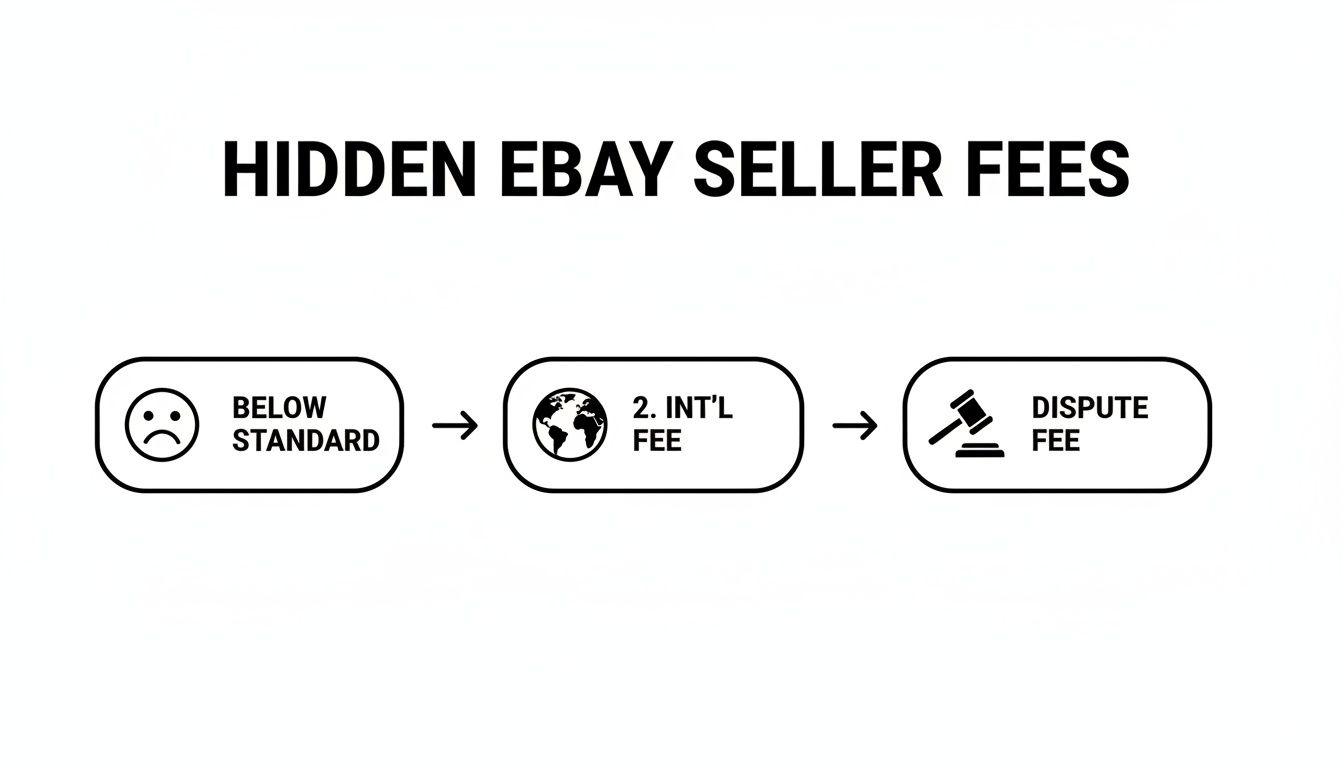
This flowchart shows how things like dropping to a 'Below Standard' seller level, making international sales, or facing payment disputes can add another layer of costs on top of the basics. Staying on top of your seller performance is key to avoiding these.
H3: Scenario 3: Promoted Item for Home Goods
Finally, let's look at a seller who's ready to grow. You're selling a competitive item—a set of designer cushions—for $120 with free shipping (which costs you $15 out of pocket). To get an edge, you use Promoted Listings Standard and set a 6% ad rate.
A buyer clicks your promoted ad and makes the purchase. This is how the multiple fees are calculated:
- Total Sale Amount: $120
- Insertion Fee: $0 (assuming you have a store or free listings left)
- Final Value Fee (FVF): 13.4% of $120 = $16.08
- Promoted Listing Fee: 6% of $120 = $7.20
- Fixed Order Fee: $0.30
The combined fees total $23.58. After you subtract that and your $15 actual shipping cost, your net profit on the $120 sale is $81.42.
The following table neatly compares these three scenarios, showing exactly how the final payout is affected by your seller status and strategy.
Fee Calculation Breakdown by Seller Scenario
| Fee Component | Scenario 1: Private Seller (Electronics) | Scenario 2: Basic Store (Fashion) | Scenario 3: Promoted Item (Home Goods) |
|---|---|---|---|
| Item Price | $250.00 | $80.00 | $120.00 |
| Postage Charged | $20.00 | $10.00 | $0.00 (Free Shipping) |
| Total Sale Amount | $270.00 | $90.00 | $120.00 |
| Insertion Fee | $0.00 | $0.00 | $0.00 |
| Final Value Fee (FVF) | $36.18 (13.4% of $270) | $10.89 (12.1% of $90) | $16.08 (13.4% of $120) |
| Fixed Order Fee | $0.30 | $0.30 | $0.30 |
| Promoted Listing Fee | $0.00 | $0.00 | $7.20 (6% of $120) |
| Total eBay Fees | $36.48 | $11.19 | $23.58 |
| Actual Shipping Cost | (Paid by buyer) | (Paid by buyer) | $15.00 |
| Net Payout | $233.52 | $78.81 | $81.42 |
As you can see, the final amount that lands in your bank account can vary dramatically. It's crucial to do these sums before you list, not after, to ensure every sale is a profitable one.
Proven Strategies To Cut Down Your eBay AU Fees
Paying fees is just part of the game when you're selling on eBay. But while you can't avoid them entirely, you can absolutely stop overpaying. Smart, proactive sellers know that a few key decisions can seriously trim their eBay AU fees, leaving more cash in their bank account after each sale.
This isn't about finding secret loopholes. It's about understanding how the system works and using it to your advantage. By thinking ahead—before you even list an item—you can actively lower your costs and boost your profitability. From your store setup to your shipping options, every choice matters.
Choose the Right Store Subscription
If you’re consistently listing more than 250 items a month, getting a Basic eBay Store subscription is almost a no-brainer. The monthly fee is usually much less than what you'd spend on individual insertion fees, but that's not even the best part.
The real win comes from the lower Final Value Fees (FVFs) that store subscribers get. A 1.3% discount on the FVF in a popular category like fashion might not sound like much, but when you multiply that across hundreds of sales, the savings really start to stack up. Do a quick calculation of your monthly listing volume and FVF costs—you might find a store subscription is the easiest first step to saving money.
Earn Top Rated Seller Status
Becoming a Top Rated Seller isn't just about getting a fancy badge next to your name; it's a direct financial reward from eBay. Top Rated Sellers get a 10% discount on their Final Value Fees. This is a massive saving that directly increases your profit margin on every single sale.
Of course, you have to earn it. To qualify, you need to be on top of your game and consistently deliver great service by meeting high standards for:
- Minimal transaction defects
- Low rates of late shipments
- Few cases closed without your resolution
It takes diligence, but the fee discount makes achieving and maintaining this status one of the most powerful ways to reduce your costs.
Think of it this way: excellent customer service is a direct investment in lowering your fees. Shipping on time, describing items accurately, and handling issues well is like a marketing cost that literally pays you back.
Optimise Your Listings and Logistics
Beyond your seller status and store subscription, there are simple, practical tweaks you can make to every listing that chip away at your fees. These small adjustments can add up to hundreds or even thousands of dollars in savings over a year.
Here are a few tactics you can start using right away:
- Offer Local Pickup: The Final Value Fee is calculated on the total amount the buyer pays, including postage. If you offer local pickup, that postage cost disappears from the equation. For larger or heavier items, this can be a significant saving.
- Bundle Low-Cost Items: That fixed $0.30 per-order fee really eats into your profit on small, cheap items. If you sell related products, encourage shoppers to buy them together. Bundling them into a single transaction means you only pay that fixed fee once, not for each individual item.
- Check Your Listing Categories: Some categories have lower Final Value Fees. You should always list your item where it most accurately belongs, but sometimes a product can reasonably fit into more than one. It pays to check the fee structures and choose the most cost-effective category when you have a legitimate choice.
As you get your eBay fees under control, remember that these are business expenses. Understanding the eligible tax deductions for small business owners can further improve your overall financial picture. And if your eBay success has you thinking about expanding, our guide on the costs of building a new website can help you plan your next move.
Frequently Asked Questions About eBay AU Fees
When you're getting to grips with eBay's fee structure, a few common questions always seem to pop up. Getting these sorted is the key to protecting your profits and running a tight ship. Here are the answers to some of the most frequent queries we hear from Aussie sellers.
Is an eBay Store Subscription Worth It For a Small Seller?
Honestly, it just comes down to the numbers. A Basic Store subscription in Australia starts to make real financial sense once you're listing more than 250 items a month. At that volume, what you save on insertion fees can often be enough to cover the cost of the subscription itself.
The real game-changer, though, is the lower Final Value Fees you get with a store. Your best bet is to calculate what you're currently spending on fees each month and weigh it against the subscription price. If the combined savings are greater, it's a no-brainer.
How Can I Avoid the High International Selling Fee?
This one catches a lot of sellers out. The international selling fee applies when your registered address is in Australia, but your buyer's delivery address is outside Australia or New Zealand. The simplest way to sidestep this 1.76% charge is to set your shipping policies to sell only within Australia.
If you do want to sell overseas, you absolutely must build this extra percentage into your international pricing. Forgetting to do so will eat directly into your profit margins on those sales.
Key Takeaway: The Final Value Fee is calculated on the total amount the buyer pays, which includes the item price, postage, and any other applicable charges like GST. This is a crucial detail that many new sellers miss.
Does eBay Charge Fees on Postage Costs?
Yes, they do, and it's a point of confusion for many. Because the Final Value Fee is charged on the total sale amount (including shipping), it's something you have to account for.
To lessen the sting, you can offer very competitive shipping rates or even consider free shipping. If you go down the free shipping route, just remember to roll the actual postage cost into your item's list price so you don't end up out of pocket. If you're weighing up your options, you might find it useful to compare the costs of selling on Amazon Australia.
What Happens If a Buyer Does Not Pay?
Thankfully, you won't be charged the Final Value Fee if a buyer ghosts you and never pays. However, you need to take action to make sure of it. You have to wait at least four full days, then formally cancel the order through eBay.
When you do this, it is vital that you select 'Buyer hasn't paid' as the reason for the cancellation. This step automatically triggers a credit for any fees you were charged and lets you relist the item without any penalty.
If this post raised some questions feel free to ask me a question