
Choosing the right SEO partner isn’t just another line item on your marketing budget. For a small business, it’s an investment in your primary growth engine. It’s what transforms your website from a simple online brochure into a machine that consistently brings in leads, delivering real, measurable returns and helping you stand out in a crowded search page.
Why Smart SEO Is a Game-Changer for Small Businesses

Does this sound familiar? You’ve got a professional-looking website, but it just sits there, underperforming. Meanwhile, your competitors seem to be everywhere, snapping up local search traffic and turning prospects into paying customers. This is exactly the gap that a skilled SEO company for small business is designed to fill.
Real SEO is so much more than just jamming keywords onto a page. It's about building genuine authority, earning Google's trust, and making sure your website is working just as hard as you are. When it's done right, you show up exactly when your ideal customers are searching for the solutions you provide.
From Digital Brochure to Lead-Generating Machine
A good SEO partner takes your static website and turns it into a dynamic, hardworking asset. This isn’t about fuzzy promises of "more traffic." It's about getting the right kind of traffic—people actively looking for your services—and making it easy for them to take the next step, whether that's making a call or filling out an enquiry form.
So, what does that actually look like in practice?
- A Technical Health Check: First, an agency will dive into the backend of your site, fixing all the underlying issues that stop Google from properly crawling and understanding your pages. This is the foundation. Without it, everything else is a waste of time.
- Optimising for User Intent: They'll figure out how your customers search—the exact questions they ask and the problems they need solved. Then, they’ll shape your website's content to provide those answers directly.
- Solid Measurement: Using tools like GA4 and Google Tag Manager, they set up tracking to measure what really moves the needle: leads, phone calls, and sales. Clicks and impressions are nice, but they don't pay the bills.
The great thing about SEO is that it's one of the most cost-effective ways to market your business. Unlike ads that disappear the moment you stop paying, good SEO builds organic traffic and long-term value that compounds over time.
The Tangible Impact of a Great SEO Partner
The results of a properly executed SEO strategy aren't just abstract numbers on a report. They're tangible, game-changing wins for a small operation. You don't have to look far to see it happening right here in Australia.
Take a couple of Perth-based success stories. Project Concrete, a local business, brought in an SEO specialist and saw their website traffic jump by a massive 312% in just three months, bringing in 62 conversions in the first month alone. Then there's Westside Auto Wholesale, which reported an incredible 4,900% ROI in 2023. They pulled in 1.4 million visitors and over 120,000 leads that year. These aren't just businesses that need SEO; they are proof of what's possible.
These results don't happen by accident. They come from a strategic partnership with an SEO company that gets the small business grind. It proves that with the right help, you can absolutely compete with the big guys and carve out your own dominant space in the local market. A great agency doesn't just get you ranked; it helps you grow.
Know Your Destination: Defining Your SEO Goals and Budget

Before you even think about Googling an SEO company for small business, you need to get your own house in order. Seriously. Walking into a meeting with a vague wish like "I want more traffic" or "I need to be on page one" is the fastest way to get a generic proposal that doesn't deliver.
Those aren't goals; they're daydreams. To find a genuine partner who can move the needle for your business, you have to be crystal clear on what success actually looks like. This isn't just about helping an agency—it's about empowering yourself. When you know precisely what you're trying to achieve, you can evaluate proposals effectively and make sure every dollar is working towards a real, tangible outcome.
From Fuzzy Ideas to SMART Objectives
The best way I’ve found to get this clarity is by using the SMART framework. It’s a simple but powerful tool for turning fuzzy ideas into concrete targets that are Specific, Measurable, Achievable, Relevant, and Time-bound. It’s the difference between hoping for growth and planning for it.
For instance, "I want more leads" becomes, "Increase qualified organic leads from our website contact form by 25% within the next three months." Now that's a target you and your SEO partner can build a strategy around.
Let's look at a few common examples from small business owners I've worked with:
- Fuzzy Idea: "I want to rank higher for what I do."
- SMART Goal: "Achieve top-3 rankings on Google for 'WordPress support Perth' and two other core service keywords within six months."
- Fuzzy Idea: "My competitors are everywhere online, and I'm not."
- SMART Goal: "Outrank our top three local competitors in the Google Maps pack for our primary service category by the end of the year."
- Fuzzy Idea: "I just want more people to know about my business."
- SMART Goal: "Grow non-branded organic website traffic (people who don't already know our name) by 40% over the next nine months."
Getting your goals down on paper is the most important thing you can do at this stage. It forces you to connect SEO activities to real business results, ensuring your investment is aimed squarely at what matters most: growing your bottom line.
Setting a Budget That Makes Sense
With clear goals in hand, the next conversation is always about money. SEO pricing in Australia can seem all over the place, but it really comes down to the scope of work required and how tough your market is. Having a realistic budget in mind before you start talking to agencies is absolutely essential.
Let me be blunt: a proper SEO campaign is a serious investment. If you see agencies promising page-one rankings for a few hundred dollars a month, run. Those rock-bottom prices almost always mean they’re using outdated, spammy, or risky tactics that can get your site penalised by Google. You'll end up in a worse position than when you started.
So, what should a small business in Australia expect to invest? Here’s a rough guide to monthly SEO retainers:
- Low Competition ($1,000 – $2,500/month): This is a good starting point for businesses in smaller local markets or niche industries. The focus is usually on getting the foundations right: technical SEO, on-page optimisation, and building local business listings.
- Moderate Competition ($2,500 – $5,000/month): If you're in a more competitive local area (like Perth) or a specific national market, this is a more realistic range. This budget allows for consistent content creation, strategic link-building campaigns, and more in-depth reporting.
- High Competition ($5,000+/month): For businesses in cut-throat industries like finance, real estate, or national e-commerce. You're competing against big brands with deep pockets, and your investment needs to reflect that reality.
Ultimately, your budget should line up with your ambition. If your goals are aggressive, your investment needs to be, too. Taking the time to understand the different search engine optimisation services for small business available at each price point will help you make a smart choice. Once you have clear goals and a realistic budget, you're finally ready to start the search for an SEO partner who can deliver true value.
What to Look For in a Small Business SEO Partner
Finding the right SEO company for small business can feel like a daunting task. It’s more than just outsourcing a marketing function; you’re bringing on a partner you need to trust with your business's growth. The market is full of agencies promising the world, but for a small business, the right fit is someone who gets your specific challenges, budget, and goals.
A generic, off-the-shelf SEO package is often a waste of money. You need an expert who provides practical, focused support, not just a list of deliverables that looks good on paper. So, what should you actually be looking for?
Look for Substance, Not a Sales Pitch
A slick presentation means nothing if there’s no real strategy behind it. The best SEO partners are less interested in showing off their own awards and more interested in understanding your business.
That first conversation is incredibly revealing. Are they asking you sharp questions about your profit margins, your most valuable customers, and what you’ve tried before? Or are they just throwing around jargon about keywords and rankings? A true partner wants to connect every SEO action directly to your bottom line, right from the get-go.
My biggest tip? Pay attention to transparency. A great agency should be able to walk you through their process and outline what they'd do in the first 30, 60, and 90 days, without hiding behind a "secret sauce."
The Must-Have SEO Services
While every strategy should be customised, any reputable SEO company will have a set of core services they provide. If a potential partner isn't talking about these fundamentals, that's a huge red flag.
- A Deep Technical Audit: This is the absolute starting point. They need to get under the hood of your website to analyse its technical health—looking for things like slow page speed, mobile usability issues, broken links, and a messy site structure that are holding you back.
- Thorough On-Page Optimisation: This is the craft of optimising your actual web pages. It involves refining everything from title tags and meta descriptions to your headings and content, ensuring it all aligns with what your target customers are searching for.
- A Strong Local SEO Strategy: For most small businesses in Perth and across Australia, being visible locally is everything. A good partner must have a clear plan to optimise your Google Business Profile, build local citations, and help you get more customer reviews to win in your service area.
- Clear, Understandable Reporting: You should never be left scratching your head. Good reports cut through the fluff and focus on what actually matters to your business: leads, sales, and phone calls. Vanity metrics like impressions and traffic are nice, but they don't pay the bills.
Do They Have Specialist and Platform Knowledge?
Does your business run on a platform like WordPress? This is a crucial detail. An agency with deep WordPress experience, like our team here at Webby, knows its specific plugins, quirks, and how to squeeze the most performance out of it. They're far more efficient than a generalist who has to learn your system on the job.
The same goes for your industry. If you're an e-commerce store, a local tradie, or a B2B service provider, your SEO partner should have real, proven experience in your sector. Don't be afraid to ask for case studies or examples of their work with businesses just like yours.
Choosing Your SEO Partner Type
Not all SEO providers are the same. Understanding the different business models will help you find the best fit for your budget, your needs, and the way you prefer to work.
Below is a quick comparison of the most common types of SEO providers. There’s no single “best” option; it’s all about what’s right for your small business.
Choosing Your SEO Partner Type
| Provider Type | Best For | Typical Cost (Monthly) | Pros | Cons |
|---|---|---|---|---|
| Boutique Agency | Businesses wanting a personalised, hands-on approach and direct access to senior experts. | $2,500 – $7,000+ | High level of customisation, strong client relationships, deep strategic involvement. | Higher cost, may have a smaller team and fewer in-house resources. |
| Large Agency | Companies needing a wide range of services (SEO, PPC, social) under one roof and national scale. | $5,000 – $20,000+ | Broad service offerings, extensive resources, established processes. | Less personalised service, you may work with junior staff, potential for "cookie-cutter" strategies. |
| Freelancer / Consultant | Startups or businesses with very specific needs and a smaller budget. | $1,000 – $4,000 | Lower cost, direct communication with the person doing the work, high flexibility. | Limited bandwidth, potential for being a single point of failure, less comprehensive service. |
| Affordable/Package-Based | Businesses on a very tight budget needing foundational SEO to get started. | $500 – $2,000 | Low entry cost, clear and predictable deliverables. | Often uses templated approaches, may lack deep strategic thinking, risk of low-quality work. |
Ultimately, you’re looking for an SEO company for small business that feels less like a vendor and more like an extension of your own team. They should be genuinely invested in your success, transparent about their methods, and have the right skills to help your business grow.
Alright, you’ve sorted out your goals and know what you’re willing to spend. Now for the hard part: telling a true SEO partner from a smooth-talking salesperson. When you're looking for the right SEO company for small business, you have to look beyond the shiny proposal and get into the nuts and bolts of how they actually work.
This is where you safeguard your budget and your business's future online. A great agency will not just tolerate your tough questions—they'll welcome them. A shoddy one will give you vague answers wrapped in confusing jargon. Your mission is to spot the difference before any contracts are signed.
Ask Questions That Force a Real Conversation
When you sit down with a potential agency, don't fall into the trap of asking "Can you get me to page one?" It's a yes/no question that tells you absolutely nothing about their capability. You need to dig deeper with questions that reveal their actual strategy and experience.
Think of it as an interview. You’re hiring a key partner, not just a service provider. Here are a few of my go-to questions:
- "Show me a case study for a business like mine. Can you walk me through the strategy from start to finish?" This immediately tests if they have relevant experience and, more importantly, if they can explain their process in a way that makes sense.
- "What happens when a campaign isn't hitting its targets? How do you pivot?" You're looking for a problem-solver, not someone who just sets and forgets. Their answer reveals how they handle adversity.
- "What does your reporting look like? For my business, which metrics would you focus on and why?" If they start talking only about traffic and impressions, be wary. The conversation should be about business results—leads, phone calls, and sales.
- "Who will I be dealing with day-to-day, and what's their background?" It's a classic bait-and-switch. You get sold by the senior expert but handed off to a junior account manager. You want to know who is actually steering the ship.
This line of questioning shows you how they think, communicate, and solve problems—all essential for a healthy partnership. An agency that knows its stuff will have no issue with this. And if you’re a Perth business, don't forget to ask about their specific experience with local SEO. We’ve put together a whole guide on what to look for in a local search engine optimisation company that you might find helpful.
The Big Red Flags You Just Can't Ignore
Knowing what to ask is half the battle. The other half is recognising the warning signs that tell you to walk away, no matter how tempting their offer sounds.
Guaranteed #1 Rankings
This is the oldest, most tired trick in the SEO playbook. Nobody can guarantee a #1 spot on Google. The algorithm is a complex, constantly changing beast that no single agency controls. Good agencies talk about realistic growth, better visibility across a portfolio of valuable keywords, and a steady climb—not an impossible promise.
Any agency that promises a #1 Google ranking is either clueless or planning to use risky "black-hat" tactics that could get your site penalised or even removed from search results. It's a non-starter.
"Secret Sauce" Strategies
If you ask about their process and they say it's a "proprietary secret," it's time to end the meeting. Of course, they won't give away all their trade secrets, but they absolutely must be able to explain their core approach to on-page SEO, technical fixes, content, and building backlinks. Transparency isn't a bonus; it's a requirement.
A Fixation on Vanity Metrics
Be on alert for agencies that only want to talk about traffic numbers, impressions, or ranking for a handful of keywords. While these metrics have their place, they're useless if they don't lead to more customers. A real partner ties everything back to return on investment (ROI). More traffic is great, but more paying customers is the goal.
Inflexible, Long-Term Contracts
A classic move from agencies lacking confidence is to lock you into a rigid 12-month contract with no easy way out. SEO certainly takes time—an initial commitment of 3-6 months is perfectly reasonable to see results. But you should never feel trapped. The best agencies are confident in the value they provide and will offer more flexible terms after that initial period.
This is especially true right now. The Australian SEO services market is exploding, projected to jump from USD 2.1 billion in 2024 to USD 5.2 billion by 2030. With Google holding 94.5% of the search market share in Australia, and accessible options starting around $400/month for less competitive industries, you have choices. Picking the right partner is what will let you ride this wave of growth instead of being left behind. You can read more about the expanding Australian SEO market to see just how critical this decision is.
Right, you’ve navigated the proposals, sat through the meetings, and finally signed a contract with an SEO company that feels like a genuine partner. It’s a great feeling, but don't pop the champagne just yet. Signing that dotted line isn’t the finish line—it’s the starting gun.
What happens in the first 30 to 90 days will set the tone for your entire relationship. This is where the foundation is laid, communication habits are formed, and the real strategy begins to take shape. A smooth start here is everything.
Your Role in the Onboarding Process
While you've hired experts to handle the heavy lifting, they can't do it alone. The best SEO strategies are built on a deep understanding of your business, and that knowledge has to come from you.
To get things moving quickly, you'll need to have a few things ready to hand over. Think of it as giving them the keys to the car.
- Digital Property Access: They’ll need logins for your website's backend (like WordPress), Google Analytics, Google Search Console, and your Google Business Profile.
- Business & Customer Intel: This is your secret sauce. Share everything you know about your ideal customers. What keeps them up at night? What are their biggest questions? Also, which of your products or services are the most profitable? This insider knowledge is gold.
- Prompt Feedback: Your new agency will have questions and need you to sign off on things. Being responsive keeps the momentum going and prevents small roadblocks from turning into major delays.
Look, this is a partnership. The more you put in at the beginning—the more context and information you share—the faster your SEO team can start chasing down the results that actually matter. A good agency will have a checklist, but being organised on your end makes a world of difference.
The hard work you did to get to this point, from researching agencies to spotting red flags, was all about starting this new partnership on the right foot.
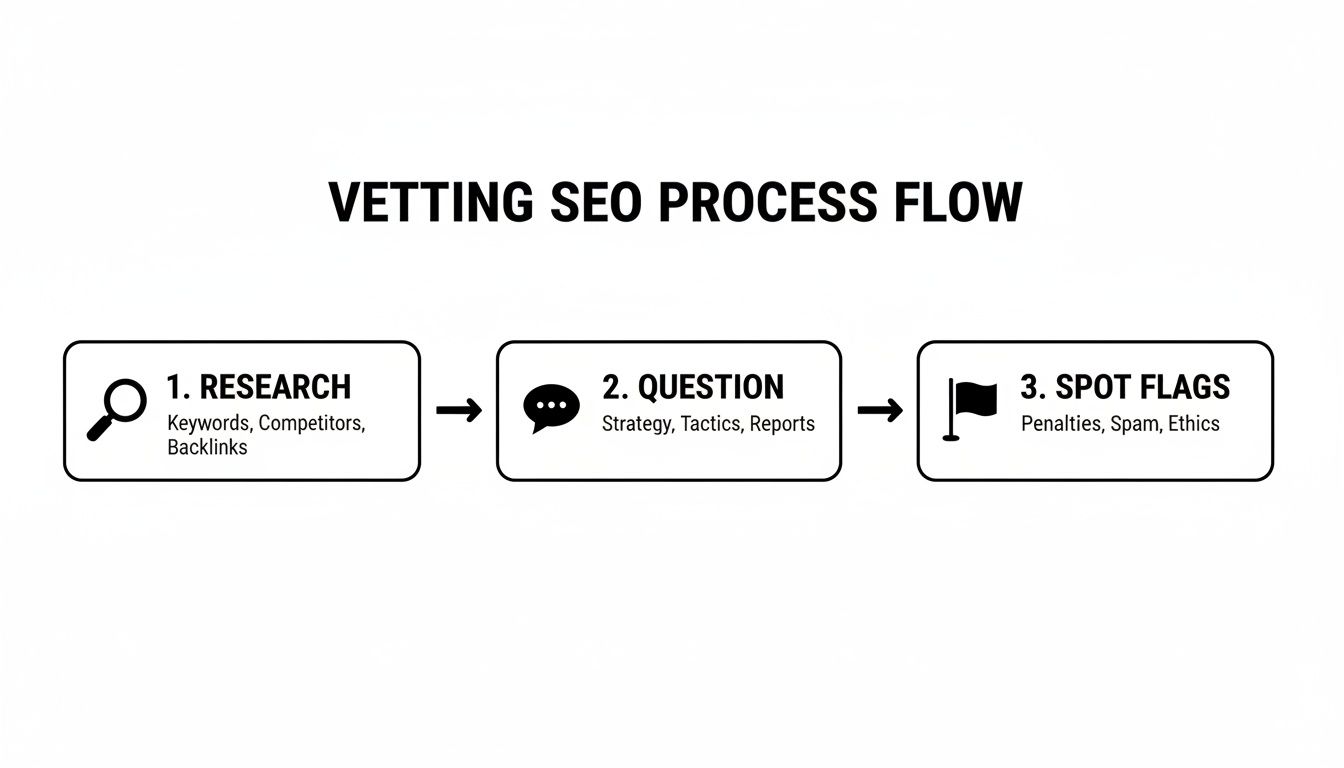
Starting with a clear, structured vetting process ensures you’re kicking off this collaboration with confidence.
What to Expect From Your New Agency
On the flip side, a professional SEO company won’t just take your logins and disappear. They should have a well-defined onboarding process designed to get them up to speed quickly and establish a clear path forward.
In the first few weeks, here’s what should be happening:
- A Kick-Off Workshop: This isn’t just another meeting. It's a deep dive to lock in the goals you’ve already discussed, allowing their entire team to hear directly from you and ask the smart questions that turn a generic plan into a tailored strategy.
- Comprehensive Audits: Before they touch a thing, they need to know what they're working with. Expect them to run in-depth technical and on-page audits to find what’s broken, what’s working, and where the low-hanging fruit is. This audit becomes the blueprint for the first few months.
- Transparent Reporting Setup: You should never have to ask, "So, what are you guys actually doing?" They should set you up with a reporting dashboard that tracks the KPIs you care about, whether that's organic leads, phone calls from the website, or keyword rankings.
- A Strategic Roadmap: Once the audits are done, they should come back to you with a clear plan of attack. This isn't a vague promise of "more traffic." It's a roadmap that outlines priorities—like fixing critical site errors first, then building out content for a specific service, and then launching a local link-building campaign.
This initial phase is all about building that solid foundation for growth. If you're curious about the kinds of things they'll be looking at on your site, our on-page SEO checklist gives a pretty good peek behind the curtain. It’s this deliberate, methodical approach that separates the pros from the pretenders.
Frequently Asked Questions About Hiring an SEO Company
Even after doing all your homework, pulling the trigger on an SEO company for your small business can feel like a huge leap. It’s normal to have a few last-minute questions pop up. It’s a big decision, and you deserve straight answers.
We've had these conversations with hundreds of business owners. Let’s walk through the most common questions we hear, from timelines and budgets to measuring what really matters.
How Long Does SEO Actually Take to Work?
This is always the first question, and for good reason. The honest answer? It takes time. Anyone promising you page-one rankings overnight is selling snake oil, not real SEO.
For most small businesses, you'll start to see the first positive glimmers—things like better keyword rankings and a small bump in organic traffic—within 3 to 6 months. This is the foundation-laying stage, where an agency is busy fixing technical glitches, optimising your key pages, and building up local signals.
The more significant, business-changing results, like a reliable flow of leads and a strong hold on competitive search terms, tend to build from the 6 to 12-month mark and grow from there.
Think of it like planting a garden. The first few months involve preparing the soil and planting the seeds. You won't see a full harvest overnight, but with consistent effort, the growth becomes undeniable and sustainable.
What Is a Realistic SEO Budget for a Small Business?
It’s tempting to shop around for the cheapest price, but "cheap SEO" can be one of the costliest mistakes a business can make. Low-cost providers often resort to spammy tactics that can get your website penalised by Google, leaving you in a worse position than when you started.
For professional, effective SEO services in Australia, a realistic monthly budget typically falls into these brackets:
- $1,000 – $2,500: A solid starting budget for businesses in less competitive local markets.
- $2,500 – $5,000: A common investment for businesses in competitive metro areas like Perth or those targeting a national audience.
This isn’t just a fee; it’s an investment in expert time for deep-dive audits, quality content creation, strategic link-building, and clear reporting. You're building a valuable business asset, not just renting temporary rankings.
Do I Need an SEO Company That Specialises in WordPress?
If your site is built on WordPress, then yes, absolutely. Working with an agency that lives and breathes the platform is a massive advantage. A WordPress specialist knows its quirks, the best plugins for performance, and how to fix common issues that can silently kill your rankings.
A generalist agency might figure it out, but a WordPress expert will get there faster and more effectively. They know which themes are built for speed, the right tools for image optimisation, and how to lock down your site's security—all of which are critical SEO factors. It’s the difference between a general mechanic and a certified specialist for your specific car model.
How Will I Know If the SEO Is Actually Working?
Good SEO is never a guessing game. A trustworthy agency will give you transparent reports that focus on the metrics that actually move the needle for your business.
While they track hundreds of data points behind the scenes, your reports should always highlight:
- Growth in Organic Leads and Sales: The number of form submissions, phone calls, and sales that came directly from search.
- Keyword Ranking Improvements: Not just for vanity terms, but for the high-intent phrases your customers are actually typing into Google.
- Increased Organic Traffic: A clear, upward trend in visitors finding you through search engines (not by typing your business name).
Your SEO partner should be able to draw a straight line from their activities to your business goals. If all you get are confusing charts about clicks and impressions, it's time to ask for clarity on how that translates to revenue.
Ready to stop worrying about your website and start seeing real results? The expert team at Webby Website Optimisation specialises in turning WordPress websites into lead-generating assets for small businesses across Australia. From technical SEO and GA4 setup to ongoing maintenance and support, we provide the clarity and expertise you need to grow. Find out how we can help by exploring our WordPress Help & Support services.