
NAP stands for Name, Address, and Phone number, and the single most important move you can make is to pick one exact version of each and publish it everywhere your business appears online. Get this right and you reduce mismatched listings, strengthen your local prominence on Google and Maps, and give search engines a clean signal to verify it. Below, you’ll find a priority checklist and a maintenance routine you can run in an afternoon.
TL;DR:
- Most NAP mismatches stem from small formatting inconsistencies, such as address abbreviations, punctuation, or capitalization, which must be standardized across all listings.
- The most impactful platforms to verify and correct are Google Business Profile, Apple Business, Bing Places, and your own website’s contact information, which carry the most search weight.
- Regular audits are necessary because changes like moving locations or rebranding can quickly cause new discrepancies if not promptly fixed and monitored.
- Claiming and verifying listings is essential for editing them, and escalating issues like duplicate profiles often requires direct support from platforms.
- Ongoing maintenance involves monthly checks of Google and Apple profiles and quarterly reviews of top directories to prevent future mismatches.
Table of Contents
- Why NAP consistency drives local search visibility
- Where to check first: the listings that actually move rankings
- The formatting mistakes that create mismatches
- Step by step: auditing every listing you have
- Fixing what you find: claiming, editing, and escalating
- Keeping NAP consistent after the first cleanup
- Our experience fixing citation chaos for local businesses
- Why most NAP advice misses the point
- How we handle NAP cleanup and ongoing local SEO
- FAQ
- Sources
Why NAP consistency drives local search visibility
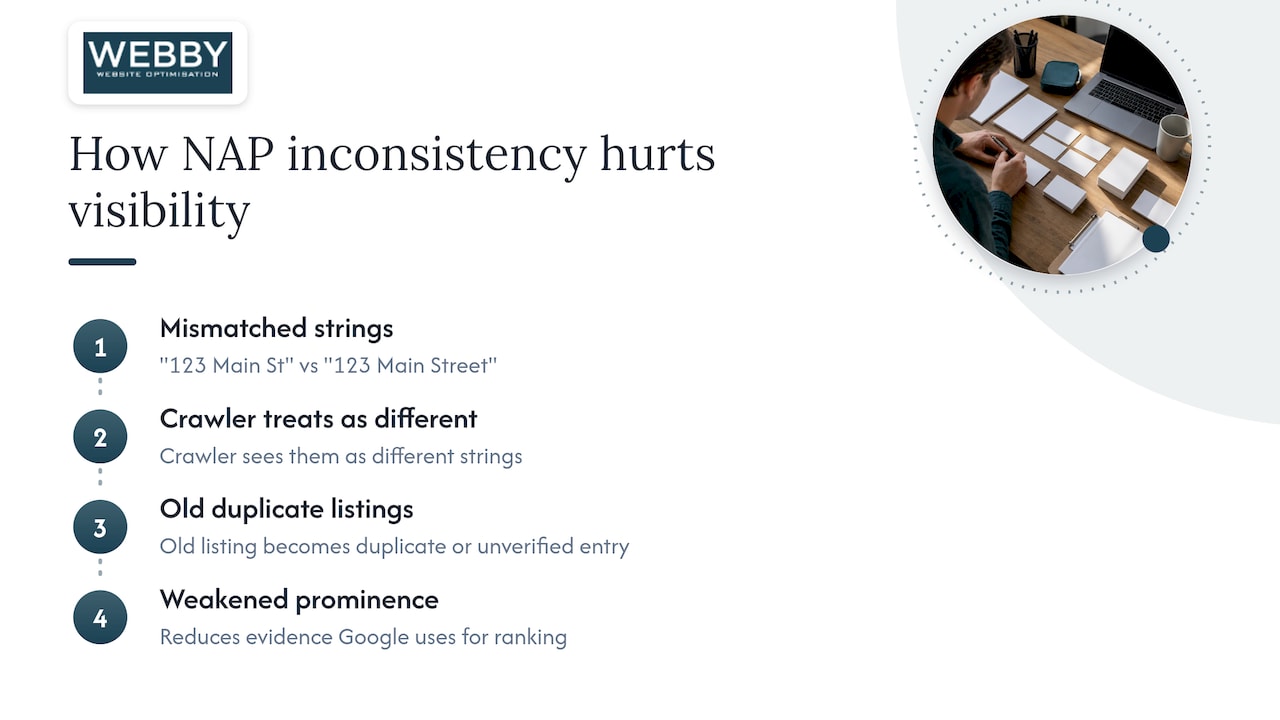
Name, Address, and Phone sound simple, but “consistent” means exact match, not close enough. “123 Main St” and “123 Main Street” are different strings to a crawler, even if a human reads them the same way.
Google states that local ranking depends mainly on relevance, distance, and prominence, and a verified, accurate profile supports that prominence signal. When your business details disagree across the web, you are not just creating confusion, you are weakening the evidence Google uses to confirm you are a real, trustworthy business at a specific location.
A common failure mode: a business moves address or swaps phone providers, updates its website, but leaves a directory listing with the old details. That old listing can sit there as a duplicate or unverified entry, competing against your real profile and diluting the signal instead of reinforcing it. Fixing it is rarely glamorous work, but it is foundational.
Where to check first: the listings that actually move rankings
Not every directory matters equally; for practical insights, see Local SEO Unlocked: Elevating Norwest Businesses and Neighboring Suburbs. Chasing all of them burns a weekend for little return, so start with the platforms that carry the most search volume and the most weight in local algorithms.
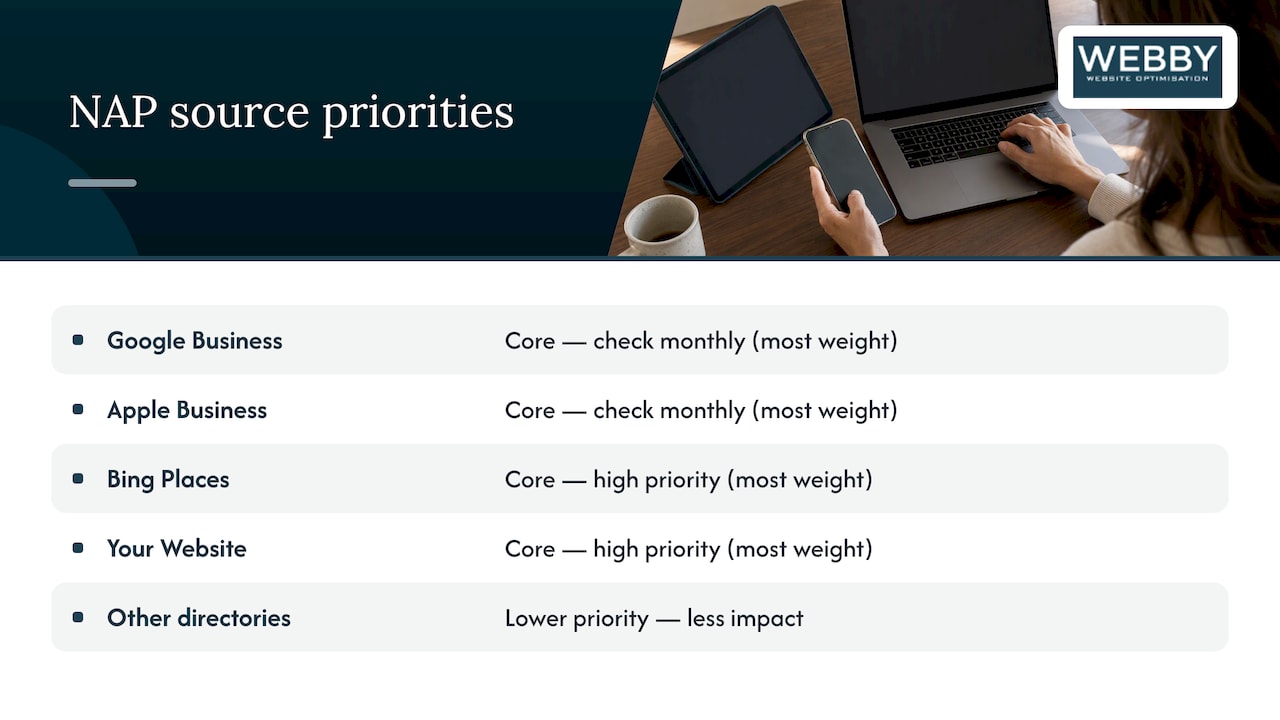
- Google Business Profile: the primary source Google uses for Maps and local search results, so it comes first.
- Apple Business: increasingly important given how many phones default to Apple Maps and Siri for local queries.
- Bing Places: smaller search share, but still indexed and still a trust signal.
- Your own website: your footer, contact page, and schema markup should match your official NAP exactly, since this is the source of truth other listings get compared against.
- Major industry directories: only after the four above are locked down, check the two or three directories most relevant to your business category.
On each platform, confirm the exact spelling of your business name, the full address including unit or suite number, the primary phone number, and the website URL. These four fields are where mismatches hide most often.
The formatting mistakes that create mismatches
Most NAP problems come from small, repeated habits rather than one big error. A few rules, applied consistently, solve the majority of them.
- Name: use your real trading or shopfront name, skip keywords or location tags, and keep the exact same branding (capitalization, punctuation, abbreviations) everywhere.
- Address: standardize how you write unit or suite numbers (for example, “Suite 4” every time, not “Ste 4” in one place and “Unit 4” in another), use one street type abbreviation convention, and double check your postal code and suburb spelling.
- Phone: pick one primary number, decide whether you include a country code, and use that exact format on every listing. If you run call tracking numbers for ads, keep those separate from your primary NAP phone.
- Punctuation and casing: match commas, periods, and capital letters across every listing so the string is identical, not just similar.
Write these four rules down once and treat them as your house style for every future listing update.
Step by step: auditing every listing you have
A proper audit finds every place your business name appears online and flags where it disagrees with your official details. This is mechanical work, well suited to handing off to an assistant.
- Pull your canonical NAP straight from your website footer and any official registration documents. This becomes your source of truth for every comparison that follows.
- Search Google Maps directly for your business name to see what the public sees first.
- Run a
site:yourdomain.comsearch to confirm your own pages are consistent internally. - Search your exact business name in quotes on Google to surface directory listings, citations, and old profiles you may have forgotten about.
- Manually check Google Business Profile, Apple Business, Bing Places, and your top two or three industry directories, since these carry the most weight.
Build a simple spreadsheet to track what you find, with these columns:
- Source URL
- Listed NAP (exactly as shown)
- Discrepancy type (name, address, phone, or combination)
- Claim status (claimed, unclaimed, unknown)
- Owner (who is responsible for fixing it)
- Action required
- Notes
- Last checked date
Work through Google, Apple, and your website first. Everything else is lower priority and can wait until the big three are clean.
Fixing what you find: claiming, editing, and escalating
Correcting a listing starts with claiming it. For Google Business Profile, verification typically happens by phone, SMS, postcard, or document upload, and Google notes that businesses with complete, accurate, verified information are more likely to appear in local results. Once verified, you can edit NAP fields directly, though some changes trigger a re-review.
Apple Business follows a similar pattern: you claim the listing, verify you represent the business, then edit the details to match your canonical NAP. Guidance on claiming Apple Business listings notes this step is often skipped, even in markets with heavy iPhone use, which leaves a visibility gap against competitors who have claimed theirs.
For directories, most offer an edit form or a correction request; expect a response within a few days to a few weeks depending on the platform.
- Escalate when a duplicate listing refuses to merge after a standard request, since this usually needs direct support contact.
- Consider a paid cleanup service when you have dozens of locations or years of accumulated duplicate listings, where the time cost outweighs the fee.
Our guide to building and fixing local citations walks through the correction process directory by directory.
Pro Tip: Keep a dated change log every time you edit a listing, and save a backup copy of your audit spreadsheet after each round of corrections.
Keeping NAP consistent after the first cleanup
An audit fixes today’s problems, but new ones appear whenever you move, rebrand, change phone providers, or open another location. A light monitoring routine catches these before they spread.
- Check Google Business Profile and Apple Business regularly, as these see the most traffic and potential unauthorized edits.
- Review your top industry directories quarterly.
- Sweep lower-value directories once a year.
- Watch for new duplicate listings, unexpected phone number changes, domain migrations, and any update tied to opening or closing a location.
Manual spot checks work fine for a single location. Multi-location businesses often find it worth paying for a citation monitoring tool once the spreadsheet becomes too large to track by hand. Either way, assign one person to own the spreadsheet so updates do not fall through the cracks between staff or agencies.
Our experience fixing citation chaos for local businesses
We’ve worked through NAP audits for local service businesses where years of agency changes, rebrands, and office moves had scattered conflicting details across dozens of listings. The pattern repeats: Google Business Profile and the website get updated, Apple Business and smaller directories get forgotten.
If you are managing more than one location, running low on time, or stuck with a duplicate listing that will not merge through standard channels, that is usually the point where handing the audit to someone who does this daily saves more hours than it costs. You can see how we approach local SEO work for service businesses across different industries.
Why most NAP advice misses the point
Most guides treat every directory as equally urgent, which sends business owners chasing fifty listings when four or five actually move the needle. That is backward. Google Business Profile, Apple Business, Bing Places, and your own website carry almost all the weight, and a clean audit spreadsheet beats any paid monitoring tool if nobody on your team actually opens it.
The bigger blind spot is treating NAP cleanup as a one-time project. A rebrand, a new office, or a swapped phone provider undoes months of work in a single afternoon if nobody owns the follow-up. The businesses that stay clean are the ones that assign a real person to check Google and Apple every month, not the ones that ran one perfect audit and moved on.
Start with the big four, write your formatting rules down once, and treat maintenance as a standing task, not a project with an end date.
— Steve Doig
How we handle NAP cleanup and ongoing local SEO
If the audit above feels like more hours than you have this month, our Website Audit service covers exactly this work: finding every inconsistent listing, prioritizing the platforms that matter, and handing you a clear fix list.

For businesses that want citation alignment built into ongoing SEO rather than a one-off fix, our Business Website Optimisation Campaign includes monitoring so new mismatches get caught before they spread.
| Service | What it covers | Price |
|---|---|---|
| Website Audit | Finds and prioritizes listing discrepancies | $1,250 AUD one-off |
| Business Website Optimisation Campaign | Ongoing SEO with citation alignment and monitoring | $3,125 AUD one-off |
Consistent, accurate business information makes you more likely to appear in local search results.
Pro Tip: Fix Google Business Profile and your website first. Everything else follows once those two agree.
Google notes that businesses with complete and accurate listings are more likely to show up in local search results, which is the practical payoff of the work above.
Get in touch through our services page to start with an audit.
FAQ
What does NAP stand for in local SEO?
NAP stands for Name, Address, and Phone number, the three core details that identify your business across online listings. Keeping these identical everywhere helps search engines verify you are a real, single business at one location.
How often should I check my Google Business Profile for errors?
A monthly check is a reasonable cadence for Google Business Profile and Apple Business, since these see the highest traffic and the most unauthorized edits. Quarterly checks work for secondary directories, with an annual sweep for lower-value listings.
Can I have more than one Google Business Profile for the same location?
No. Google’s guidelines require one profile per real-world business location, and duplicate profiles for the same address typically get merged or removed.
What’s the fastest way to find every listing with my business details?
Search your exact business name in quotes on Google, check Maps directly, and run a site:yourdomain.com search to confirm your own site is consistent, then manually check Google Business Profile, Apple Business, Bing Places, and your top directories.
Is it worth paying someone to fix NAP inconsistencies?
It depends on scale. A single-location business can usually self-audit in an afternoon, but multi-location businesses or anyone stuck with duplicate listings that will not merge often save time by handing the cleanup to a service like our Website Audit.