
When you start looking for SEO companies for small business, you’re not just hiring a supplier. You’re searching for a growth partner. The right agency won’t just talk about "more visibility"—they’ll deliver real, tangible results like qualified local customers, more online sales, and a clear return on your investment.
Why the Right SEO Partner Is a Small Business Game-Changer

As a small business owner in Australia, you’re already juggling a dozen different things. Between managing operations, serving customers, and keeping an eye on the books, the thought of cracking the code on search engine optimisation can be overwhelming. That’s exactly why finding the right SEO partner can completely change the game.
This guide is designed to cut through the noise and confusing jargon. My goal is to give you the practical knowledge you need to confidently find, vet, and hire an SEO partner who gets your business. We're not looking for the cheapest option; we're looking for a specialist who acts like an extension of your own team.
It’s About More Than Just Rankings
One of the most common traps business owners fall into is chasing that coveted #1 spot on Google. While rankings are a piece of the puzzle, they aren't the whole picture. What good is being number one if the traffic you get isn't turning into business?
The real value of great SEO is attracting the right people—customers in your local area, like Perth, who are actively looking for the exact products or services you provide.
A top-notch SEO partner focuses on what actually matters to your bottom line:
- Getting Qualified Local Customers: They bring in visitors who are not only nearby but also ready to buy.
- Driving More Online Revenue: If you run an e-commerce store on WordPress, this means fine-tuning your product pages and checkout to turn browsers into buyers.
- Proving a Clear ROI: Every dollar you spend on SEO should be tracked back to measurable business growth.
This is a huge mindset shift. You stop paying for keywords and start investing in a system that generates leads and sales month after month. For a deeper dive, check out our guide on unlocking growth with SEO services for small businesses.
A true SEO partnership builds a powerful, long-term asset for your business. It transforms your website from a simple online brochure into a 24/7 sales engine that brings in new opportunities—without you having to pay for every single click.
Throughout this guide, I'll walk you through the exact steps, checklists, and real-world examples you need. You'll learn what to ask, what red flags to watch out for, and how to choose a partner who will help you achieve real, measurable growth, not just a list of vanity metrics.
Right, before you even think about Googling “SEO companies for small business,” let’s pause for a moment. Just diving in without a plan is a bit like asking a builder to start on your house with no blueprints. You'll almost certainly end up with something that isn't quite right and a bill that's much higher than you'd hoped.
Most business owners start with vague wishes like "I need more traffic" or "I want to rank higher." The problem is, these are just vanity metrics. They look nice on a report but don't automatically put money in the bank. The key is to tie your SEO efforts directly to tangible business outcomes.
From Vague Hopes to Concrete Goals
What you need are specific, measurable goals that mean something to your bottom line. Getting this right from the start makes every conversation with a potential SEO partner more productive and gives you a real way to measure your return on investment.
Think about what success actually looks like for your business. For instance:
- Instead of just "more traffic," what about: "Increase qualified organic traffic from the Perth metro area by 30% in the next 12 months."
- Rather than "rank higher," try: "Secure a top-5 ranking for my three most profitable service keywords."
- And instead of "get more leads," a much better goal is: "Generate 15 new quote requests each month directly from organic search on my WordPress site."
Having these kinds of specific targets gives you and your future agency a clear finish line to run towards. It turns SEO from a mysterious marketing expense into a predictable engine for growth.
A well-defined goal is your best filter. As you talk to different SEO companies, you can instantly tell if they're proposing a strategy that actually solves your business problem or just selling a generic package they give to everyone.
Do a Quick Health Check on Your Website
You don't need to be an SEO wizard to get a snapshot of where you're at right now. A quick self-audit gives you incredibly valuable context for those first calls with an agency, helping you point out what you think might be wrong or where the opportunities lie.
Here’s a quick once-over you can do on your WordPress site:
- Dig into your data: Pop open your Google Analytics 4 (GA4) account. Have a look at your top organic landing pages. Are they actually bringing in leads or sales? Finding pages that get plenty of visitors but zero enquiries is a golden nugget of information to share.
- Check your mobile experience: Grab your phone and pull up your website. Seriously, do it now. Can you easily read everything, click buttons, and fill out a contact form without needing to pinch and zoom? With over 60% of searches now happening on mobile, a clunky mobile site is like having a door that’s hard to open.
- Test your speed: Use a free tool like Google's PageSpeed Insights and plug in your website address. A slow-loading WordPress site is a guaranteed way to frustrate visitors and tell Google you don't offer a great experience. Make a note of your score and any big, red warnings it gives you.
Doing this little bit of homework means you can walk into a meeting with SEO companies for small business with a clear brief. You'll be able to say, "My main goal is to drive more foot traffic to my Perth shop," or "I need to fix these technical issues that I think are holding back my sales," which is a world away from just saying, "I need some SEO."
Alright, you’ve got your goals sorted. Now for the tricky part: sifting through all the options to find an SEO company for your small business that you can actually trust. This is where you need to look past the slick sales pitch and figure out who can really deliver the goods.
A great presentation is easy to fake; proven expertise is much harder to find. You’re looking for a long-term partner, not just a service provider, so it’s crucial to ask the right questions. You need to probe their experience with businesses like yours, especially if you're a Perth-based business running on WordPress.
Look Beyond the Sales Presentation
A polished proposal doesn't guarantee results. Your job is to get under the hood and understand their real process. Remember, you’re about to give them deep access to your website and business data, so this vetting stage is critical.
The good news is, you've got plenty of choices. The Australian market has over 120 specialised SEO agencies listed as top performers, meaning Perth WordPress site owners have a solid pool of local experts who get our market.
You’ll see agencies boasting some impressive numbers. For example, it’s not uncommon to find a top-tier local agency with 100 reviews, a 4.9-star average, and a track record of generating over $41 million in client revenue. One case study I saw recently showed a 364% jump in online bookings for a local service business. These are the tangible results you should be looking for. You can see more success stories from top Australian SEO companies to find agencies that might be a good fit.
To make sure you’re prepared for these conversations, think about your process like this: start with your vision, get a clear picture of where you are now, and turn that into a solid brief for potential agencies.
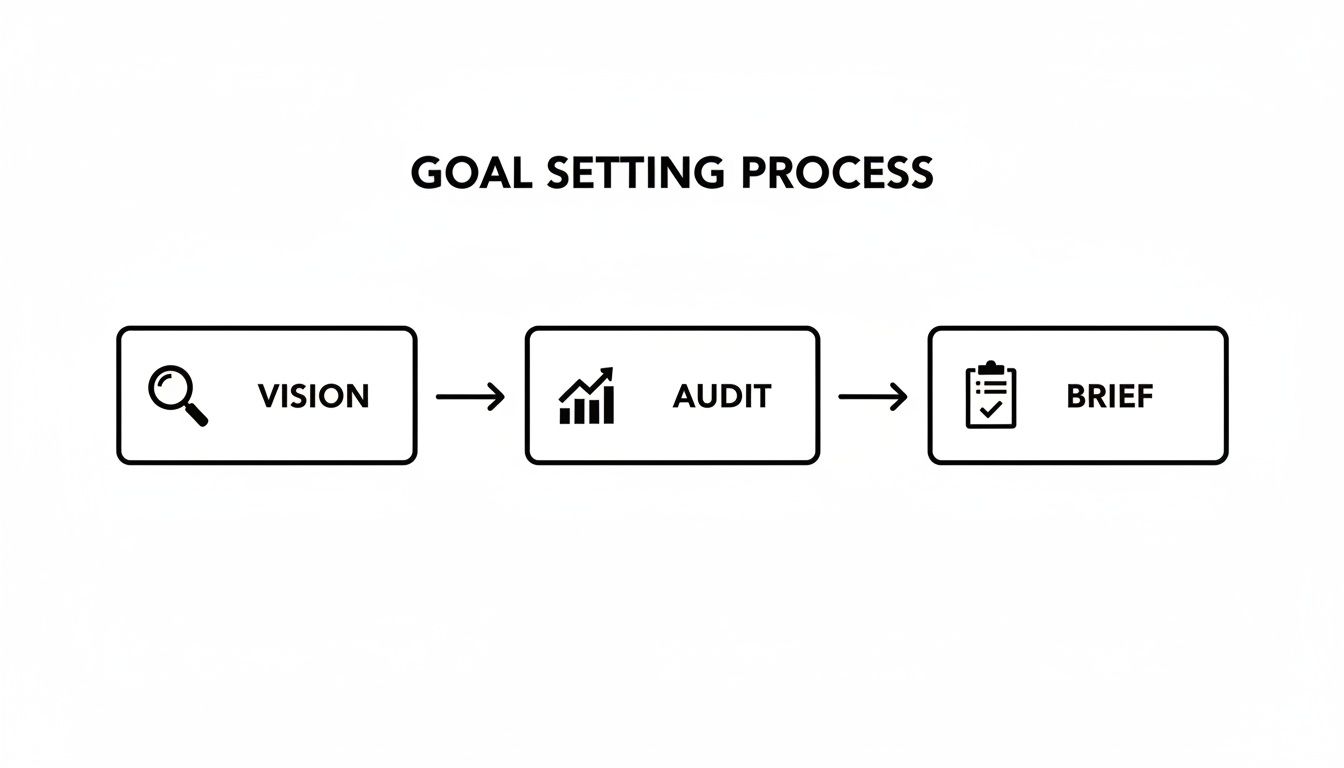
Walking in with this clarity helps turn a vague wish for "more traffic" into an actionable plan that any competent agency can get to work on.
Essential Questions to Ask Potential Agencies
To cut through the noise, you need to ask questions that force them to show, not just tell. Forget the generic stuff and get specific. Here are a few must-asks for your checklist:
"Can you show me a technical SEO audit you've done for a WordPress site like mine?" This is a direct test of their hands-on experience with your platform. You want to see how they spot and prioritise real issues like site speed, indexation problems, or broken schema markup.
"What’s your approach to link-building for a small local business in a competitive market like Perth?" Their answer here is telling. You’re listening for sustainable, white-hat strategies (like local PR and industry partnerships), not risky shortcuts that could get your site penalised down the track.
"Walk me through how you set up and configure Google Analytics 4 and Google Tag Manager." This is a non-negotiable. If they stumble here or can't clearly explain how they track conversions and user behaviour, they simply can't measure ROI. End of story.
A really great sign is when they start asking you a ton of questions. If they’re genuinely curious about your business model, profit margins, and customer lifetime value—instead of just pushing a package—you’re probably talking to a true partner.
Red Flags to Watch Out For
Just as important as knowing what to look for is knowing what to run from. Some promises and behaviours are classic warning signs that should have you heading for the door.
Be on high alert for these red flags:
- Guaranteed #1 Rankings: Nobody can guarantee a specific spot on Google. The algorithm is a beast, and anyone who says they’ve tamed it is selling you snake oil. It’s the oldest trick in the SEO book.
- A Fixation on Vanity Metrics: If the entire conversation is about "more traffic" or ranking for a long list of keywords without tying it directly to leads and sales, their priorities are wrong. Traffic doesn't pay the bills.
- One-Size-Fits-All Packages: Your business is unique. A cookie-cutter SEO plan pulled from a menu is a lazy approach. A good strategy is always built around your specific goals.
- Lack of Transparency: Are they cagey about their methods? Can't explain what they're doing in plain English? Huge red flag. You have a right to know exactly what work is being done on your website.
Alright, let's talk money. This is often where business owners get a bit nervous, and for good reason. Trying to figure out what SEO should cost can feel like guesswork, especially with every agency quoting something different. But if you know what to look for, you can make a smart investment rather than just an expense.
Most SEO agencies in Australia structure their pricing in a few common ways. Getting your head around these models is the first step to finding a package that actually fits your business.
Common SEO Pricing Models
You'll quickly notice that the monthly retainer is the most popular option. This is where you pay a fixed fee each month for a bundle of ongoing services. It’s the best approach for a proper, long-term strategy that covers all the bases—technical tune-ups, content creation, and building your site’s authority over time.
Some agencies also offer project-based pricing. This is a one-off cost for a very specific job, like a deep-dive technical audit of your WordPress site, getting your local SEO sorted from scratch, or a short, sharp content marketing blitz. It’s great for fixing a specific issue, but it won’t give you the sustained growth that a retainer does. Lastly, you might see hourly rates, which are usually for high-level consulting or quick, ad-hoc tasks with a senior specialist.
Remember, the price tag isn't the whole story. A cheap SEO plan that brings in zero leads is far more expensive than a well-priced strategy that delivers a tangible return on your investment.
What Should You Expect to Pay in Australia?
So, what’s a realistic budget? For most small businesses in Perth and across Australia, a solid, growth-focused SEO package will usually sit in the $1,500–$3,000 per month range. From my experience, this is the sweet spot. It’s enough budget to cover sustained on-page work, consistent content development, and the kind of authority-building that actually moves the needle.
Cheaper plans are out there, but they often just skim the surface and rarely produce the meaningful results you’re after. Of course, this price can shift based on how competitive your industry is, the current state of your website, and your specific goals.
For a clearer picture, here's a breakdown of what you can generally expect at different price points.
Australian SEO Pricing Tiers for Small Business
| Price Tier (Monthly) | Typical Services Included | Best For |
|---|---|---|
| $750 - $1,500 | Basic on-page optimisation, keyword tracking, a small amount of content (e.g., 1 blog post), basic reporting. | Businesses on a very tight budget with low competition, or those just wanting to maintain a presence. |
| $1,500 - $3,000 | Comprehensive on-page and technical SEO, consistent content creation (2-4 articles), local SEO management, some link-building efforts. | Small to medium businesses serious about growth and looking for a noticeable increase in leads. |
| $3,000 - $5,000+ | All of the above, plus advanced technical SEO, a dedicated content strategy, significant authority-building, and proactive CRO suggestions. | Businesses in highly competitive markets or those looking to dominate their niche and scale quickly. |
Ultimately, this table shows that you get what you pay for. The key is to match your investment level to your growth ambitions. If you want to learn more about the factors that influence these costs, check out our guide on the cost to rank on the first page of Google.
Reading the Fine Print in Your SEO Contract
Before you sign anything, you absolutely must read the contract carefully. Look for a crystal-clear scope of work that spells out exactly what you're getting each month. It should list the specific deliverables, like the number of blog posts, technical fixes, or the type of reports you’ll receive. No vague promises!
Pay very close attention to the contract length and cancellation clause. My advice? Be wary of getting locked into a rigid 12-month contract with no easy way out. A good agency will be confident in their ability to deliver results and will offer more flexible terms.
Look for a 3-month initial commitment that then rolls into a month-to-month agreement. This is a huge green flag. It shows they’re focused on earning your business through performance, not just locking you into a long-term contract.
Winning Your Neighbourhood: Why Local SEO Matters for Aussie Businesses
If you’re running a local business in Perth, trying to compete with national chains online can feel like you’re bringing a knife to a gunfight. But it doesn't have to be that way. This is where local SEO flips the script. Forget about trying to win the whole internet; it’s all about winning your own backyard.
Local SEO is what makes your business pop up for customers who are physically nearby and ready to spend money. Think about it. When someone in Joondalup searches for an "emergency electrician near me," they need someone local, and they need them now. They aren't interested in a sparky from Melbourne. A good SEO partner gets this, shifting the entire strategy away from generic keywords to focus on these high-intent local searches.
For a local service-based business, this means your website has to do the heavy lifting. It's not just a brochure; it's your primary tool to get more customers with a local service business website.
What a Good Local SEO Strategy Actually Looks Like
A proper local SEO campaign is so much more than just sticking "Perth" at the end of your page titles. It's a focused, multi-pronged effort. As you vet potential SEO companies for your small business, make sure they can show you how they'll nail these fundamentals.
Mastering Your Google Business Profile (GBP): Think of your GBP listing as your digital front door. It needs constant care—we’re talking regular updates, answering questions people post, and actively managing your reviews. For many potential customers, it's the very first impression they'll have of your business.
Building Consistent Local Citations: This is all about getting your Name, Address, and Phone number (NAP) listed correctly across all the important Australian online directories. If your details are different from one site to another, it confuses Google and makes your business look less credible.
Creating Hyper-Local Content: A sharp agency won't just write generic blog posts. They’ll help you create content that resonates with your local community. Imagine a landscaper in the Perth Hills writing about "The Best Reticulation Systems for Perth's Clay Soil" or a plumber creating a landing page specifically for "Blocked Drains in Canning Vale." This is how you prove you're the local expert.
The numbers don't lie. A staggering 46% of all Google searches are for local information, and the businesses in the top few local results scoop up 24.4% of all the clicks. We’ve seen it firsthand—one Perth business client saw a 312% jump in website traffic and landed 62 new customer enquiries in a single month after we rolled out their local SEO plan.
Of course, none of this works if your WordPress site is slow or technically broken. A fast, well-built website is the foundation that all your local SEO efforts are built upon.
By concentrating on the customers right around the corner, a local strategy lets a small Perth business punch well above its weight and outmanoeuvre the bigger, faceless competitors. To go deeper on this, check out our guide on finding the right local search engine optimisation company. It’s about becoming the best, most trusted answer for the community you serve.
Your Questions About Hiring an SEO Company Answered
Even after you’ve done all the research, it’s completely normal to have some final questions nagging at you. It’s a big decision, after all. Let's tackle some of the most common things we hear from small business owners before they partner with an SEO company.
How Long Does It Take to See Real SEO Results?
This is the million-dollar question, isn't it? The honest, no-fluff answer is that it takes time. While you might see a few quick wins from fixing technical glitches in the first month or so, the kind of results that actually bring in leads and sales generally take 4 to 6 months to materialise.
Think of the first few months as laying a solid foundation. We're talking about a deep-dive audit of your website, mapping out the strategy, sorting out technical problems, and creating the core content you need to compete. You should start to see some positive movement in your keyword rankings and organic traffic around the three-month mark. The really meaningful growth, however, usually kicks in from month six onwards.
Be very, very cautious of any agency promising you instant, page-one rankings. Real, sustainable SEO is a long-term investment, not an overnight trick. Anyone telling you otherwise is selling you a fantasy.
What Is the Difference Between On-Page, Off-Page, and Technical SEO?
It often helps to think of your website as a house you're trying to get people to visit and love.
Technical SEO is the foundation and framework of your house. It ensures everything is structurally sound, built on solid ground, and easy for Google's 'inspectors' (crawlers) to navigate and understand. This covers things like site speed, mobile-friendliness, and security.
On-page SEO is all about the interior design. This is where you make sure every room (or page) is perfectly set up for its purpose. It involves optimising your content, headlines, and images to be incredibly relevant to what your ideal customers are searching for.
Off-page SEO is your reputation around the neighbourhood. This is all about building authority and trust by getting genuine recommendations (backlinks) from other respected 'houses' (websites) in your industry.
A successful SEO campaign needs all three working in harmony. A shaky foundation or a bad reputation will completely undermine even the most beautiful interior.
My WordPress Site Is Slow. Will an SEO Agency Fix That?
Yes, they absolutely should. Any SEO partner worth their salt must treat page speed as a top priority. A slow WordPress site isn't just frustrating for your visitors; it’s a direct negative ranking signal for Google. In fact, just a one-second delay in page load time can slash your conversions by 7%.
A proper technical audit will pinpoint exactly what's causing the slowdown—whether it's massive images, clunky code from having too many plugins, or cheap hosting that can't keep up. The agency should then give you a clear, actionable plan to fix these issues. This is a non-negotiable part of their job, as a fast website is essential for any SEO success.
What Metrics Should I Actually Care About?
It's time to look beyond vanity metrics like raw traffic numbers. The data that truly matters is the data that connects directly to your business goals. Your reports should tell a story about business growth, not just website activity.
Here are the key performance indicators (KPIs) you should be focusing on:
- Organic Conversions: The actual number of leads or sales generated directly from your search engine traffic. This is your bottom line.
- Conversion Rate: The percentage of organic visitors who take the action you want them to, like filling out a contact form or making a purchase.
- High-Intent Keyword Visibility: How well you rank for the keywords that signal someone is ready to buy (e.g., "emergency plumber Perth" or "best local accountant").
- Google Business Profile Actions: Especially for local businesses, this includes clicks-to-call, requests for directions, and website visits that come straight from your map listing.
Ready to stop worrying about your WordPress site and start focusing on growth? At Webby Website Optimisation, we handle all the technical details—from speed optimisation and security to expert GA4 setup—so you can get a real return on your SEO investment. Get reliable WordPress help and support today.