

SEO is all about making sure your business shows up on Google when people are looking for what you do. For a small Aussie business, it’s the difference between a potential customer finding you or your competitor down the road. It’s how you turn your website from a simple online brochure into your best customer-generating machine.
Why Your Australian Small Business Is Invisible Online
Imagine you run the best café in Perth. You’ve got incredible coffee and amazing service, but your shop is hidden down a laneway with no sign. People walk right past, completely clueless that you’re even there. That's exactly what it's like to have a website without good Search Engine Optimisation (SEO).
Right now, countless Australian small businesses are missing out. Their ideal customers are typing things like "plumber in Ballarat" or "best hairdresser in Surry Hills" into Google, and those businesses are nowhere to be found. Being visible online isn't a 'nice to have' anymore; it's how customers find you. The good news? It's a problem you can absolutely fix.
The Untapped Opportunity for Local Businesses
If your website runs on WordPress, you're already sitting on a goldmine. The platform is naturally built to be SEO-friendly, but you need a proper strategy to actually get it working for you. A surprising number of Australian small and medium businesses (SMEs) just aren't doing this yet.
A 2023 study of 700 Australian SMEs found a massive gap: only 36% were properly using SEO. This leaves a whopping 64% in the dark, invisible to the very clients who are looking for them online.
That gap is your opportunity. When you start taking SEO seriously, you get a huge leg-up on the competition. Think about it: local searches lead to real customers walking through your door. With 72% of users who search for something local visiting a store within 8km, being visible isn't just about website traffic—it's about real-world business. Explore more insights into Australian SME digital strategies.
Your Roadmap to Getting Found
Think of this guide as your plan to finally take off that invisibility cloak. Investing in SEO services for your small business isn't just another marketing cost. It's a direct investment in being found by people who have their wallets out, ready to buy what you sell.
This is about making sure that when someone in your local area needs what you offer, your business is the first and best answer Google gives them. Let's walk through how you can claim that top spot and start turning those online searches into loyal customers.
So, What SEO Services Does Your Business Actually Need?
Think of Search Engine Optimisation less as a single task and more like the different departments in your business. You have sales, marketing, and operations—all separate, but all working together towards the same goal. SEO is no different. It's a collection of specialised services, and they all need to be in sync for you to start winning new customers online.
Getting your head around these different parts is crucial. It means you know exactly what you're paying for and why each piece of the puzzle matters. Without that clarity, you're just throwing money at a problem, hoping something sticks.
This is the exact problem many small businesses face. They're basically invisible to the people who are actively looking for them.
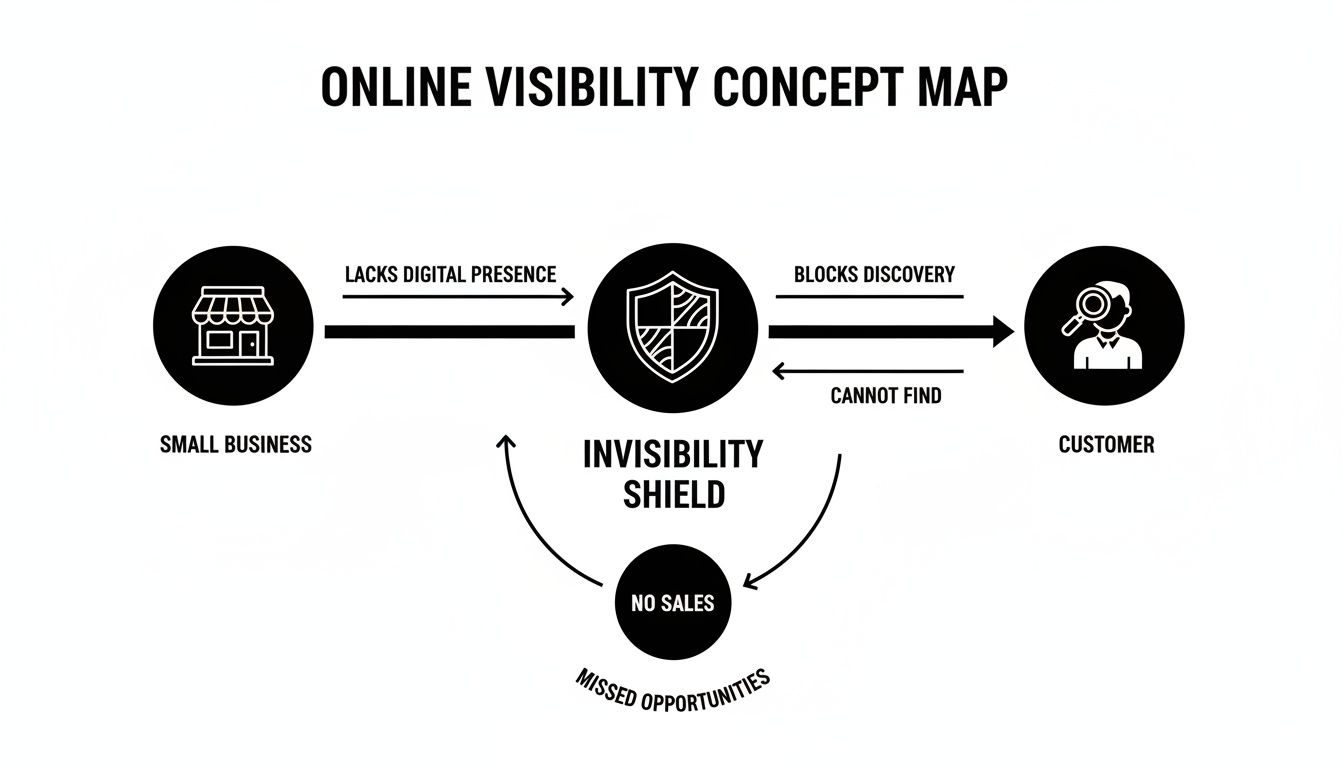
This invisibility shield is what we're trying to break down. Each of the core SEO services we’re about to cover is a tool designed to chip away at that barrier, making you more visible to potential customers.
Let's break down the four essential pillars of a solid SEO strategy for any Australian small business.
The Four Pillars of Small Business SEO
Here’s a simple table to demystify the main types of SEO. It shows what each service does and what kind of work is typically involved on a WordPress website.
| SEO Service | Primary Goal | Key Activities for Your WordPress Site |
|---|---|---|
| On-Page SEO | Make your content easy for search engines and people to understand. | Keyword research, optimising page titles, writing meta descriptions, structuring content with headings. |
| Technical SEO | Ensure your website is fast, secure, and easily accessible to Google. | Improving site speed, ensuring mobile-friendliness, creating an XML sitemap, implementing HTTPS security. |
| Local SEO | Dominate search results for customers in your immediate service area. | Optimising your Google Business Profile, building local citations, gathering customer reviews. |
| Content & Links | Build trust and authority by becoming a go-to resource in your industry. | Writing helpful blog posts, creating guides, earning links from other reputable local websites. |
By addressing all four of these areas, you create a powerful, well-rounded strategy that gives your business the best possible chance to be found by the right people at the right time.
On-Page SEO: The Blueprint for Your Content
Let's start with On-Page SEO. Think of it as organising the information on each page of your website so it’s crystal clear what you're talking about—both for Google and for your visitors. This isn't about sneaky tricks; it's about providing clear signposts.
For your WordPress site, this means doing your homework to find the keywords your customers in Australia are actually typing into Google. Then, you’ll work those keywords naturally into your page titles, meta descriptions (that little summary you see in the search results), and your headings (H1, H2, etc.).
When it's done right, Google’s bots can scan your page and immediately understand, "Okay, this page is all about emergency plumbing services in Fremantle," and show it to the right person.
Technical SEO: Keeping Your Website’s Engine Tuned
If on-page SEO is the blueprint, Technical SEO is the foundation, the wiring, and the plumbing. It’s all the work that happens behind the scenes to make sure your website is fast, secure, and a breeze for search engines to navigate. After all, a stunning shopfront is useless if the doors are locked and the lights are off.
For a WordPress website, this typically involves:
- Improving Site Speed: Nobody waits for a slow website. With over 50% of users leaving a site that takes more than three seconds to load, speed is non-negotiable.
- Mobile-Friendliness: Your site must look and work perfectly on a smartphone. This is where most of your local customers will find you.
- Creating a Sitemap: This is literally a map of your website that you hand to Google, showing it where all your important pages are.
- Securing Your Site (HTTPS): That little padlock in the browser bar is a must. It builds trust with visitors and is a confirmed ranking signal for Google.
Technical problems are the silent killers of online growth. A slow, buggy, or insecure website frustrates users, and Google takes notice. It'll push you down the rankings where no one can find you.
Local SEO: Winning Over Your Neighbourhood
For most Aussie small businesses, the real game is won at the local level. Local SEO is all about making your business the obvious choice for customers in your specific suburb or city. It’s how a cafe in Carlton gets found by someone searching "best coffee near me."
A huge piece of this puzzle is your Google Business Profile. This is that important info box that pops up in Google Maps and search results, showing your address, hours, phone number, and—crucially—your customer reviews. Keeping this profile accurate, active, and full of great reviews is one of the single most effective things a local business can do.
Understanding these fundamentals is the first step to leveraging the core SEO services that will set you apart from your competition.
Content: The Fuel for Your Growth
Finally, we have Content. This is the fuel for your entire SEO engine. It’s about creating genuinely useful and relevant stuff—like blog posts, guides, or short videos—that answers your customers' questions and solves their problems. This isn't just about selling; it's about building trust and positioning yourself as the go-to expert.
For example, a landscaper in Perth could write a blog post on "5 Low-Maintenance Plants That Thrive in a Perth Summer." This helps local homeowners, introduces them to the business, and shows off their expertise. Over time, this kind of helpful content builds authority and earns links from other websites, which tells Google that you're a trustworthy resource worth showing to more people.
The Power of Local SEO to Win Your Suburb
For most Australian small businesses, the digital battle isn't won by competing nationally; it's about owning your local suburb. This is where Local SEO becomes your secret weapon. It’s the strategy that makes sure when someone around the corner searches for what you do, your business is the first and best answer they find.
Think of it like this: trying to rank for a massive term like "builder" is like putting a single billboard up in the middle of the Nullarbor. Sure, a few people might drive past, but how many are actually looking for a builder in your specific area? Ranking for "builder in Fremantle," on the other hand, is like having a glowing neon sign on the main street, seen by people actively looking for you nearby.

This is the very heart of effective SEO services for small business. It’s all about precision, not just noise. You want to bring in the right customers—the ones who can actually walk through your door or book your services.
Your Google Business Profile Is Your Digital Shopfront
The absolute cornerstone of any local SEO strategy is your Google Business Profile (GBP). This is that prominent info box you see in Google Maps and at the top of local search results. It's your digital storefront, showing your address, opening hours, phone number, and, crucially, your customer reviews.
An incomplete or neglected profile is a huge red flag for both Google and potential customers. A fully optimised profile, however, sends a powerful signal of trust and relevance. It tells Google you’re a legitimate, active business in a specific location, making it far more likely to show you to local searchers.
The Critical Role of NAP Consistency
Imagine a customer finds three different phone numbers for your business online. Which one do they call? This is exactly the kind of confusion Google tries to stamp out. That’s why having a consistent Name, Address, and Phone number (NAP) across the web is so vital.
This data needs to be identical everywhere it pops up, from your own website to online directories like Yellow Pages and other industry-specific listings.
Inconsistencies in your business information create confusion for search engines and erode trust. Google rewards businesses that present a clear, consistent, and reliable digital footprint, making it easier for customers to find and contact them.
Think of each consistent listing as a vote of confidence in your business's location and details. The more consistent votes you collect, the more certain Google is about who you are and where you operate, which directly boosts your local ranking authority.
Turning Customer Reviews into a Ranking Magnet
In the local search game, customer reviews are pure gold. Not only do they provide powerful social proof to potential customers, but they're also a massive ranking factor for Google. A steady stream of positive, genuine reviews shows that your business is trusted and valued by the local community.
Making it easy for happy customers to leave feedback on your Google Business Profile should be a core part of your process. This isn't about faking it; it's about encouraging real customers to share their great experiences. Responding to all reviews—both good and bad—also shows you’re an engaged and customer-focused business.
The data backs this up in a big way. A huge 46% of all Google searches have local intent, and searches including "near me" have absolutely exploded. This trend is a massive opportunity for Perth-based businesses, from local WordPress agencies to e-commerce stores, who need that hyper-local visibility. Discover more insights about Australian search trends.
Winning Your Suburb with Targeted Content
Finally, your website content itself needs to speak directly to your local audience. This is about more than just mentioning your main city. A highly effective strategy is creating specific landing pages for the suburbs you serve.
For example, a dedicated page for "SEO services in Fremantle" lets you get specific about projects you've handled in the area or tailor your message to that community. This tactic makes your services feel instantly more relevant to both users and search engines. To see what we mean, check out our guide on SEO for businesses in Fremantle.
This approach transforms your website from a generic brochure into a targeted, local resource, making you the undeniable choice for nearby customers.
Connecting SEO with WordPress Maintenance and Hosting
Your SEO strategy is only as good as the website it’s built on. Many small business owners pour money into content and keywords but completely forget about the engine running the whole show: the technical health of their WordPress site. It's a classic mistake, and one that can quietly torpedo even the most brilliant SEO plan.
Think of it like this: your SEO strategy is a world-class Formula 1 driver. But if you put that driver in a car with a dodgy engine and flat tyres (your website's technical health), they're not winning any races. Your website's performance isn't a separate task—it's a core part of your SEO.
Google's number one priority is giving its users a great experience. That means it naturally favours websites that are fast, secure, and reliable. A slow, buggy, or vulnerable site sends all the wrong signals, and your rankings will suffer because of it.
The Unseen Heroes: Website Speed and Uptime
A slow-loading website is an absolute ranking killer. We know that over 50% of people will hit the back button if a page takes more than three seconds to load. That high bounce rate screams "bad user experience" to Google, which can send your rankings into a nosedive.
This is where your web hosting and maintenance step in. Quality hosting gives your site the power it needs to load quickly, even when you get a sudden rush of visitors. For Aussie businesses, choosing the best Australian hosting for WordPress can make a massive difference to both your site speed and local search performance.
Likewise, you need your website to be online and available 24/7. If your site is constantly crashing because of cheap hosting or technical glitches, Google's crawlers can't do their job. If they can’t access your pages repeatedly, they might just remove them from the search results altogether.
Security and Updates: A Foundation of Trust
Google has made it clear it prefers secure websites. That little padlock icon and 'HTTPS' in your address bar, which comes from an SSL certificate, is a confirmed (though small) ranking factor. Far more importantly, it shows your visitors they can trust you. A site flagged as 'Not Secure' is a huge red flag for potential customers.
This is where regular WordPress maintenance becomes non-negotiable. It covers the essentials:
- Core, Theme, and Plugin Updates: Staying on top of updates is your first line of defence, patching security holes before hackers can find them.
- Malware Scanning: Regular scans hunt for and eliminate any malicious code that could get your site blacklisted by Google.
- Daily Backups: If the worst happens, reliable backups mean you can get your site back online in a flash with minimal disruption.
A healthy, well-maintained website isn't just a tech chore; it's a powerful signal to Google that your business is trustworthy, reliable, and deserves to rank well. Proactive maintenance is proactive SEO.
Why Integrated Services Make Sense for Small Businesses
Let's be realistic. As a busy small business owner, juggling separate providers for hosting, security, updates, and SEO is a recipe for disaster. Things inevitably fall through the cracks. That’s why so many Australian businesses are now choosing a single provider that bundles these services together. If you want to understand the platform better, it's worth exploring the benefits of using WordPress for your business to see how its structure lends itself to this integrated approach.
When your website maintenance and SEO are handled under one roof, you get a cohesive strategy. Your SEO expert can work confidently, knowing the site is technically sound. At the same time, your maintenance team knows exactly what performance goals are needed to support your search rankings. It’s this synergy that creates a stable, fast, and secure foundation where your SEO investment can finally deliver a real return.
Understanding SEO Pricing and Packages in Australia
Trying to figure out how much to budget for SEO services for small business can feel a bit like guesswork. Prices in Australia are all over the map, leaving many business owners wondering what a fair price actually is. The trick is to shift your mindset: stop seeing it as a cost and start treating it as an investment in your business's future.
This isn't about hunting for the cheapest deal you can find. Cheap SEO is often cheap for a reason. It usually means cutting corners with dodgy, low-quality tactics that can actually hurt your website down the track. Real value comes from knowing exactly what you're paying for and choosing a plan that genuinely matches your business goals.
Common SEO Pricing Models in Australia
In Australia, you'll mostly run into two main ways agencies structure their pricing. Each one suits different needs and budgets.
- Monthly Retainers: This is the go-to model for ongoing SEO. You pay a set fee each month for a consistent amount of work, which usually covers everything from creating content to technical check-ups and reporting. Retainers are perfect for long-term growth because SEO is a marathon, not a sprint.
- Project-Based Fees: If you have a specific, one-off job—like a deep-dive website audit or fixing a nasty technical glitch—a project-based fee is the way to go. You and the provider agree on a fixed price for a clearly defined task.
For most small businesses looking to build real momentum and get results that last, a monthly retainer is the standard.
What Can You Expect for Your Budget?
The level of service you get is directly linked to what you invest. A bigger budget allows for a more comprehensive and aggressive campaign, which nearly always means faster, more noticeable results. While every agency packages things differently, here’s a general guide to what you can expect at different price points here in Australia.
Be very cautious of any agency promising to get you on page one of Google for just a few hundred dollars a month. Proper, sustainable SEO takes real expertise, time, and resources. If a deal sounds too good to be true, it almost certainly is.
A good provider will always be upfront about what’s included in their packages. To give you a clearer picture, here’s a breakdown of what different levels of investment typically get you.
| Investment Level | Typical Monthly Budget (AUD) | What You Can Generally Expect |
|---|---|---|
| Entry-Level / Foundation | $500 - $1,500 | Basic on-page tweaks, Google Business Profile management, building local citations, and simple reporting. A good starting point for businesses in low-competition local areas. |
| Growth / Comprehensive | $1,500 - $3,500 | Everything in the foundation plan, plus regular high-quality content (like blog posts), deeper technical SEO fixes, some initial link-building work, and more detailed performance analysis. |
| Aggressive / Competitive | $3,500+ | A full-blown campaign with a detailed content strategy, building links from authoritative sites, in-depth competitor analysis, and even conversion rate optimisation to help turn that traffic into customers. |
This table makes it pretty clear that a realistic budget is essential for getting meaningful results. If you’d like to dig deeper into the factors that shape these prices, we suggest reading our detailed guide on the cost to rank on the first page of Google. It really unpacks what drives the cost and what you should expect from your investment, helping you find a partner who delivers real value, not just empty promises.
How to Choose the Right SEO Partner for Your Business
Picking an SEO agency is a massive decision for your business. Get it right, and you've got a powerful engine for growth. Get it wrong, and you’re looking at a wasted budget and a whole lot of frustration. The key is to look past the slick sales pitch and start asking the right questions.
Think of it like hiring a builder to renovate your home. You wouldn't just take their word for it; you'd want to see their previous work, understand their process, and feel confident in their expertise. It’s the exact same principle here. You're searching for a partner who is transparent, experienced, and genuinely focused on your business goals.
Vetting Your Potential SEO Provider
Before you even think about signing a contract, it’s time to do your homework. A good agency won't just tolerate your questions—they'll welcome them and provide clear, honest answers. How they respond will tell you everything you need to know about their skills, communication style, and whether they’re the right fit for you.
Use this checklist as your guide during those initial chats to properly size up any provider of SEO services for small business.
Key Questions to Ask:
- Can you show me some examples of your work with businesses like mine? You’re looking for case studies or real-world examples from other Aussie small businesses, ideally ones also on WordPress. This shows they actually understand your local market.
- How would you approach local keyword research for my business in my specific suburb? Their answer should be more detailed than just naming a few generic tools. A great response will touch on local search intent, competitor analysis in your area, and targeting those all-important suburb-specific phrases.
- What does your monthly report actually look like? Ask for a sample. It needs to be clear and easy to understand, focusing on the metrics that really matter to your business—like leads, phone calls, and contact form submissions, not just vanity metrics like traffic.
- How will we communicate, and how often? A great partner sets a clear rhythm from the start, whether it's a scheduled monthly call, a shared dashboard, or regular email updates. You should never be left wondering what’s going on.
The goal is to find a partner who measures success the same way you do: through real business growth. Vague promises and a focus on vanity metrics are clear signs that an agency may not be aligned with your bottom-line objectives.
Major Red Flags to Watch Out For
Knowing what to look for is only half the battle; knowing what to run away from is just as crucial. Some promises sound amazing but often hide ineffective or, worse, damaging practices.
Be extremely cautious of any agency that:
- Guarantees a number-one ranking on Google. Nobody can ethically guarantee this. Not even people who work at Google. The search algorithms are far too complex and are always changing, making that kind of promise an absolute fantasy.
- Has a "secret sauce" they can't explain. Transparency is everything in SEO. A trustworthy provider will be completely open about their methods for on-page optimisation, content strategy, and technical fixes. Secrecy is usually a cover for outdated or risky tactics.
- Locks you into a long-term contract with no way out. SEO certainly takes time—you're typically looking at 6-12 months to see significant results. However, a partner who is truly confident in their ability to deliver will offer reasonable and flexible terms.
By asking these tough questions and keeping an eye out for these red flags, you can put yourself in the driver's seat and choose an SEO partner who will deliver real, sustainable results for your business.
Your Top SEO Questions Answered
Diving into SEO often brings up more questions than answers, doesn't it? As a small business owner, you need straight-up advice to feel confident about where you're putting your budget. Let's tackle some of the most common questions we get from Australian businesses just like yours.
Think of SEO like planting a tree. You don't get a huge, shady gum tree overnight. But with consistent watering and care, it grows strong and becomes a valuable asset for years to come. That’s SEO in a nutshell.
How Long Does SEO Take to Show Results?
This is the big one, and the honest answer is: it’s a marathon, not a sprint. While you might spot some early wins from quick technical fixes within the first 1-3 months, seeing real, meaningful growth in your organic traffic and rankings usually takes anywhere from 6 to 12 months.
Why the big window? Well, it all depends on how competitive your industry is, the history of your website, and the horsepower behind your SEO campaign. The one thing that's non-negotiable is consistency. Stick with it, and the results will come.
Can I Do SEO Myself for My WordPress Website?
Absolutely. You can definitely get your hands dirty with the basics. Great WordPress plugins like Yoast SEO or Rank Math make it pretty simple to manage on-page fundamentals, like tweaking the title tags and meta descriptions for your pages and blog posts.
But a comprehensive strategy is a different beast altogether. Things like technical SEO, digging deep into what your competitors are doing, building quality backlinks, and advanced keyword research require a specialised skillset. For most busy owners, it makes sense to partner with an expert who can do it right, saving you a massive amount of time and getting you much better results in the long run.
What’s the Difference Between SEO and Google Ads?
The easiest way to think about this is "earning" versus "buying" your spot on Google.
SEO (Search Engine Optimisation) is all about earning your way to the top of the search results organically. It’s a long-term play that builds genuine authority, trust, and a consistent flow of traffic that doesn’t vanish the moment you stop paying for it.
Google Ads, on the other hand, is a pay-per-click (PPC) platform. You're essentially buying a prominent position at the top of the page for immediate exposure. While ads are fantastic for quick, targeted campaigns, SEO is what delivers that sustainable, compounding value over time. The smartest strategies often use a bit of both.
At Webby Website Optimisation, we provide the specialised WordPress help and support that forms the bedrock of a winning SEO strategy. Get expert assistance to ensure your site is perfectly optimised from the ground up.
If this post raised some questions feel free to ask me a question