
Think of SEO as a strategic investment, not just another business expense. It's what turns your website from a passive online brochure into your most productive employee—one that works tirelessly, 24/7, to bring in new customers. Without it, even the most beautifully designed website is invisible. This guide will walk you through how to put your website to work.
Why Your Website Needs to Be Your Best Employee
Imagine your website isn't just a collection of pages, but your hardest-working team member. Right now, it might be sitting in a quiet digital back alley, completely hidden from potential customers actively searching for what you sell. It shows up for work every day, but nobody even knows it’s there.
This is where search engine optimisation (SEO) steps in. Think of it as a major relocation project, moving your business from that forgotten laneway to a prime storefront on the busiest high street in town. Suddenly, you're front and centre, capturing the attention of a constant stream of people who are ready to buy.
This simple shift in thinking reframes SEO from a confusing technical chore into a vital business investment. It’s not about tricking Google; it’s about making sure your best employee—your website—is in the right place, at the right time, to meet new clients.
For any Australian business, whether you’re a plumber in Perth or a boutique in Brisbane, this visibility is everything. With over 92% of all online experiences starting on a search engine, where you rank can make or break your business.
To transform your underperforming website into a superstar employee, it needs a specific set of skills. This skill set is built on the core pillars of SEO:
- On-Page SEO: This is all about clear communication. It’s like ensuring your shop has big, bright signs and well-organised aisles, so customers can instantly find what they’re looking for.
- Technical SEO: This is the solid foundation of your digital shop. It covers things like site speed and security—the invisible but crucial elements that make for a smooth, trustworthy customer experience.
- Local SEO: This is your direct connection to your local community. It’s what literally puts your business on the map, ensuring local customers searching for services "near me" can find you without a hassle.
By getting these areas right, your website stops being a passive cost and starts generating real, measurable returns. It becomes a magnet for new customers, driving your business forward.
Understanding the Core SEO Services You Need
Getting your head around SEO can feel like trying to learn a new language. To make sense of it all, let's ditch the jargon and think about your website like a physical shop. Each part of an SEO strategy plays a different role, from laying the foundations of your store to putting up a big, bright sign that brings people in.
These aren't just isolated tech tasks; they're all connected. When they work together, they turn your website from a simple online brochure into a machine that actively finds new customers. Let's walk through the absolute essentials.
Technical SEO: The Foundations of Your Digital Storefront
First things first, you need a solid foundation. Technical SEO is all the crucial stuff that happens behind the scenes—the plumbing, the wiring, the structural beams of your website. Your customers might not notice it, but Google definitely does.
If search engines can't easily find, crawl, and understand your website, nothing else matters. Think about it: if your site is painfully slow, confusing to navigate, or insecure, Google sees that as a poor experience for its users. In fact, over 50% of users will give up and leave a page if it takes longer than three seconds to load. Speed is everything.
A good technical SEO plan typically covers:
- Improving Site Speed: This means optimising images and code so your pages load in a snap.
- Mobile-Friendliness: Making sure your site looks great and works perfectly on a phone, where most of your customers are probably searching from.
- Site Security (HTTPS): That little padlock in the address bar is non-negotiable. It protects your visitors' data and builds massive trust.
- XML Sitemaps: This is basically a roadmap of your website that you hand directly to Google, making sure it doesn't miss any important pages.
On-Page and Local SEO: Your Signage and Location
With a solid foundation, it's time to put up the signs. On-page and local SEO are all about making it crystal clear what your business is and where it is.
On-page SEO involves fine-tuning the content on your web pages. It’s how you tell Google, "Hey, this page is about emergency plumbing in Perth."
You do this by using the right keywords in your page titles, headings, and text. The goal isn't to stuff keywords everywhere, but to make the topic of your page obvious and relevant to what people are searching for.
Local SEO is the secret sauce for any Aussie business with a physical address or a defined service area—think of a cafe in Fremantle or a sparkie covering the northern suburbs. It’s all about showing up for those "near me" searches. A massive part of this is keeping your Google Business Profile updated with the correct name, address, and phone number.
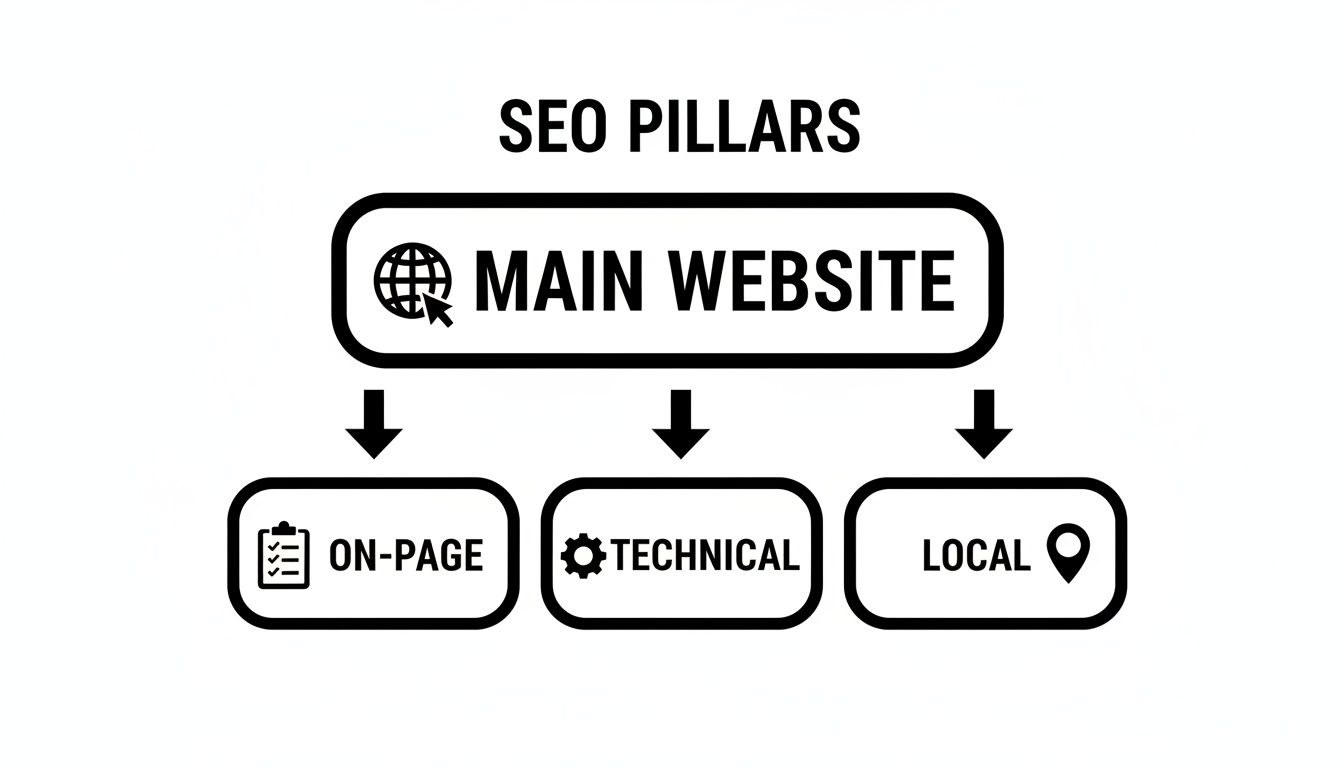
As you can see, a successful website needs all these pillars working in harmony. Each one supports the others to create a strong, stable strategy that gets results.
Content and Link Building: Building Your Reputation
Finally, let's talk about reputation. Great content and links from other websites are the online equivalent of word-of-mouth marketing.
High-quality content—like genuinely helpful blog posts, guides, or detailed service pages—shows that you're an expert in your field. It gives potential customers a reason to trust you. When you’re trying to understand the core SEO services you need, getting a grip on SEO content writing best practices is a must for creating content that actually gets seen.
Link building is about earning links to your site from other respected websites. Google sees each of these links as a vote of confidence, a sign that you're a trustworthy source. Put them together, and powerful content with quality links builds the authority you need to climb to the top of the search results.
Core SEO Services at a Glance
To tie this all together, here’s a simple breakdown of how these essential services work in the real world for a local business.
| SEO Service Type | Primary Goal | Example for a Perth Business |
|---|---|---|
| Technical SEO | Ensure the website is fast, secure, and crawlable. | A dentist in Subiaco optimises their site so booking pages load in under 2 seconds on a mobile phone. |
| On-Page SEO | Make page content relevant to specific search terms. | A local bakery optimises its "Sourdough Bread" page with keywords, images, and clear headings. |
| Local SEO | Appear in location-based searches and on Google Maps. | A Joondalup plumber ensures their Google Business Profile is complete with service areas and opening hours. |
| Content | Build authority and attract customers with expertise. | A financial planner in Perth writes a blog post: "5 Common Mistakes First Home Buyers Make in WA." |
| Link Building | Earn "votes of confidence" from other websites. | The same planner gets a link from a popular Perth real estate blog, boosting their site's credibility. |
Each of these elements is a critical piece of the puzzle. A truly effective SEO strategy doesn't just focus on one but integrates them all to create sustainable growth.
Winning the Local Search Game in Your Suburb
For most Australian small businesses, the best customers are the ones right around the corner. While dreaming of ranking across the country is nice, winning the local search game in your own suburb is what really pays the bills. This is what local SEO is all about: making your business the obvious choice for customers in your immediate area.

Think of it this way: when someone in Fremantle searches for "best coffee near me," Google’s job is to give them a great local result, not a café in Sydney. Your job is to send all the right signals to Google so your business pops up on that map. These signals are the nuts and bolts of the local SEO services small business owners should be focusing on.
Mastering Your Local Signals
The absolute cornerstone of local SEO is your Google Business Profile (GBP). This is your digital storefront on Google Search and Maps, and it's non-negotiable to keep it perfectly updated with your correct name, address, phone number (NAP), and opening hours.
But a truly powerful GBP goes beyond the basics. You need to fill it out with:
- High-Quality Photos: Show off your work, your team, and your shop or office.
- Service Listings: Be crystal clear about what you actually do.
- Customer Reviews: Actively ask for and respond to reviews. This builds incredible trust – in fact, 95% of consumers trust online reviews as much as a personal recommendation.
- Regular Posts: Share updates, special offers, and news, just as you would on social media.
Every one of these details strengthens your local relevance and tells Google that you're an active, trusted business worth recommending.
Expanding Your Digital Territory
If you only optimise for a single location, you're leaving money on the table. This is especially true for businesses that cover multiple suburbs, like a Perth tradie who works everywhere from Joondalup to Rockingham. Creating location-specific pages on your website is a total game-changer. These can't just be copy-paste pages with the suburb name changed.
Each page needs to be a unique and valuable resource for customers in that specific area. Mention local landmarks, talk about common problems you solve for that neighbourhood, and sprinkle in testimonials from clients who live there.
This strategy shows Google you have deep relevance across a much wider service area, turning your website into a powerful magnet for local enquiries. The data on this is compelling. A 12-month study of 36 Australian businesses revealed that those targeting multiple locations generated a massive 557% more organic traffic than their single-location counterparts. You can dig into the full findings of this Australian local SEO research to see the massive potential.
By building out targeted content for every suburb you serve, you’re not just tweaking a website. You're building a network of digital signposts that guide local customers straight to you. For a practical example of this in action, check out our breakdown of SEO strategies for Fremantle businesses. This is how you turn clicks into real-world customers.
Keeping Your WordPress Website SEO-Ready
It’s no surprise so many Aussie small businesses build their websites on WordPress. It’s powerful, flexible, and gets the job done. The trap, however, is thinking you can just "set and forget" it. That approach can quietly undo all your hard work on SEO.
A neglected WordPress site is like a shop with a flickering sign, a door that sticks, and a roof that leaks. It’s frustrating for customers and tells Google all the wrong things.
Your website is your digital shopfront, and just like a physical store, it needs regular upkeep to stay in top shape. This ongoing maintenance is a critical part of any good SEO services for small business package. It’s all about ensuring the technical foundation of your site is solid, so your other SEO efforts have a chance to shine.
The Dangers of a Neglected Site
An outdated or poorly maintained website will eventually drag down your search rankings. Slow loading times are a huge killer—over 50% of users will give up and leave a page if it takes more than three seconds to load. That high bounce rate is a massive red flag to Google that your site isn’t providing a good experience.
It gets worse. Outdated plugins or an old version of WordPress can open the door to security vulnerabilities. Getting hacked can lead to being blacklisted by search engines, making your online visibility vanish overnight. This is why proactive maintenance isn’t just a "nice-to-have" task; it’s an essential part of protecting your business.
"Think of WordPress maintenance as the regular tune-up for your business's primary marketing engine. Skipping it is like never changing the oil in your delivery van—sooner or later, it’s going to break down, and always at the worst possible time."
Essential WordPress Maintenance Tasks
To keep your website healthy and search-engine-friendly, you need a consistent maintenance routine. This is more than just logging in every now and then; it’s about a proactive process that keeps everything running smoothly and securely.
A solid maintenance plan should always cover these bases:
- Regular Updates: This means updating the WordPress core, all your themes, and every single plugin as soon as new versions are released. This is your first line of defence against security holes and bugs.
- Performance Tuning: Your website has to be fast. This involves optimising images so they don't slow things down, using browser caching, and cleaning up your site’s database to ensure zippy load times.
- Security Measures: You need active protection. Proactive malware scanning, a strong firewall, and regular security audits are crucial for keeping threats at bay.
- Consistent Backups: Think of daily or weekly off-site backups as your insurance policy. If the worst happens, you can restore your site quickly with minimal downtime.
To make sure your WordPress site is properly optimised for local searches, it's worth exploring the best local SEO WordPress plugins available. For a deeper dive, our guide on https://www.webby.net.au/guides/the-wordpress-best-practices-checklist/ is a great resource. Keeping your site in peak condition is absolutely fundamental to your long-term success in search rankings.
How to Choose the Right SEO Partner
Picking someone to handle your SEO is a massive decision. It’s not just another marketing expense; you’re handing over the keys to your most critical asset – your visibility on Google. The right partner acts like a true extension of your team, driving real growth. The wrong one can burn through your budget and, in the worst-case scenario, actually hurt your website's rankings.
To make the right call, you need to cut through the industry jargon and focus on what actually matters: more qualified leads and sales. You need a solid process to vet potential agencies or consultants to find someone genuinely committed to helping your business win in the long run. Think of it as finding a business partner, not just hiring a service provider.
This means you need to arm yourself with the right questions and know what to look for. Any decent SEO specialist will welcome tough questions and give you straight, transparent answers.
Questions to Ask Any Potential SEO Provider
Before you even think about signing a contract, you have to do your homework and really understand how a potential partner works. The way they answer your questions will tell you everything you need to know about their process, their transparency, and their real-world experience.
Here are the non-negotiable questions to ask:
"Can you show me a case study for a business like mine in Australia?" You're looking for proof they've done this before, preferably in your industry or at least in a local market like Perth. Vague, generic examples don't mean much; you want to see specific, relevant success stories.
"What does your communication and reporting look like?" Don't settle for fuzzy answers. Ask to see a sample monthly report. It should be easy to understand and focus on KPIs that directly impact your bottom line—things like organic traffic growth, lead conversions, and keyword visibility for your key services, not just vanity metrics.
"What's your game plan for the first 90 days?" A professional will have a clear, structured roadmap. This should involve a deep-dive technical audit, building out a keyword strategy, getting your on-page SEO in order, and making sure all the tracking is set up correctly from day one.
"How do you actually measure success?" Their answer must connect back to your business goals. If they start waffling on about rankings and nothing else, that’s a major red flag. Success is about more phone calls, more form submissions, and ultimately, more revenue.
Spotting Red Flags and Understanding Pricing
Asking good questions is half the battle, but you also need to know what warning signs to look out for. Be extremely cautious of anyone who offers a guarantee.
No one can ethically guarantee a #1 ranking on Google. The algorithm is far too complex and always changing. Big promises often signal a reliance on risky, black-hat tactics that can get your site slapped with a penalty.
Finally, let's talk about the elephant in the room: pricing. For comprehensive local SEO services, small business owners in Australia should budget for an investment of $1,500 to $3,000 per month. It's a significant investment because it builds a sustainable asset that keeps paying you back long after a paid ad campaign is switched off.
Consider this: 46% of all Google searches are for local information, and a staggering 72% of those searchers will visit a store within 8km. Local SEO is incredibly powerful, and it's worth understanding how these stats impact Australian businesses to see the full potential.
Measuring SEO Success Beyond Rankings
Everyone wants that number one spot on Google. It's a great feeling, but chasing rankings alone is a classic rookie mistake—it's what we call a vanity metric. Real success from SEO services for a small business isn't about bragging rights; it's about making the phone ring, filling up your inbox with quote requests, and getting more sales through the door.
Ultimately, you want your website to be a reliable, predictable engine for growth.
To make that happen, the goal isn't just to be seen, but to be found by the right people—your ideal customers who are actively searching for exactly what you offer. This means we need to track Key Performance Indicators (KPIs) that are directly tied to your business goals. It's time to stop obsessing over daily ranking changes and start focusing on the numbers that actually grow your bottom line.
Tracking What Truly Matters
The first 90 days of any SEO campaign are all about laying a solid foundation. It always starts with a deep dive into your website to figure out what's working and what's holding it back. From there, we build a strategy and get the initial fixes and improvements rolling. You can get a better sense of what this involves by looking at what a comprehensive website audit service uncovers.
During this initial phase, we keep a close eye on progress using indispensable tools like Google Analytics 4 (GA4) and Google Search Console. These platforms give us the hard data we need to measure the KPIs that show a real return on your investment.
Here are the core metrics we monitor:
- Organic Traffic Growth: Are more people finding your website through Google searches without you paying for ads?
- Lead Generation: How many contact forms, phone calls, or direct emails are coming from that organic traffic?
- Conversion Rate: What percentage of those website visitors are actually taking action and becoming a lead?
By focusing on these business-centric KPIs, SEO stops being some kind of digital dark art and becomes a transparent, measurable marketing channel. You can draw a straight line from your investment to your business's growth.
Think about it this way: for an electrician here in Perth, success isn't just ranking for "electrician." It's seeing a 25% increase in online bookings from customers in Subiaco and Joondalup. That's how you measure the real-world impact of a smart SEO strategy.
Common Questions About Small Business SEO
Dipping your toes into the world of SEO always brings up a few questions. As a business owner, you want to know what you’re getting into and feel confident about where your marketing budget is going. Let’s cut through the noise and answer a few of the most common queries we hear.
How Long Does It Take to See SEO Results?
This is the big one, isn't it? While you might spot some small wins within the first three months, you should really expect to see significant, lasting results from SEO in about four to six months.
Think of it like getting fit. You don't walk out of the gym with a six-pack after one session. It takes consistent effort over time to build strength and see real change. The same goes for SEO. Factors like how competitive your industry is here in Perth and the starting condition of your website will also affect that timeline. It’s a long-term strategy, not a magic wand.
SEO is about building a real asset for your business. It's the difference between renting a billboard (paid ads) and actually buying the land and building your own shop—a store that brings in free, organic foot traffic for years to come.
Can I Do SEO Myself for My Business?
You absolutely can, and many business owners successfully manage the basics. Things like keeping your Google Business Profile updated or optimising a few page titles are great starting points.
But where it gets tricky is the deeper technical stuff, the consistent content creation, and the strategic link building. This is often where progress stalls. A professional brings the expertise, the expensive tools, and most importantly, the dedicated time to get the job done properly. They can steer you clear of common mistakes that might actually hurt your rankings, ultimately saving you a lot of headaches and wasted effort. It’s about building real momentum, not just spinning your wheels.
At Webby Website Optimisation, we take the guesswork out of WordPress SEO for Australian businesses. If you're ready to see your site get faster, more secure, and start climbing the search rankings, check out our expert WordPress support services.