
For many Australian business owners, SEO services for small businesses are what turn a quiet website into your main source of customer leads. It's all about making sure local customers, who are actively looking for what you sell, can actually find you.
Why Your Small Business Needs SEO More Than Ever
Imagine you’ve opened a brilliant new shop, but it’s tucked away in a back alley with no sign. You could have the best products in town, but if no one knows you’re there, you won't be in business for long. Your WordPress website is that shop, and Search Engine Optimisation (SEO) is the big, bright sign that guides customers right to your door.
Without a decent SEO plan, your website is pretty much invisible online. Customers searching for a plumber in Perth or a new café in Fremantle won’t see you—they’ll see your competitors who are already on the first page of Google. SEO isn't just a technical chore; it's your most powerful tool for getting in front of locals who are ready to buy.
Connecting with Customers Who Are Ready to Buy
Think about how you use Google. When you need something, you search for it. The businesses that pop up first seem more credible, and you're far more likely to click on their links. In fact, over 75% of people never bother scrolling past the first page of the search results, which makes that top spot incredibly valuable real estate.
A well-thought-out SEO plan makes sure your business shows up in these critical moments. It’s working for you around the clock to:
- Boost Your Visibility: Puts your business in front of people actively looking for what you do.
- Build Trust and Credibility: A high ranking is like a stamp of approval from Google itself.
- Drive Quality Traffic: Attracts visitors who are genuinely interested in your offerings, which means they're more likely to become customers.
SEO is really about making your business the best and most trusted answer to a potential customer’s problem. When someone searches, you want Google to point directly to you.
The Foundation of a Winning Strategy
For Australian small businesses, a successful SEO strategy isn't about jumping on every new digital trend. It’s built on a few core pillars that work together to create a reliable stream of new business. This guide will walk you through the essentials, using practical examples and clear, no-fluff advice. We’ll demystify the whole process and show you how a solid WordPress site, strong local visibility, and genuinely helpful content come together to drive real growth.
The Four Pillars of an Effective SEO Strategy
Thinking about SEO services for small businesses can feel a bit like trying to assemble flat-pack furniture without the instructions. You’ve got all these different parts, and it’s not immediately clear how they all fit together to create something solid.
To make it simpler, a strong SEO strategy is built on four essential pillars. Each one supports the others, and together, they work to drive real business growth. Understanding these pillars helps you see the whole picture—it’s not about a single trick, but about building a sturdy structure that gets your business noticed by the right customers.
This diagram shows how these core SEO pillars work together to achieve the main goal: more customers.
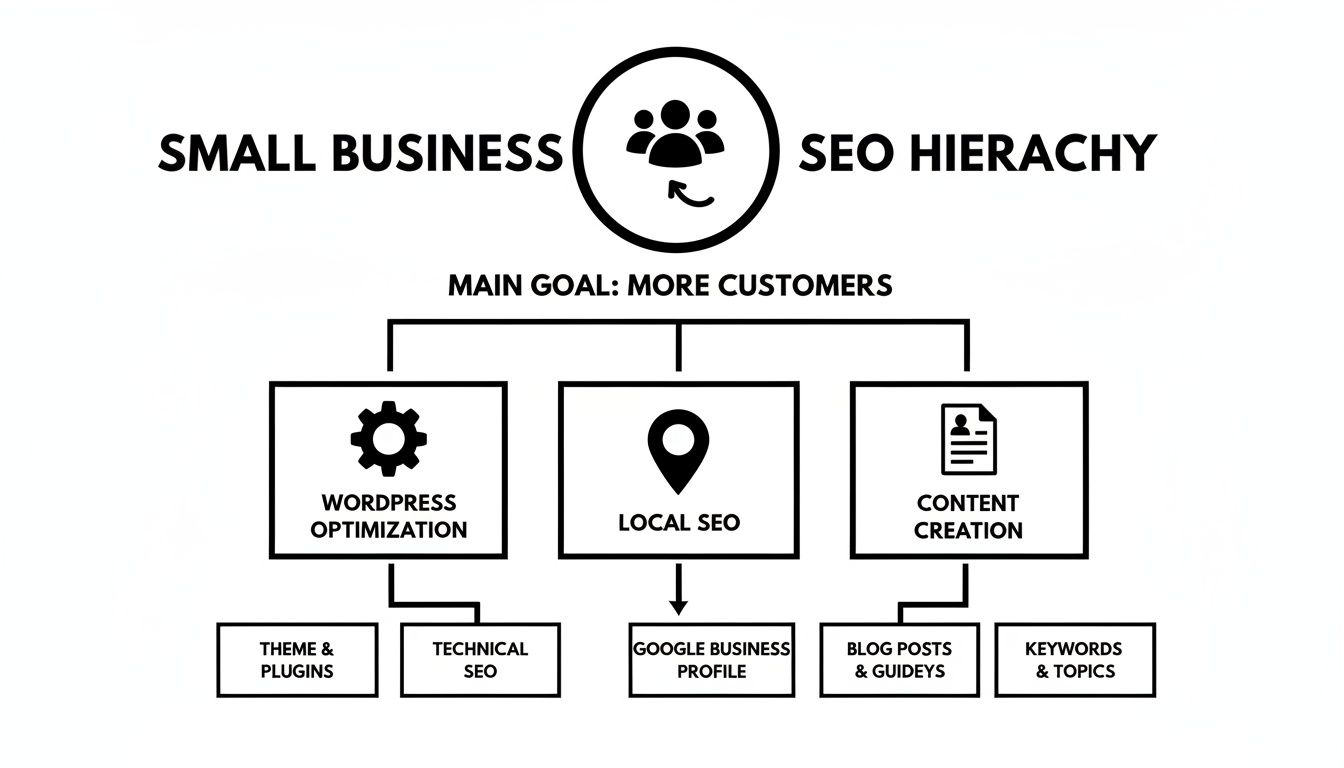
As you can see, a solid WordPress foundation, smart local targeting, and genuinely helpful content are all needed to attract and convert customers effectively. Let’s break down what each of these pillars actually involves.
To give you a clearer picture, here's a quick overview of how these four essential pillars break down into specific, actionable services.
Breaking Down Essential SEO Services
This table provides a clear overview of the four key SEO pillars and the specific services that support each, helping you understand what to look for in a complete SEO plan.
| SEO Pillar | Key Services Included | What It Achieves |
|---|---|---|
| Technical SEO | WordPress updates, speed optimisation, mobile-friendliness, security (HTTPS), schema markup, sitemap management. | Ensures your website is fast, secure, and easily understood by search engines, forming a solid base for all other efforts. |
| Local SEO | Google Business Profile optimisation, local citations, online review management, location-specific keyword targeting. | Makes your business visible to nearby customers actively searching for your services, driving foot traffic and local enquiries. |
| Content & On-Page SEO | Keyword research, blog writing, service page optimisation, meta descriptions, internal linking, header tags. | Answers customer questions, builds authority in your industry, and helps you rank for the specific terms your audience uses. |
| Conversion Optimisation | Call-to-action (CTA) design, user experience (UX) improvements, A/B testing, form optimisation, landing page design. | Turns website visitors into actual leads or customers by making it easy and compelling for them to take the next step. |
Each pillar is crucial. A technically perfect site with no content won't rank, and great content on a slow, broken site won't convert. They all need to work in harmony.
Pillar 1: Technical SEO and WordPress Maintenance
Think of Technical SEO as the foundations of your house. Before you can even think about paint colours or furniture, you need to be certain the walls are strong, the wiring is safe, and the plumbing works. For your website, this means ensuring your WordPress site is fast, secure, and easy for Google's crawlers to understand.
A slow or broken website is a massive turn-off for both visitors and search engines. In fact, statistics show that over 50% of users will give up and leave a page if it takes more than three seconds to load.
Key parts of a solid technical SEO plan include:
- Site Speed: Optimising images, code, and server response times so pages load in a snap.
- Mobile-Friendliness: Making sure your site looks great and works perfectly on smartphones and tablets.
- Crawlability: Giving Google a clear map to find and index all the important pages on your site.
- Security: Using HTTPS to protect your visitors' data and build trust from the get-go.
For a Perth-based electrician, a technically sound website means that when someone frantically searches "emergency electrician Perth" on their phone, the site loads instantly without any frustrating errors.
Pillar 2: Local SEO
If you run a local business, Local SEO is your digital shopfront sign. For businesses with a physical shop or those serving a specific geographic area, this pillar is absolutely non-negotiable. It’s all about making sure you pop up in local search results, like Google Maps, when potential customers nearby are looking for exactly what you offer.
This is especially critical for service-based businesses. The goal is to appear right at the top for searches like "best coffee near me" or "plumber in Fremantle," driving real-world foot traffic and local phone calls. A huge part of this is building a strong online reputation through local directory listings and, of course, customer reviews.
A well-optimised Google Business Profile is the cornerstone of any local SEO strategy. It’s your free, high-visibility listing that puts your business on the map—literally.
For that Fremantle cafe, a strong local SEO presence means appearing in the "Local Pack" map results when tourists and residents search for a place to eat, guiding them straight to their door.
Pillar 3: Content and On-Page SEO
If technical SEO lays the foundation, then your content is the expert salesperson working for you 24/7. It’s the blog posts, service pages, and guides on your website that answer your customers’ biggest questions, build your authority, and give Google a very good reason to rank you.
On-page SEO is simply the art of optimising this content. It involves strategically placing keywords in your page titles, headings, and text to signal to Google what each page is about. This is how you start ranking for the specific phrases your ideal customers are typing into the search bar. If you're new to this, you can check out our quick guide to SEO.
Imagine a landscaping business in Perth. They could write a blog post titled "5 Drought-Resistant Plants Perfect for Perth Gardens." This content directly solves a common local problem, establishes their expertise, and helps them rank for valuable search terms, attracting homeowners who need their services.
Pillar 4: Conversion Optimisation
The final pillar, conversion optimisation, is all about turning your website visitors into actual customers. It’s the process of making it as easy and compelling as possible for a user to take the next step—whether that's filling out a contact form, making a phone call, or buying a product.
You can have all the traffic in the world, but if your website doesn't persuade those visitors to act, your SEO efforts are going to waste. This involves having clear calls-to-action (CTAs), simple navigation, and trust signals like testimonials and case studies.
An important part of this is also building your site's authority with off-page SEO tactics like getting high-quality backlinks. When other reputable sites link to yours, it signals to search engines that you're a trusted source. You can dive deeper with a practical guide to finding pages that link to you to understand this better.
For an online store selling handmade goods, conversion optimisation might involve adding high-quality product photos, simplifying the checkout process to just a few clicks, and displaying customer reviews prominently to encourage a purchase.
Winning the Local Search Game in Australia
For most small Aussie businesses, local search isn't just part of the strategy—it's the whole game. It's the digital equivalent of setting up shop on the busiest street in town. When someone in your area needs what you offer, you want to be the first name they see. This is where SEO gets real, turning your website from a simple online brochure into a machine that generates phone calls and quote requests.
Think of it like drawing a digital circle around your service area. Anyone inside that circle searching for your services should find you, no sweat. This is especially true for tradies, cafes, clinics, and any other business that lives and breathes by its local customer base.

Beyond a Single Location
One of the biggest missteps I see small businesses make is getting fixated on their physical address. Your customers aren't just in one suburb; they're spread across the entire region. A smart local strategy involves creating dedicated service area pages on your WordPress site.
Let’s say you're a plumber based in Perth. You don't just work in the CBD, right? You probably serve customers in Joondalup, Rockingham, and Mandurah too. By building a unique page for each of those areas, you're sending a strong signal to Google that you're a relevant local expert there. This can open the floodgates for traffic from all those surrounding suburbs.
The impact here is massive. That small plumbing business, previously just scraping by, could see 557% more organic traffic by implementing this exact strategy. That’s not a hypothetical number; a 12-month study of 36 Aussie businesses found that single-location businesses averaged 12,186 sessions, while those targeting multiple locations pulled in an incredible 80,022.
Your Google Business Profile Is Non-Negotiable
Your Google Business Profile (or GBP) is the absolute cornerstone of local search. It's that handy info box that pops up in Google Maps and on the side of the search results, showing your hours, phone number, and reviews. An unoptimised profile is like having a shopfront with no sign and boarded-up windows. It just doesn't invite anyone in.
Getting your GBP right is non-negotiable. It's your digital front door.
- Complete and Accurate Information: Make sure your business name, address, and phone number (NAP) are identical everywhere online. Consistency is king.
- Select the Right Categories: Be specific. Choose primary and secondary categories that truly describe what you do.
- Upload High-Quality Photos: Show off your work, your team, and your space. It builds trust and gives people a feel for your business.
- Use Google Posts Regularly: Share updates, special offers, and news to keep your profile looking active and fresh.
Think of your Google Business Profile as a mini-website that lives directly on Google. Every piece of information you add makes it that much easier for a customer to choose you over a competitor.
The Power of Local Reviews and Citations
What other people say about your business carries huge weight. Positive reviews are one of the most powerful ranking factors in local SEO, building enormous trust with both potential customers and Google. Make a habit of actively encouraging your happy customers to leave a review on your GBP – it can give your visibility a serious boost.
Beyond reviews, you need to get your business listed in key Australian directories. These listings are called citations, and they act as little votes of confidence, verifying your business's legitimacy and location.
Make sure you’re listed on essential Aussie directories like:
- Yellow Pages
- TrueLocal
- Yelp Australia
- Your local business chambers
Again, consistency is the key. Every single listing must have the exact same name, address, and phone number. This repetition reinforces your location in Google's eyes and builds a rock-solid foundation for your local presence. For those targeting specific suburbs, knowing how to dominate local search is a game-changer. You might find our deep dive into SEO services for Fremantle businesses useful for more localised insights.
When you put it all together, a Perth-based electrician who optimises their GBP, creates service pages for suburbs like Canning Vale and Armadale, and actively gathers reviews will see a direct and measurable increase in quote requests. This isn't just about vanity rankings; it’s about connecting with genuine, high-intent local customers who are ready to hire someone. That's the real measure of success for any SEO services small businesses invest in.
How Quality Content Builds Trust and Attracts Customers
For a lot of busy small business owners, the idea of writing blog posts or creating new pages for your website feels like just another chore on a never-ending to-do list. I get it. But what if you started thinking about your website's content as your most valuable employee? One that works 24/7, answers customer questions at all hours, and consistently brings in new leads without ever asking for a pay rise.
That’s the real power of a smart content strategy. It’s the engine that fuels your SEO, giving Google more and more reasons to show your website to the right people. Every helpful article, every detailed service page, is another chance to build trust and show off your expertise long before someone is even ready to pick up the phone.

Answering Questions Your Customers Are Actually Asking
The secret to great content isn't about being a professional writer—it's about being an expert problem-solver. Your customers are already on Google, typing their biggest frustrations and most pressing questions into the search bar. Your goal is simply to be the best, most helpful answer they can find.
Just think about the questions you get asked every single day:
- "How much does X cost?"
- "Which option is better for my situation?"
- "How do I fix this common problem?"
- "What should I look for when hiring a [your profession]?"
Each of these questions is a golden opportunity for a piece of content. When you create pages that directly address these real-world queries, you attract highly relevant visitors who are already looking for what you offer. Before you start writing, it's absolutely vital to develop a robust content strategy to make sure your efforts are focused and effective.
Building Your Digital Asset Library
Every article and page you publish on your WordPress site becomes a permanent asset for your business. It's not like a paid ad that disappears the second you stop paying for it. A well-written blog post can attract traffic and generate leads for years to come, creating a powerful compounding effect over time.
A single, high-quality article can rank for hundreds of different search terms, continuously drawing in new visitors long after it’s published. Think of it as planting a tree that will bear fruit for seasons to come.
This isn’t just a nice theory; it's backed by hard data from businesses right here in Australia. A detailed 12-month analysis of 36 Aussie businesses showed that those who consistently published new content saw dramatically more website traffic. The numbers don't lie: businesses with a content plan averaged 60,276 sessions, completely dwarfing the 14,143 from those without one.
From Traffic to Trust: The Content-Driven Sales Funnel
Good content does so much more than just boost your rankings. It guides potential customers on a journey, turning them from complete strangers into paying clients. It works by establishing you as a credible, trustworthy authority in your field.
Here’s how that journey usually plays out:
- Awareness: A potential customer searches a question on Google, and your helpful blog post pops up in the results.
- Consideration: They read your article, find real value in it, and start browsing your other service pages. They start to see you as a knowledgeable expert.
- Conversion: When they’re finally ready to make a decision, your business is top of mind because you've already helped them out so much.
This is precisely why SEO services for small businesses must include a solid content component. Without it, you’re missing the most important piece of the puzzle—the part that actually convinces a visitor that you're the right choice. Your content is what turns a simple click into a loyal customer.
Choosing the Right SEO Partner for Your Business
Finding the right team to handle your SEO can feel like a bit of a minefield. The industry is packed with agencies making huge promises, but let's be honest, not all seo services for small businesses are created equal. Your mission is to find a transparent, reliable partner who actually gets your business, speaks your language, and can deliver a genuine return on your investment.
Making the right choice really boils down to asking the right questions. You’re not just buying a service; you're handing over a critical part of your business's growth to an expert. It's so important to look past the slick sales pitches and dig into their actual processes, how they report on progress, and their real-world experience.
A great partner will feel like an extension of your own team, focusing on your specific business goals, not just fluff metrics like keyword rankings.
Key Questions to Ask Potential SEO Providers
Before you even think about signing a contract, you need to have a proper chat to see if they're a good fit. Think of it as an interview for a long-term partnership. Coming prepared with a few sharp questions will help you cut through the jargon and spot the real experts.
Here are the non-negotiable questions you should have on your list:
- What’s your process for getting to know my business and my customers? A one-size-fits-all approach is a massive red flag. A good provider will want to dive deep into your ideal customers, your profit margins, and what sets you apart from the competition.
- Can you show me some examples or case studies of similar businesses you’ve helped? While they might not be able to share sensitive data, they should absolutely be able to talk you through their wins with other Aussie businesses, especially those on WordPress.
- How do you measure success, and what will my monthly reports actually look like? Look for answers that go beyond just rankings. They should be talking about tracking leads, phone calls, form fills, and real growth in organic traffic. Always ask for a sample report to see if their data is clear and genuinely useful.
- What’s your communication and support process like? You need to know exactly who you’ll be talking to and how often you'll hear from them. A clear communication plan from the start avoids a lot of frustration down the track.
A trustworthy SEO provider will never guarantee you the #1 spot on Google. What they will promise is a clear, data-driven strategy aimed at steady, sustainable growth. If a promise sounds too good to be true, it almost certainly is.
Setting Realistic Expectations for Results
One of the biggest letdowns with SEO comes from mismatched expectations around timelines. SEO is a long game, not a quick fix. It’s like planting a garden—it takes time for the seeds you sow to sprout and grow into something that bears fruit.
You should expect to see some initial movement and small wins within the first 3 to 4 months. This might look like better rankings for less competitive keywords or a small lift in organic traffic. But the significant, business-changing growth? That typically takes 6 to 12 months of consistent, focused effort. This is when all the foundational work—the technical fixes, content creation, and local optimisation—really starts to compound and deliver powerful results.
Why Local Expertise Matters
Choosing an SEO partner who truly understands the Australian market is non-negotiable. The way Aussie customers search and the competitive landscape here are unique. For a Perth small business, for example, local SEO isn't just a nice-to-have; it's a direct line to new customers and revenue. Think about it: the top-ranking spots in local searches pull in a massive 24.4% of all clicks, leaving everyone else fighting for scraps.
This is why nailing your local presence is so critical for generating high-converting leads, especially when you learn that 46% of all Google searches have local intent.
A partner with on-the-ground experience in your local market, like Webby Website Optimisation, will know exactly how to optimise your Google Business Profile, build relevant local citations, and create content that clicks with your community. This is how you win in a market where sharp targeting leads directly to higher conversion rates. By partnering with the right team, you're not just buying a service; you're investing in a proven roadmap for growth. To get a better idea of what a complete strategy looks like, you can learn more about our full range of SEO services.
Your Small Business SEO Questions, Answered
Jumping into SEO for your business can feel like a big move, and it's completely normal to have a stack of questions about cost, timing, and what to expect. Let's walk through the most common questions we hear from Australian business owners, giving you the straight answers you need to feel confident about your next steps.
How Long Does SEO Actually Take to Work?
This is usually the first question on everyone's mind. You’re investing time and money, and you want to know when you'll see a return. The honest answer is that real, lasting SEO is a long game—it's more like building a great local reputation than flipping a switch.
You'll likely start seeing some encouraging signs within the first 3 to 4 months. These are the early green shoots—maybe you'll notice your site popping up for a few more search terms, or you'll see a small but steady climb in website visitors from Google. It shows things are moving in the right direction.
But the results that really move the needle—a consistent flow of quote requests, phone calls, and new customers—typically take shape between 6 and 12 months. That’s the point where all the hard work (fixing technical issues, creating great content, building local signals) starts to compound and pay off in a big way.
Think of it this way: SEO isn't an overnight fix. It’s an investment in a powerful, long-term business asset. The goal is to build a solid foundation that keeps delivering value for years, unlike paid ads that vanish the second you turn off the spend.
This sustained effort is what makes your growth stable and protects you from the inevitable shifts in Google's algorithms.
What Should a Small Business in Australia Budget for SEO?
Let’s talk money. The cost of SEO isn’t one-size-fits-all; it really depends on what you're up against. A local plumber in a small town has a very different competitive landscape than an e-commerce store trying to rank Australia-wide.
For a typical small, locally-focused business in Australia, a comprehensive SEO campaign usually lands in the $1,000 to $3,000+ per month range. This investment covers the expertise, specialised tools, and dedicated hours needed to manage everything from your WordPress site's health to your local search presence and content strategy.
It helps to think about this differently. SEO isn't just another monthly expense; it's an investment in what is often your most powerful marketing channel. When it's done right, the return you get from a steady stream of high-quality organic leads almost always outweighs the cost.
Can I Just Do SEO Myself for My WordPress Website?
Yes, you absolutely can! In fact, getting your hands dirty with the SEO basics is a fantastic way to start building momentum without a huge upfront cost.
Here are a few high-impact things you can tackle on your own:
- Master Your Google Business Profile: This is your most valuable free tool for attracting local customers. Fill out every single section, add great photos regularly, and make a habit of asking your happy customers for reviews.
- Create Genuinely Helpful Content: Start a simple blog on your WordPress site. Think about the top 10 questions customers ask you and write articles that answer them. This builds trust and helps you show up in search results for those exact questions.
- Tidy Up Your On-Page SEO: Learn how to write clear, compelling page titles and meta descriptions for your main service pages. It’s like writing a mini-ad for your business that appears right in the search results.
But it's also important to know where the DIY path ends. The deeper, more technical side of SEO—and the strategic nous required to overtake established competitors—is where an expert comes in. A seasoned pro can help you sidestep costly mistakes, like a botched website migration or technical glitches that can make your site practically invisible to Google.
What Does a Good SEO Report Actually Look Like?
A good SEO report should do more than just show you a list of keyword rankings. Seeing your site climb from page three to page one is great, but that number doesn't tell you if it's actually making your phone ring.
A truly valuable report connects the dots between SEO activity and your business goals. It should clearly show you:
- Growth in Organic Traffic: Are more people finding you through Google this month than last month? And where are they coming from?
- Leads and Conversions: Of all those new visitors, how many took the next step? This means tracking form submissions, phone calls, and online sales directly from search.
- Key Performance Indicators (KPIs): It should highlight important metrics like the click-through rate from Google search results and which specific pages are bringing in the most valuable traffic.
- What’s Been Done & What’s Next: A transparent report summarises the work completed and clearly lays out the plan for the upcoming month.
Ultimately, a great report tells a simple story, backed by data, of how SEO is helping your business grow.
Ready to stop worrying about your WordPress site and start focusing on growth? The team at Wordby offers expert WordPress help and support, from daily maintenance and security to conversion-focused SEO and GA4 setup. Let us handle the technical details so you can get back to what you do best. Learn more about our flexible support plans.