
Performance Max can bring in leads for a plumber, accountant, clinic or tradie, but only if the account behind it is ready. It is a fully automated campaign type that runs across Google’s channels from one campaign, so it is only as smart as the conversion data you feed it. Get tracking, goals and exclusions right and it can add enquiries that Search alone would miss. Get them wrong and it will spend your budget on junk leads very efficiently.
This guide is for owners and managers of local service businesses in Australia. It covers when Performance Max (PMax) makes sense, how to set it up for leads rather than online sales, and the best practices that matter most.
TL;DR
- Performance Max is a goal-based campaign that reaches all of Google’s ad inventory from one campaign. For services, it works best alongside Search, not instead of it.
- Fix conversion tracking first. Count real enquiries (calls, form submissions, booked appointments), not page views.
- Use lead-specific goals and, once you have the data, optimise toward deeper actions such as qualified leads, by importing offline results.
- Give PMax strong text, image and video assets, then keep control with brand exclusions, negative keyword lists and a close look at Final URL expansion.
- Judge it on cost per qualified lead, not on the number of form fills.
Table of Contents
- What Performance Max does for a service business
- When Performance Max suits a service business
- Readiness checks before you launch
- How to set up Performance Max for service leads
- Bidding and measuring qualified leads
- Controls that protect your budget
- Our perspective on Performance Max for services
- Getting help with the setup
- FAQ
- Sources
What Performance Max does for a service business
Google describes Performance Max as a goal-based campaign type that accesses all Google Ads inventory from a single campaign. That means Search, YouTube, Display, Discover, Gmail and Maps can all be served from one setup. It is designed to complement keyword-based Search campaigns, helping you reach people and moments that a keyword list does not cover.
The automation is the point. Google uses its AI to automate bidding, targeting and creative optimisation across its channels to find leads at scale. You supply the goal, the budget, the assets and the audience signals. Google decides where each ad shows and who sees it.
That is helpful when you do not have the time to build and test dozens of ad groups. It is risky when you cannot see exactly what you are paying for. Understanding that trade-off is the whole game with PMax.
Why services are different from shops
Much of the PMax advice online was written for ecommerce, where a product feed and a clear revenue number on each sale give the algorithm plenty to learn from. A service business has no catalogue and often no online checkout. Your “sale” is a phone call, a quote request or a booking, and the real value only appears after you talk to the customer. We cover how this plays out locally in our guide to Performance Max for local services in Australia without a catalog.
The practical consequence: the quality of what you tell Google counts as a conversion decides everything.
When Performance Max suits a service business
Google recommends PMax when you have specific conversion goals, such as lead generation, and want to maximise performance across all channels using a single campaign. It also stresses that PMax should complement Search rather than replace high-intent keyword campaigns, as stated in the Performance Max overview in Google Ads Help.
In our experience with local service accounts, that translates to a simple rule of thumb.
| Situation | Where to start |
|---|---|
| No conversion tracking, or tracking you do not trust | Fix tracking before spending on any campaign type |
| Small budget, one or two core services, people search by service name and suburb | Search campaigns first |
| Search campaigns already capture most of the demand and you want more reach | Add PMax alongside Search |
| You can record which leads became paying customers | PMax is a strong candidate, with offline conversion imports |
| You cannot answer the phone or follow up leads quickly | Fix your response process before adding lead volume |
Search versus Performance Max
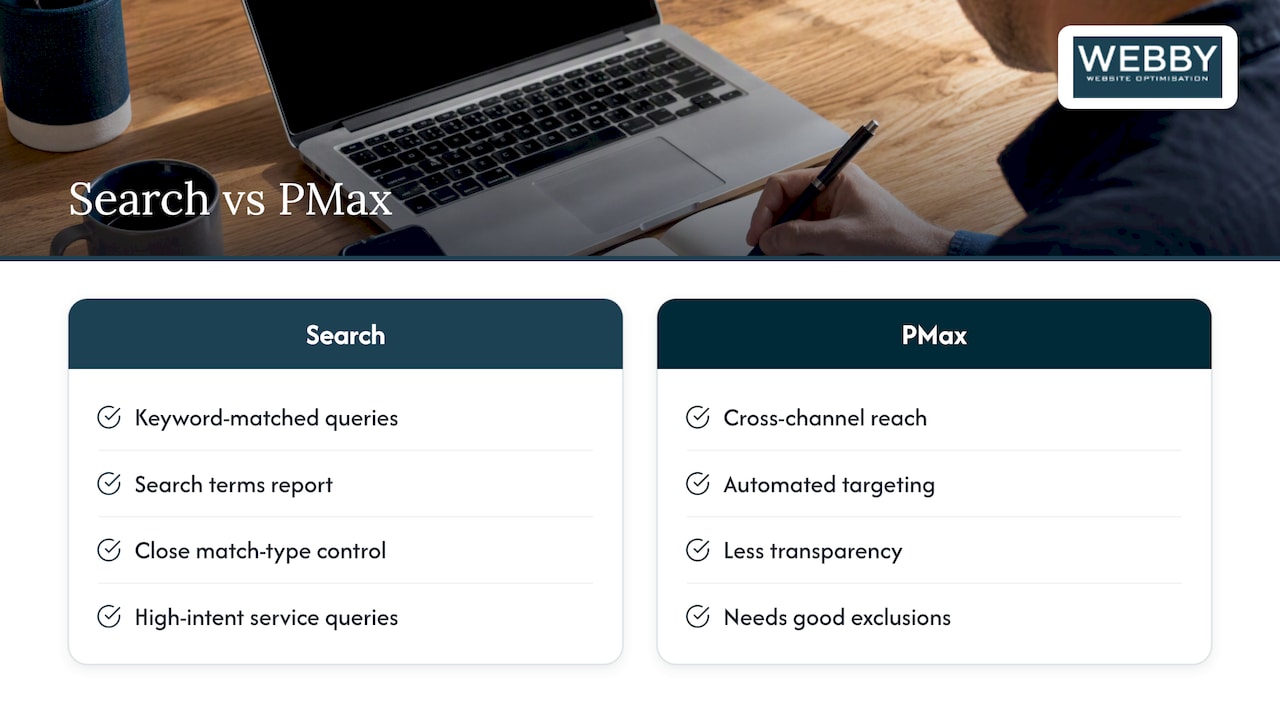
Search campaigns show your ad when someone types a query that matches your keywords. You choose the terms, see the search terms report and can control match types closely. For high-intent services like “emergency electrician Perth” or “tax accountant Fremantle”, that control is valuable.
PMax gives up some of that control in exchange for reach and automation. It can show your business to people who are earlier in their decision, on YouTube or Discover for example, and to people whose searches you never thought to target. The cost is less transparency and a greater need for good exclusions.
For most small service businesses, the sensible order is Search first, then PMax once Search is working and tracking is trustworthy.
Readiness checks before you launch
Before you create the campaign, work through these checks. They take a day or two and save weeks of wasted spend.
1. Conversion tracking counts real enquiries
Google’s lead generation guidance puts accurate conversion tracking and the right conversion actions at the top of its list. For a service business that usually means:
- Form submissions that reach a thank-you state, not just clicks on a Submit button.
- Calls from ads and calls from your website phone number.
- Click-to-call taps on mobile.
- Booking or quote requests through your scheduling tool.
If you use GA4, work through our four QA checks for GA4 conversion setup, and make sure the two platforms are connected properly using our guide to linking Google Ads and GA4. Duplicate conversions are the most common problem we see: one form fill counted twice makes your cost per lead look half what it really is, and teaches PMax to chase the wrong thing.
2. Goals match your business
Google lists lead-generation goals such as Contact, Submit lead form, Book appointment, Sign-up, Request quote, Qualified lead and Converted lead. Pick the ones that reflect real business value. A newsletter sign-up and a quote request should not carry the same weight.
3. Your website can convert the traffic
PMax sends visitors to your pages. If the page is slow, confusing on mobile or buries the phone number, you pay for clicks that go nowhere. Fixing the page is often a cheaper way to lift leads than raising the budget. Our website audit is built to find exactly these problems.
4. You can handle the leads
Automation will not fix a business that takes two days to return a call. Decide who answers, how fast, and how you will record the outcome of each lead. You will need that record shortly.
How to set up Performance Max for service leads
Here is the sequence we follow for local service accounts.
- Choose a lead goal. When creating the campaign, select a leads-focused objective and use only the conversion goals tied to real enquiries.
- Set a realistic budget. PMax needs enough daily conversions to learn. A budget too small to produce a steady flow of leads will keep the system in a slow learning state.
- Structure asset groups by service. Keep a drain-cleaning offer apart from a hot-water-system offer, so each set of headlines, images and landing pages speaks to one need. Organising asset groups around service categories and keyword themes is a widely used approach.
- Write varied assets. Google’s guidance is to provide a range of high-quality text, image and video assets. Use real photos of your team, vehicles and finished work. Include suburb names and service specifics in the text. If you do not supply video, Google may generate one automatically, which is rarely as good as your own.
- Add audience signals. Upload your customer list, add custom segments based on the searches your best customers use, and name the locations you actually serve.
- Set location and language carefully. A Perth plumber does not want clicks from Sydney. Use presence-based targeting and check the settings rather than accepting defaults.
- Review final URLs. Send each asset group to the most relevant service page, not the home page.
- Launch, then wait. Resist changing things daily. Give the campaign a few weeks of data before drawing conclusions.
What good assets look like for a service
A headline such as “Licensed Electricians in Fremantle” tells a searcher who you are and where. “Same-Day Quotes” or “Free On-Site Estimate” adds a reason to act. Mix benefit-led lines, proof lines (years in business, licences, review counts you can verify) and clear calls to action. Provide the full set of headline and description slots so Google can test combinations.
Bidding and measuring qualified leads
Google’s lead generation best practices suggest Maximize conversions when your aim is lead volume, and value-based Smart Bidding when your aim is lead value. For value-based bidding, Google advises choosing a conversion goal closest to a sale or closed deal that has at least 15 conversions in the last 30 days.
For a small service business, that points to a staged approach:
- Start with volume. Optimise to enquiries (form fills and calls) while you build up data.
- Add value. Assign different values to different actions. A booked job is worth more than a brochure download.
- Move deeper. Once you have enough qualified leads or closed jobs flowing back into Google Ads, optimise toward those.
Share offline results with Google
A form fill is not a customer. Google recommends that lead generation advertisers use offline conversion imports to share which leads actually resulted in sales, which helps Performance Max improve lead quality across its channels. In practice, you record the outcome in your CRM or even a spreadsheet (qualified, quoted, won) and upload it on a regular schedule.
This is the single most effective lever for stopping PMax from chasing cheap, low-quality enquiries. It is also the step most small businesses skip.
Which numbers to watch
- Cost per lead, by conversion type.
- Cost per qualified lead, which needs your own follow-up data.
- Lead-to-customer rate, by campaign.
- Revenue from won jobs against ad spend.
Ignore vanity metrics like impressions. A campaign with a higher cost per lead but a much better close rate is the better campaign.
Controls that protect your budget
PMax’s biggest complaint is the lack of visibility. Google gives you several controls, and Google’s own lead generation guidance covers them: Final URL expansion, brand exclusions and negative keyword lists.
Final URL expansion
By default, Google can send people to pages on your site other than the ones you chose. If ads appear against irrelevant pages, such as your careers page or a blog post, you can switch this off. For most service businesses we recommend turning it off or adding exclusions for pages that should never receive paid traffic.
Brand exclusions
PMax can show ads for searches on your own business name, which you might have received free from organic results or from a cheaper brand Search campaign. Brand exclusions help stop it taking credit for traffic you already own. Check how many of your conversions come from brand searches before judging results.
Negative keywords
Negative keyword lists can be applied at campaign or account level. For a service business, typical exclusions include job seekers (“jobs”, “careers”, “apprenticeship”), DIY searchers (“how to”, “free”, “tutorial”), and services you do not offer. We walk through a structured clean-up in our two-week negative keyword audit for PMax.
Common mistakes to avoid
- Counting every conversion equally. A phone call of three seconds is not a lead.
- Launching without tracking. The campaign will optimise to whatever signal you give it, including bad ones.
- Judging results in the first week. The system needs time to learn.
- Making constant edits. Frequent changes restart the learning process.
- Replacing Search entirely. Google itself positions PMax as a complement to Search.
- Ignoring lead handling. Leads that wait a day to be called go cold.
Our perspective on Performance Max for services
We treat Performance Max as a second-stage tool for local service businesses. Most of the accounts we see have a bigger problem than campaign type: the website is slow, the contact path is unclear or the tracking is double counting. Those problems make every ad format look worse than it is.
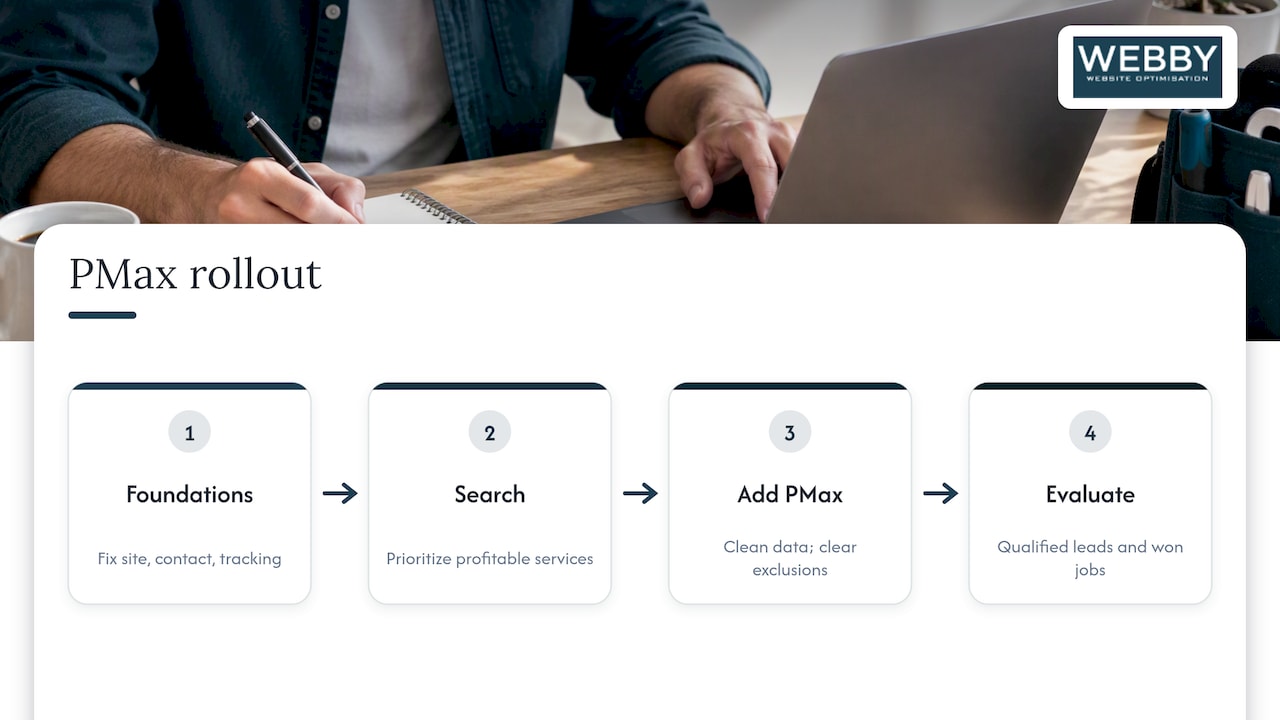
Our approach is to fix the foundations first, run tight Search campaigns on the services that make the most money, and only then add PMax with clean conversion data and a clear exclusion list. When the numbers come back, we judge them by qualified leads and won jobs, not by the platform’s own reporting. That is also why we put so much weight on the website itself: paid traffic is only as profitable as the page it lands on.
If a business tells us it wants “more leads” from PMax but cannot say which leads are good, we start there. Defining a good lead is the work that makes automation useful.
— Steve Doig
Getting help with the setup
If you would like a second pair of eyes before you put budget behind PMax, start with our Website Audit, a one-off A$1,250 review of the site that PMax will be sending traffic to. If you want one team to look after search, site and conversion improvements together, see the End-to-End Growth Engine™, or get in touch through our main site to talk about your Google Ads account.
FAQ
Is Performance Max worth it for a small service business?
It can be, once tracking is reliable and Search is already working. Google positions it as a complement to Search, not a replacement. If your budget only stretches to one campaign, start with Search on your highest-value services.
What is the best bidding strategy for service leads?
Google suggests Maximize conversions when you want lead volume and value-based Smart Bidding when you want lead value. For value-based bidding, it advises a goal closest to a sale with at least 15 conversions in the last 30 days. Many small businesses begin with volume and move to value as data builds.
How do I stop Performance Max wasting money on bad leads?
Start with accurate conversion actions, then import offline results so Google learns which enquiries became customers. Add brand exclusions, negative keyword lists and consider turning off Final URL expansion. Review search terms and placements regularly.
Do I need a product feed?
No. A service business does not need a product catalogue. You supply text, image and video assets, a goal and audience signals instead, and organise asset groups by service.
How long before I know if it works?
Allow a few weeks of steady spend before judging it, and avoid constant edits during that time. Judge it over a longer period by cost per qualified lead and won jobs, not early click numbers.
Sources
- About Performance Max campaigns, Google Ads Help
- Performance Max best practices for lead generation, Google Ads Help
- Drive conversions across Google’s ad channels with Performance Max, Google Ads Help