
Optimize your Google Business Profile and build review velocity before touching anything else. That single move controls who wins the local map pack, and the map pack is where pest control customers actually click. Start today: verify your listing, confirm the right business type, and send a review request text to your last three completed jobs.
TL;DR:
- Improving your Google Business Profile and review volume can significantly increase local visibility within weeks, especially on the map pack.
- Prioritize claiming the correct listing type, filling all categories and services, and collecting at least 50 reviews for a substantial lead boost.
- Create dedicated service pages for each pest type and location pages with unique content to strengthen your site’s authority and relevance.
- Focus on fixing site speed, implementing local structured data, and building relevant local links to enhance technical SEO and ranking signals.
- Tracking impressions, lead conversion time, and review growth helps measure progress, with organic rankings generally taking 6 to 12 months to fully develop.
Table of Contents
- Why Pest Control SEO Depends on the Local Map Pack
- Google Business Profile Checklist for Pest Control Companies
- How Should You Structure Service and Location Pages?
- Building a Keyword Map That Actually Converts
- Technical SEO Fixes That Actually Move the Needle
- Content and Link Building Approaches Worth Your Time
- What to Expect: Timeline, Budget, and KPIs
- How Webby Website Optimisation Approaches Pest Control SEO
- Three Priorities, In Order
- Get a Local SEO Starter Package Built Around Your Service Area
- Sources
- FAQ
Why Pest Control SEO Depends on the Local Map Pack
Pest control SEO is not the same game as SEO for a blog or an e-commerce store. Someone with carpenter ants in the kitchen wall is not researching. They’re searching “pest control near me” with a phone in hand, ready to call whoever answers first with a good reputation. That urgency shapes everything about how you should prioritize your marketing.
The map pack, the three business listings Google shows above organic results for local searches, captures the bulk of that click activity. Top-3 local pack results capture roughly 44% of clicks for local-intent queries, according to industry analysis. That’s nearly half of all interested searchers going to just three businesses, before anyone scrolls to a website link.
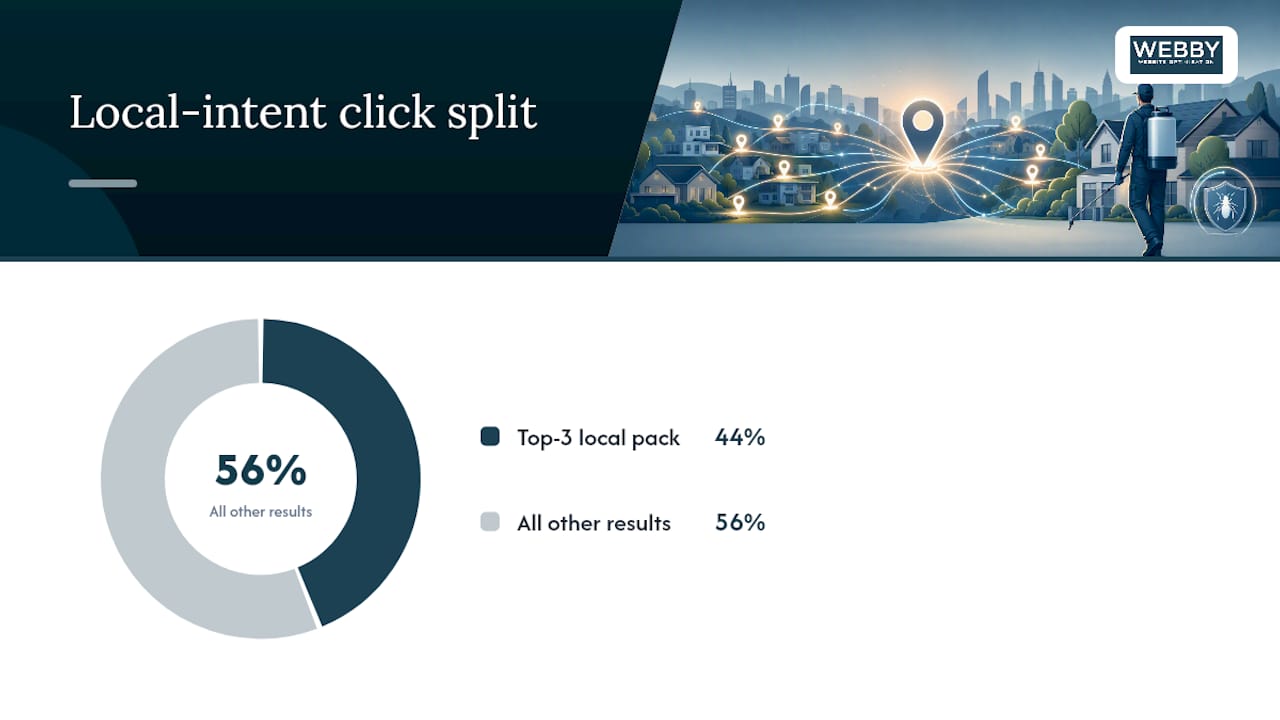
Two forces decide who lands in those three spots: proximity and prominence. Proximity you can’t change much. Prominence, largely driven by review count, review recency, and profile completeness, you can influence within days.
A few things separate pest control from other local trades in this equation:
- Emergency searches (bed bugs, wasp nests, rodent infestations) convert fast because the pain is immediate.
- Preventative searches (termite inspections, quarterly pest plans) convert slower but carry higher lifetime value.
- Close rates on local pack leads tend to run higher than cold leads from generic content, because intent is already established.
That’s why a GBP fix often beats another blog post for near-term revenue.
Google Business Profile Checklist for Pest Control Companies
Get the fundamentals wrong here and Google will actively suppress your visibility, not just ignore you. Here’s the order to work through:
- Pick the correct listing type. Service-area businesses that don’t see walk-in customers should hide their address and set a defined service radius; storefront operations should show the address. Mixing these up gets listings flagged or filtered out of local results.
- Fill every category and attribute field. Add your primary category (Pest Control Service) plus secondary categories for termite control, exterminator, or wildlife removal if they apply.
- List every service you offer, not just a generic description, so Google can match you to specific searches like “flea treatment” or “wasp nest removal.”
- Upload real photos of trucks, technicians, and completed jobs, and keep hours accurate, especially for emergency availability.
- Build a review request workflow. Send a direct review link by SMS or email within an hour of job completion, when satisfaction is highest.
- Reply to every review, positive or negative, within 48 hours using a short, specific response, not a copy-paste line.
- Post weekly updates using Google Posts to target seasonal pests like ants in spring or rodents in fall.
The review count part matters more than most owners realize. Businesses with 50+ Google reviews generate 266% more leads than those with fewer than 10, based on industry-reported comparisons.
Pro Tip: Text the review link, don’t email it. Text messages get opened within minutes; review request emails often sit unread for days, and by then the customer has moved on.
How Should You Structure Service and Location Pages?
A single “pest control services” page trying to rank for termites, bed bugs, rodents, and ants at once rarely ranks well for any of them. Google rewards specificity. Each pest problem carries different search intent, different urgency, and different vocabulary, so each deserves its own page.
Build dedicated pages for your core services: termite inspection and treatment, bed bug removal, rodent control, ant extermination, and any specialty service like wildlife removal or commercial contracts. Dedicated pest-specific pages combined with location pages create entity signals across your site that strengthen your overall local authority, not just rankings for individual pages.
Location pages need the same discipline. A page for “termite control in [suburb]” that just swaps the city name from a template is thin content, and Google treats it that way. Instead, include:
- Local pest pressures specific to that area’s climate or housing stock
- Real details about your service process and response times there
- A testimonial or case reference from a customer in that area
- A unique H1, a phone-number CTA, FAQ schema, and LocalBusiness structured data
Skip any of those and the page becomes competitor bait.
Building a Keyword Map That Actually Converts
Not every keyword deserves the same page or the same urgency. Sort your keyword list into three buckets before you write a single page.
- Emergency and money keywords get service pages: “bed bug exterminator [city],” “same day pest control,” “termite inspection cost.” These carry the highest intent and should link directly to a phone number and quote form.
- Commercial-investigation keywords support the buying decision: “best pest control company [city],” “pest control vs DIY.” These work well as comparison content or FAQ sections on service pages.
- Informational keywords build long-tail traffic and topical authority: “signs of bed bugs,” “how to tell if you have termites,” “do ultrasonic pest repellers work.” These belong on the blog, not the service pages.
A simple mapping example: “bed bug removal [city]” routes to your bed bug service page with a booking CTA. “Signs of bed bugs” routes to a blog post that educates, links back to that service page, and captures searchers before they’ve decided who to call. That second visitor often returns later, once the panic sets in, already familiar with your brand.
Technical SEO Fixes That Actually Move the Needle
Site speed decides whether a scared, itchy customer waits for your page to load or hits back and calls a competitor instead. Aim for a mobile load time under 2.5 seconds. Common fixes:
- Compress and resize images before upload instead of relying on plugins alone
- Host web fonts locally rather than pulling from multiple third-party servers
- Trim unused JavaScript and defer anything non-critical to the initial render
Structured data matters almost as much as speed for local service sites. Implement LocalBusiness schema, Service schema for each pest type, AggregateRating schema tied to your real review data, and explicit telephone and address markup so Google can match your listing to local queries with confidence.
Beyond that, three unglamorous items catch most technical audits:
- NAP (name, address, phone) consistency across your website, GBP, and every directory listing
- Clean canonical tags and an updated XML sitemap submitted through Google Search Console
- Click-to-call tracking on every phone number so you can tie calls back to specific pages
Test changes with Google’s PageSpeed Insights and the Rich Results Test before assuming a fix worked. Both take under two minutes and catch most implementation errors immediately.
Content and Link Building Approaches Worth Your Time
Skip the generic “10 ways to prevent ants” listicle that every pest control blog on the internet has already published. It won’t rank and it won’t convert. Better options:
- Publish case studies of real jobs, with before-and-after details and honest timelines
- Write localized how-to content tied to your service area’s specific pest pressures
- Build out service pages before blog content; conversion pages carry more weight for lead generation than articles
For links, target sources that carry real relevance: local property management companies, real estate agents, home inspection firms, trade associations, and community news sites covering neighborhood issues. Avoid bulk directory submissions with no editorial oversight; they add little and occasionally hurt more than they help.
Pro Tip: A single link from a local property manager’s resource page often outperforms twenty generic directory listings, because Google weighs relevance and context over raw link count.
These efforts compound with your GBP work. More citations and mentions across relevant local sites reinforce the prominence signals that push your listing into the map pack.
What to Expect: Timeline, Budget, and KPIs
Set expectations early so progress doesn’t get judged against the wrong clock. GBP and review improvements can shift call volume within a few weeks. Organic rankings and steady lead flow from service and location pages typically take 6 to 12 months to mature, based on industry benchmarks for local service SEO programs.
Budget accordingly. Pest control keywords carry high CPCs, averaging $29 to $34 per click in competitive markets, which is exactly why organic investment pays off over time: every lead you earn organically is one you’re not paying $30+ to capture through ads.
| Metric | What it tells you | Check frequency |
|---|---|---|
| Map pack impressions | Local visibility trend | Weekly |
| Calls from GBP | Direct lead volume | Weekly |
| Organic keyword positions | Ranking progress | Monthly |
| Site conversion rate | Whether traffic turns into leads | Monthly |
| Speed-to-lead (time to first response) | Whether leads get contacted before they call a competitor | Ongoing |
How Webby Website Optimisation Approaches Pest Control SEO
Webby Website Optimisation works with local service businesses on the exact stack this guide covers: WordPress site design, speed optimization, Google Business Profile fixes, and local SEO campaigns built around service and location pages. Webby documents these engagements through published case studies showing ranking and lead improvements for local industries facing the same map pack competition pest control businesses deal with.
What that looks like in practice for a pest control client:
- Auditing GBP setup, categories, and review workflow against the checklist above
- Rebuilding or restructuring service pages so each pest type gets its own optimized page
- Fixing site speed issues that cost mobile conversions
- Setting up structured data and NAP consistency across directories
A fixed-scope local SEO starter package or a free audit is usually the fastest way to see where the biggest gaps sit before committing to a longer program.
Three Priorities, In Order
When we look at a new pest control client’s website, three things get checked before anything else: Google Business Profile accuracy, review velocity, and how fast a lead gets a response after submitting a form. Get those three right and most of the ranking work downstream becomes easier, because Google is already seeing signals of a trustworthy, active local business.
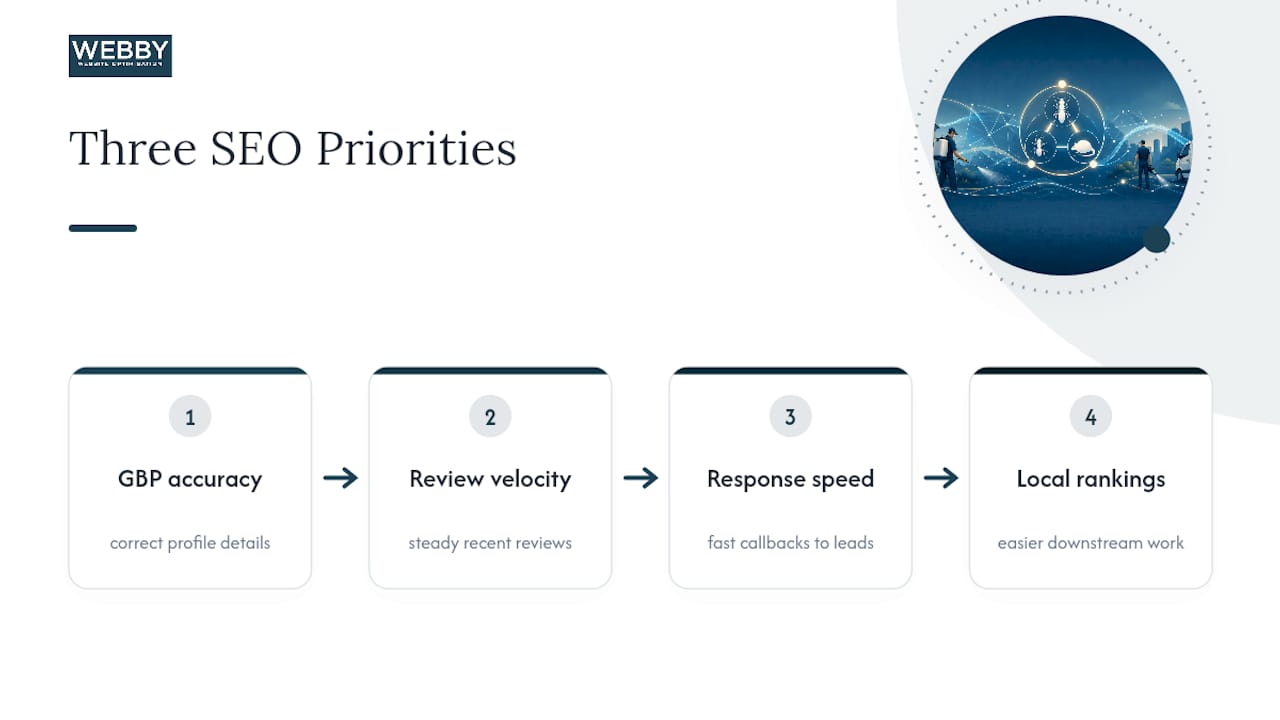
Owners chase blog traffic before fixing speed-to-lead constantly, and it’s backwards. A lead that waits four hours for a callback has usually already hired someone else. Fix the response time first. Then build the review system. Then worry about content depth.
Start with the GBP checklist above, or request a free audit to see exactly where your profile and site are leaking leads right now.
— Steve Doig
Get a Local SEO Starter Package Built Around Your Service Area
A professional digital marketing agency gives pest control owners a faster path than hiring a full-time marketer or juggling three different freelancers for site design, speed fixes, and local SEO separately. Everything, from Google Business Profile cleanup to service page builds to WordPress speed optimization, runs through one team that already understands how local pack rankings work for service businesses.
A free audit covers your current GBP setup, site speed scores, existing service and location page structure, and where competitors are outranking you in the map pack. From there, you can move into a fixed-scope local SEO starter package or a full website design and development rebuild if your current site is the bottleneck. If ongoing technical upkeep is the gap, WordPress maintenance support keeps fixes from slipping once the initial work is done.
Check the full services overview and request your free audit to see where your listing and website stand today.
Sources
- Pest Control SEO Guide — PipelineOn
- Guide to SEO for Pest Control Companies (2026) – Go Fish Digital
- Pest control SEO — rank on Google (2026 guide) · Aaptly
FAQ
How much should I expect to pay for SEO?
Costs vary by market and scope, but pest control keywords averaging $29 to $34 per click in paid search make organic investment worthwhile for reducing long-term customer acquisition costs. Fixed-scope local SEO packages typically cost less than sustained paid ad spend once rankings mature.
Who is the best SEO expert for a pest control business?
There’s no single universal answer, but the right choice is an agency or specialist with documented local service industry experience, not just general SEO knowledge. Webby Website Optimisation focuses specifically on local service businesses and backs its approach with published case studies.
How do I advertise a pest control business effectively?
Combine a strong Google Business Profile with active review generation, dedicated service and location pages, and paid search for immediate demand while organic rankings build. A structured local SEO approach typically outperforms scattershot advertising for sustained lead flow.
Who are the biggest SEO companies?
Large national SEO firms exist, but bigger doesn’t mean better fit for a local pest control business competing in one metro area or a handful of suburbs. A smaller agency with proven local service results, tracked through case studies and clear KPIs, usually delivers more relevant results than a generalist enterprise firm.
How long does pest control SEO take to show results?
Google Business Profile and review improvements can affect call volume within a few weeks, while organic rankings and steady lead flow usually take 6 to 12 months to mature fully.