
Claim and fully optimize your Google Business Profile, publish focused service pages for each job type you do, and start a steady review-request routine. That combination produces the fastest, most measurable lift in qualified plumbing calls from search, usually within two to three months, for a cost that’s a fraction of paid ads once rankings settle. Open Google Business Profile right now and check that your category, hours, and phone number are correct. That fifteen-minute task alone can change how often you show up for emergency searches this week.
TL;DR:
- Claim and verify your Google Business Profile, ensuring categories, hours, and contact details are accurate to boost emergency search visibility immediately.
- Focus on building a specialized service page for each core offering, including FAQs, pricing, and a clear call-to-action to improve ranking and conversions.
- Maintain steady review generation and respond promptly to build recent social proof that outranks older, stagnant reviews.
- Run paid ads alongside SEO, then gradually reallocate budget to organic strategies as local rankings and organic call volume increase over a 6 to 12-month timeline.
- Ensure your website loads quickly, is mobile-friendly, and uses schema markup to maximize local search presence and improve conversion rates.
Table of Contents
- Why Plumber SEO Matters More Than Paid Ads Right Now
- How Do You Optimize Google Business Profile for a Plumbing Business?
- What Should a Plumbing Service Page Actually Include?
- Does Site Speed Actually Affect Plumbing Calls?
- How Do You Fix Directory Listings and NAP Consistency?
- What Is a Realistic Timeline and Budget for Plumber SEO?
- What Should Be on Your Plumber SEO Audit Checklist?
- What I’ve Learned Building Plumber SEO Campaigns
- How Webby Website Optimisation Helps You Get There Faster
- Tools and Resources Worth Bookmarking
- Sources
- FAQ
Why Plumber SEO Matters More Than Paid Ads Right Now
Emergency plumbing searches convert fast. Someone with a burst pipe isn’t comparing five quotes. They’re calling whoever looks credible and answers first, which is why Google Business Profile visibility and phone responsiveness matter more than polished copy for these queries.
The cost math makes the case even clearer. Once a plumbing site’s rankings mature, organic leads run about $10 to $25 each, while Google Ads can climb well past that per lead. Local Service Ads sit in between at roughly $45 to $70 per lead in sampled benchmarks. SEO isn’t free. It takes months to build. But the long-term cost per call drops dramatically compared to running ads forever.
Pro Tip: Don’t cut your paid ads the day you launch an SEO campaign. Run both, then shift budget away from paid channels as organic calls start showing up in your call-tracking reports.
A practical channel mix looks like this:
- Run Local Service Ads and Google Ads early to keep the phone ringing while rankings build
- Track which paid keywords actually convert, and prioritize those same terms in your organic content
- Reallocate paid budget toward organic-supporting work (content, links, reviews) as SEO traction grows
- Reassess spend every quarter, not every month, since rankings take time to stabilize
Most plumbing companies still aren’t investing in SEO at all, which leaves a real gap for the ones who do the basics well and consistently.
How Do You Optimize Google Business Profile for a Plumbing Business?
Your Google Business Profile is often the very first thing a searcher sees, before they ever click through to your website. For emergency plumbing queries, it functions as core infrastructure rather than a nice-to-have listing, and a complete, accurate profile directly affects whether the phone rings.
Work through these steps in order:
- Claim and verify the profile, then set your primary category to “Plumber” (not “Contractor” or “Home Services,” which dilute relevance).
- Add secondary categories that match real services, such as “Drainage Service” or “Hot Water System Supplier,” if they apply to your business.
- Upload current photos of your team, vehicles, and completed jobs. Profiles with active photo updates read as more trustworthy to both searchers and Google.
- Set accurate hours, including holiday hours and 24/7 emergency availability if you offer it.
- List every service you perform individually rather than lumping them into one vague “plumbing services” entry.
- Add booking and call links so mobile users can act in one tap instead of hunting for your number.
- Build a review-request routine. Ask every satisfied customer within 24 hours of job completion, ideally through a text link.
- Respond to every review, positive or negative, within a few days.
Review velocity carries real weight here. Recent, steady reviews outrank older, static review sets, even when the older profile has a higher total count. A plumber with 15 reviews from the last two months often outperform a competitor sitting on 80 reviews from three years ago with nothing new added.
Pro Tip: Set a recurring calendar reminder to check GBP messages and Q&A weekly. Unanswered questions on your profile sit there in public, and competitors’ customers see them too.
What Should a Plumbing Service Page Actually Include?
Generic “our services” pages don’t rank and don’t convert. What works is a dedicated page for each major service, built to answer the exact question the searcher typed.
A solid service page template includes:
- An H1 that names the service plainly, like “Blocked Drain Repair” or “Hot Water System Installation”
- A short intro (two to three sentences) that confirms you do this exact job, right up top
- The signs or symptoms that tell a homeowner they need this service
- A plain-language explanation of your process, so the reader knows what to expect
- General pricing guidance, even a range, since cost is the first thing people search for after the problem itself
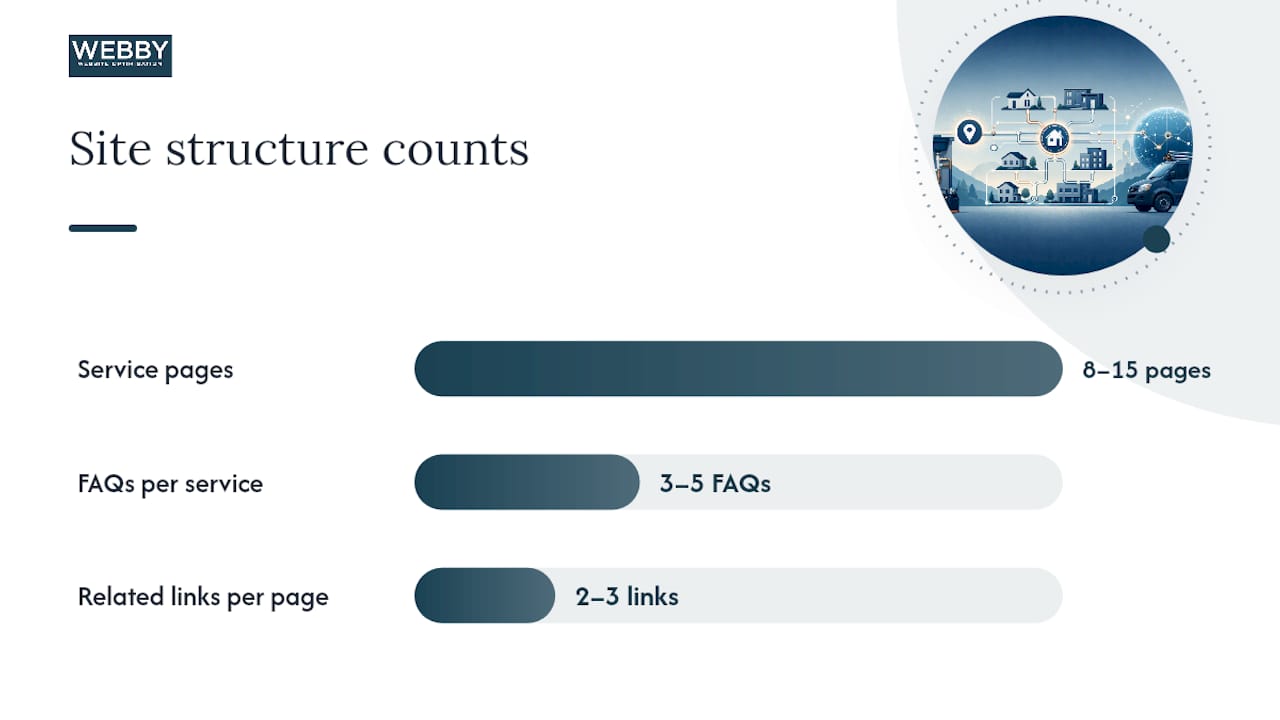
- Three to five FAQs specific to that service
- A clear call-to-action with a tappable phone number, repeated near the top and bottom of the page
Building service+location pages is where most plumbing sites get sloppy. The minimum viable structure for a plumbing SEO site includes a homepage, a services hub, 8 to 15 individual service pages, a service-areas hub, and city pages only for locations you actually serve regularly.
The decision rule is simple: build a city page only if you have real job history, real reviews, and real local knowledge to fill it with. If you’d have to swap out one city name for another and change nothing else, don’t build that page. Google, and your readers, notice.
Internal linking ties this whole structure together. Your homepage should link to the services hub, the services hub links to individual service pages, and every service page should link sideways to two or three related services and down to any relevant location page. This concentrates authority on the pages that actually generate calls, instead of spreading it thin across dozens of near-duplicate pages.
Does Site Speed Actually Affect Plumbing Calls?
Yes, and the effect is bigger for plumbers than for most other local businesses. Someone searching “emergency plumber near me” on a phone with a cracked screen and one hand isn’t going to wait for a slow page to load. They’ll hit the back button and call the next result.
Core Web Vitals matter here in a very concrete way. The most common fixes are:
- Compress and resize images before uploading, rather than relying on the CMS to shrink them
- Reduce render-blocking scripts, especially third-party chat widgets and tracking pixels loaded before content
- Choose fast, lightweight hosting suited to your site’s actual traffic, not a bloated shared plan
- Test with PageSpeed Insights monthly, not once at launch
Beyond raw speed, conversion design matters just as much. Phone numbers should be tappable links, not plain text a user has to copy and paste. A sticky call button that follows the user down the page on mobile removes friction at the exact moment someone decides to call. Trust signals, licensing numbers, years in business, review star ratings, belong above the fold, not buried at the bottom.
Schema markup rounds this out. Adding LocalBusiness, Service, and FAQ structured data helps Google understand exactly what you offer and where, which can improve how you appear in search results.
Finally, set up call-tracking. A provider like CallRail lets you tie phone calls back to the exact page and keyword that generated them, alongside GA4 event tracking for form submissions. Without this, you’re optimizing blind.
How Do You Fix Directory Listings and NAP Consistency?
NAP stands for name, address, and phone number, and inconsistency across directories quietly undermines local rankings even when your website itself is solid.
Run through this cleanup process:
- Search your business name across Google, Bing, Yelp, Apple Maps, and any trade-specific directories to see what’s live right now.
- Flag mismatches, especially old phone numbers, outdated suite numbers, or a business name that doesn’t match your current branding exactly.
- Check data aggregators like Data Axle and Foursquare, since these feed information to dozens of smaller directories automatically.
- Correct listings directly where you can claim them, and request removal of any duplicate profiles you find.
- Consider a citation management service if you’re managing more than a handful of locations, since manual cleanup at scale eats hours you don’t have.
Duplicate listings are the most common trap. They split your review count across two profiles and confuse Google about which one is authoritative.
What Is a Realistic Timeline and Budget for Plumber SEO?
The first 90 days are about foundation, not rankings. Focus on claiming and completing your Google Business Profile, publishing your top three to five service pages, fixing the worst speed issues, and launching your review-request flow. These are quick wins that set up everything after them.
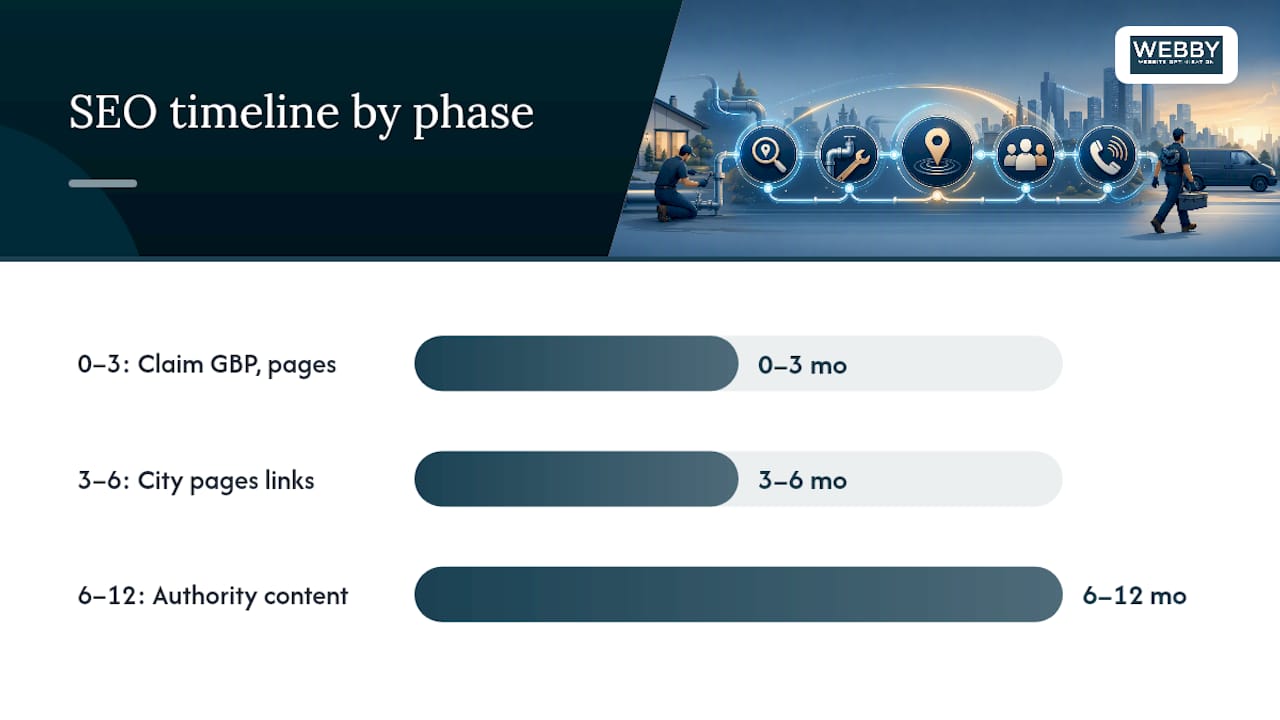
Months three through six are where city pages, local link building, and expanded on-site content come into play, assuming the foundation is solid. This is also when most contractors keep paid ads running while organic traction builds underneath.
By months six through twelve, authoritative content and a mature service page structure should be generating steady organic calls, at which point many businesses start trimming PPC spend since the cost-per-lead gap becomes hard to ignore.
Typical monthly agency spend for plumber SEO breaks down roughly like this:
- Small, single-location plumbers: modest monthly retainers focused on GBP and a handful of service pages
- Multi-branch or regional plumbing companies: higher monthly spend covering city pages, content, and link building
- DIY with occasional paid ads: lowest direct cost, but slowest and least consistent results
Given that organic leads settle around $10 to $25 each once mature, most owners find the math works in their favor well before the 12-month mark.
What Should Be on Your Plumber SEO Audit Checklist?
Run this yourself before hiring anyone, or use it to check work already being done for you.
- Is the site indexed in Search Console with no manual actions or coverage errors?
- Does the homepage load in under three seconds on mobile per PageSpeed Insights?
- Is Google Business Profile complete with correct category, hours, and services?
- Are there duplicate or templated location pages with no unique local content?
- Is LocalBusiness and Service schema present and validated?
- Is the review count growing month over month, not just sitting static?
The multi-branch trap catches even experienced operators: templated city pages that swap only the town name read as thin to both users and Google. Fixing this typically produces measurable ranking gains within 60 to 90 days, because unique local proof, real job photos, area-specific FAQs, actual customer names, is exactly what those pages were missing.
Pro Tip: Rank your fixes by impact versus effort. GBP completeness and tappable phone numbers are high impact and low effort, do those first. City page content overhauls are high impact but high effort, so schedule those in month two or three, not week one.
What I’ve Learned Building Plumber SEO Campaigns
Most plumbing SEO advice treats rankings as the goal. That’s backwards. Rankings are a proxy. Booked calls are the actual outcome, and I’ve seen plenty of plumbers celebrate a page one position that generates almost no phone activity because the page itself doesn’t convert.
Our approach prioritizes Google Business Profile completeness, tightly built service clusters, and conversion-focused page design over chasing broad keyword volume, because that combination is what shows up in the call-tracking data our clients actually care about. Case studies across local service industries back this up consistently: the businesses that treat GBP and service pages as infrastructure, not marketing add-ons, see call volume move faster than the ones chasing vanity rankings.
— Steve Doig
How Webby Website Optimisation Helps You Get There Faster
We build local SEO packages, fix site speed issues, manage Google Business Profile, and run review-generation programs, the exact stack this guide just walked through, without asking you to become an SEO specialist yourself. If you’re evaluating providers, ask three questions in any discovery call: how do you measure success (rankings or booked calls), how do you handle multi-location service pages without duplicating content, and what does a typical 90-day plan look like for a business your size.
If your site is slow, hard to navigate on a phone, or missing the service page structure this article outlined, a rebuild might be the faster path than patching an old site piece by piece. Our website design and development service is built around exactly this: fast, mobile-first sites structured for local service businesses that need the phone to ring. Get in touch and ask for a site audit against the checklist above, it’s a concrete starting point for the conversation.
Tools and Resources Worth Bookmarking
Before hiring anyone, spend an hour with these:
- Google Search Console and the Google Business Profile Help Center, both free, for indexing status and profile setup
- PageSpeed Insights for Core Web Vitals scores and specific fix recommendations
- BrightLocal’s local SEO benchmarks for a sense of how your review counts and citation coverage compare industry-wide
- A call-tracking provider like CallRail to start measuring which pages actually generate booked jobs
For broader local SEO fundamentals beyond plumbing specifically, our guide to local SEO for small business covers the same core mechanics that apply across service industries.
Sources
- SEO for Plumbers: Complete Playbook for 2026 | Web Tonic™
- Plumber SEO Audit: 16-Point Framework for Multi-Branch Sites
- The Complete SEO Playbook for Plumbing Companies | Hozio
- SEO for Plumbers: The Complete Guide | SEOTakeoff Blog
FAQ
How Much Should I Expect to Pay for SEO?
Costs vary by business size and market competition, but once rankings mature, organic leads typically settle around $10 to $25 each, well below the $45 to $70 range for Local Service Ads or the higher cost of Google Ads.
How Much an Hour Should a Plumber Charge?
This depends entirely on your local market, licensing, and overhead rather than anything SEO related. What SEO does is increase the volume of qualified calls at whatever rate you already set.
What Is the 80/20 Rule in SEO?
For plumbers, a practical version is that a small share of pages, usually your top service pages and Google Business Profile, drive most of your booked calls, so prioritizing those over broad content expansion tends to pay off faster.
What Is the Best Way to Advertise as a Plumber?
The strongest approach combines a fully optimized Google Business Profile, dedicated service pages for each job type, and paid ads running early to fill the gap while organic rankings build, then shifting budget toward organic as call volume from search increases.