
The fastest lever for tradie SEO is a tight combination of Google Business Profile optimization, focused service pages, and a steady drip of reviews. Get those three right and most trades see more calls within weeks. Your move today: log into Google Business Profile, confirm every service and suburb is listed correctly, and add a click-to-call button to your homepage.
TL;DR:
- Focusing on properly claiming and updating your Google Business Profile, including services, suburbs, and review generation, can produce call increases within weeks.
- Building targeted service and location pages with clear service descriptions, FAQs, and strong calls-to-action offers better local ranking results than a broad website.
- Maintaining a steady flow of three to five recent reviews monthly signals trustworthiness and helps keep your profile competitive in the map pack.
- Technical improvements like site speed, HTTPS, mobile click-to-call, and schema markup are crucial daily factors that affect visibility and lead conversion.
- Expect local SEO results to take six to twelve weeks for map pack rankings and three to six months for organic page rankings, depending on market competitiveness.
Table of Contents
- What Should a Tradie Fix First for Local SEO?
- The Core Tactics That Move Rankings and Phones
- What Does Tradie SEO Actually Cost in Australia?
- How Do You Vet an SEO Provider Without Getting Burned?
- Real Results: What Baseline Fixes Look Like in Practice
- How Should Tradies Weigh Speed Against Sustainability?
- Get Hands-On Help Without the Long-Term Contract
- Sources
- FAQ
What Should a Tradie Fix First for Local SEO?
You don’t need a six-month strategy document to start moving the needle. You need a short list you can knock out this week, even if you’re the one doing it between jobs. Hand this to an apprentice or office manager and most of it gets done in a day.
- Claim and verify your Google Business Profile. Add every service you offer, list the suburbs and postcodes you cover, and upload at least ten real photos of finished jobs, not stock images.
- Add click-to-call and your main service area to your homepage headline. A visitor on a phone should see your trade and location in the first five seconds, with a tap-to-dial number they don’t have to hunt for.
- Send a review request to your last five happy customers today. Use a direct link straight to your Google review form, not a general “leave us feedback” message that makes people guess where to go.
- Build or fix one to three service pages that name the job and the suburb. “Hot Water System Repair Fremantle” beats a vague “Our Services” page every time it’s searched.
- Run your site through a mobile speed check and fix the obvious drags. Compress oversized images, confirm you’re on HTTPS, and turn on basic caching if your host offers it.
None of this requires a developer. Most of it requires twenty minutes and a phone.
Pro Tip: Text your review link instead of emailing it. Text messages get opened within minutes; review emails often sit unread for days, and by then the customer’s memory of the job has faded.
If you only do one thing this week, make it the Google Business Profile audit. It’s free, it’s fast, and it’s the single asset most tradies neglect the longest after setting it up once and forgetting it exists.
The Core Tactics That Move Rankings and Phones
Local SEO for contractors comes down to five interlocking pieces: your Google Business Profile, your website’s service and location pages, your reviews, your citations across trade directories, and the technical bones of your site. Skip one and the others work harder for less payoff. Here’s how to run each one properly.
Google Business Profile: the engine room
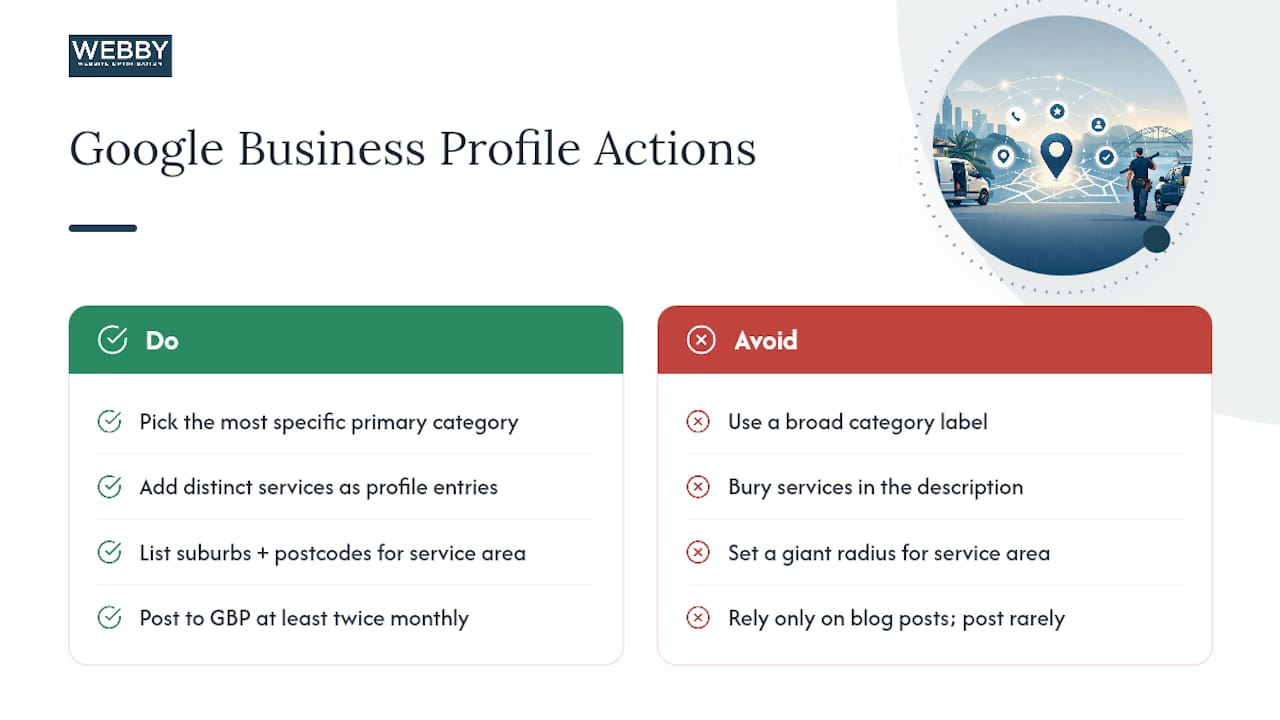
Pick the most specific primary category available, not the broadest one. “Electrician” beats “Contractor.” If you offer switchboard upgrades, smoke alarm compliance, or EV charger installs, add those as separate services inside your profile rather than burying them in a description nobody reads.
Set your service area using actual suburb names and postcodes rather than a giant radius circle, which Google tends to interpret loosely. A Melville plumber who lists Melville, Bicton, Palmyra, and Attadale by name signals real coverage far more clearly than a 25-kilometer radius pin.
Post to your Google Business Profile at least twice a month. A finished job photo with a two-line caption (“Replaced a corroded gas hot water unit in Booragoon, same-day turnaround”) does more for local relevance than any blog post you’ll write this quarter. Local guides increasingly point out that Google is weighting proximity and verified trust signals more heavily, which means an active, detailed profile now carries more of the load than it did a few years back, according to Ready to Rank’s 2026 guide for Australian tradies.
The map pack, the block of three local business listings that appears above organic results, drives the majority of local clicks for trade searches, which is exactly why profile work should be your first priority over any other tactic on this list.
Service and location pages that actually rank
Build one page per service, and where you cover multiple distinct towns with real demand, one page per service and area combination. The URL and heading pattern matters more than most tradies assume: something like /hot-water-repair-fremantle/ with an H1 reading “Hot Water System Repair in Fremantle” gives Google an unambiguous signal without tipping into keyword stuffing, a structure detailed in Get a Trades Website’s guide to local SEO for tradespeople.
Each page needs:
- A clear statement of the exact service and who it’s for
- The specific suburbs or postcodes covered
- Three to five FAQs answering the questions customers actually type into Google
- A visible call-to-action with your phone number and a booking link
- Internal links to related services (a blocked drain page linking to a hot water page, for instance)
Resist the urge to build twenty thin pages just to cover every suburb in your service area. A focused five-page site that clearly answers what you do, where you do it, and why someone should call you outperforms a bloated site stuffed with near-duplicate pages nearly every time.
Reviews: the compounding asset
A steady trickle of three to five reviews per month outperforms a one-off push of thirty reviews followed by silence for a year, based on patterns Digital Tradies has observed across trade businesses. Google reads consistency as a trust signal, and customers researching a plumber at 9 p.m. tend to trust a profile with recent activity over one that peaked eighteen months ago.
Ask at the moment of highest satisfaction, which is usually right after you’ve handed over the invoice and the customer has thanked you, not three days later via an automated email they’ve forgotten about. A short text works: “Thanks for having us out today! If you’ve got 30 seconds, a review here would mean a lot: [link].” Keep a simple script for handling a critical review too: acknowledge the specific issue, state what you did or will do about it, and invite them to call you directly. Never argue in the replies.
Citations and trade directories
Consistent NAP (name, address, phone number) across every directory you appear in still matters, even though its influence has softened compared to a decade ago. Accreditation-style directories, the Australian equivalents of the UK’s Gas Safe or NICEIC registers, carry weight because they combine a trust signal with a real backlink, a pattern Digital Tradies flags as still worth prioritizing. Master Electricians Australia, the Plumbing Industry Association in your state, and your local council business directory are worth the twenty minutes it takes to list yourself properly.
Audit your existing listings for old addresses or dead phone numbers before adding new ones. A citation with wrong information does more damage than no citation at all.
Technical basics that punish or reward you daily
Mobile speed isn’t optional for trade searches, most of which happen on a phone, often from someone standing in front of a leaking pipe. Field service marketing research consistently flags tap-to-call and fast-loading pages as non-negotiable for emergency and on-the-go searches. Compress your images before upload, confirm your site runs on HTTPS, and put your phone number in the header where a thumb can reach it without scrolling.
Add LocalBusiness schema markup to your homepage. This is a small block of code that tells Google explicitly what you do, where you’re located, and what hours you operate, and it can help your listing display richer information in search results.
Content for the customer who hasn’t called yet
Short, focused answers to specific problems, around 400 words, rank well for problem-aware searches like “why is my hot water system making a banging noise.” Pair a written answer with a simple before-and-after photo gallery of similar jobs, and you’ve built an asset that captures someone three weeks before they’re ready to book, not just the day they’re desperate.
Measurement that isn’t guesswork
Check your Google Business Profile insights monthly for calls, direction requests, and website clicks. Set up basic call tracking with a dedicated tracking number on your website so you know which leads came from search versus a referral. Google Search Console tells you which queries are already bringing people to your site, often revealing service or suburb combinations you hadn’t built a page for yet.
What Does Tradie SEO Actually Cost in Australia?
Pricing varies by market competitiveness, but most Australian tradies fall into one of three tiers. A basic one-off setup, covering Google Business Profile optimization, a handful of service pages, and technical fixes, typically runs as a project fee rather than a subscription. Ongoing local SEO management, which includes new content, review campaigns, and monthly reporting, is usually billed monthly and scales with how competitive your trade and city are.
What a solid first 90 days should include:
- A fully optimized Google Business Profile with correct categories, services, and area coverage
- Three new or rebuilt service pages targeting your highest-value jobs and suburbs
- Core technical fixes: speed, HTTPS, mobile click-to-call, and basic schema
- A review request system running consistently, not a one-time blast
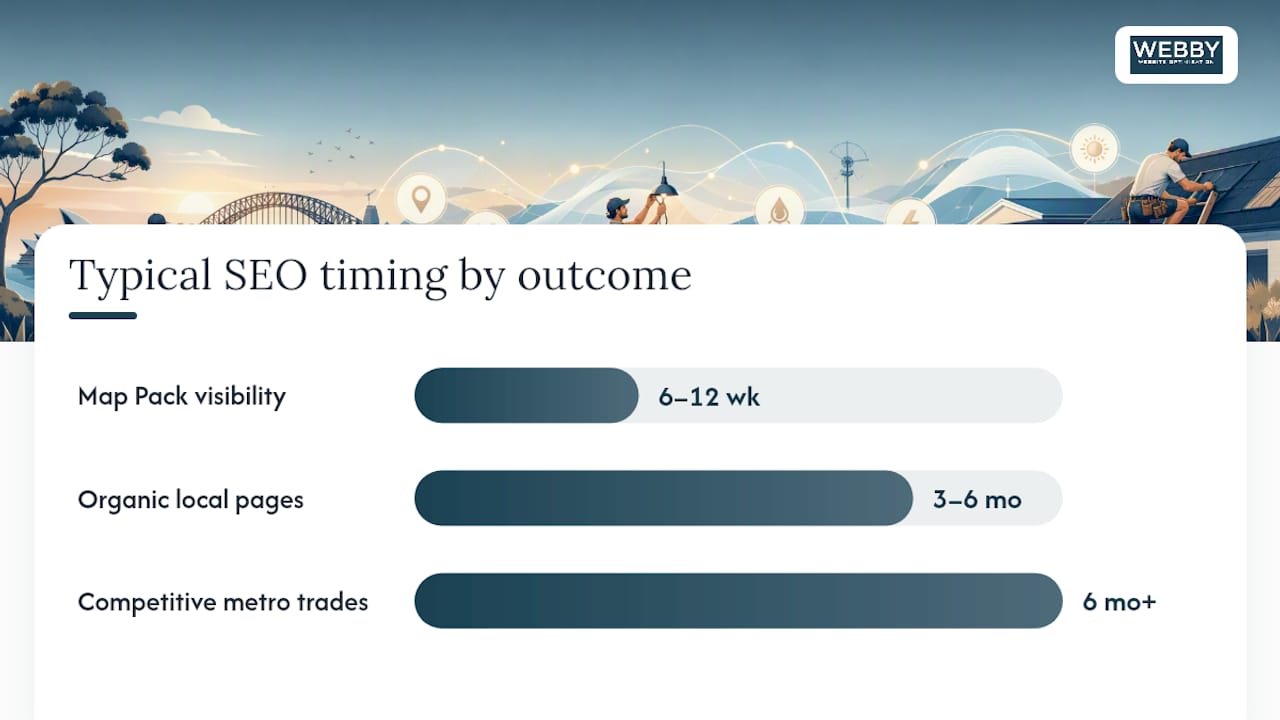
| Timeline | What typically moves | Realistic window |
|---|---|---|
| Map Pack visibility | Google Business Profile ranking for target services | 6 to 12 weeks |
| Organic local pages | Service and location pages ranking in standard results | 3 to 6 months |
| Competitive metro trades | Both, in dense markets like inner Perth or Melbourne | 6 months or longer |
Map pack movement tends to happen faster than organic ranking because it responds directly to profile completeness and review velocity, both of which you can control in weeks rather than months.
To judge whether SEO spend is worth it against paid lead platforms, work out your cost per booked job, not just cost per lead. A lead-gen platform might charge you per inquiry regardless of whether it converts, while SEO leads, once the site is ranking, arrive without an incremental fee. If you’re weighing paid traffic while your organic presence builds, a structured Google Ads campaign can fill the gap in the meantime.
How Do You Vet an SEO Provider Without Getting Burned?
Australia’s trade sector is crowded. The ABS counts on business entries and exits confirm what every tradie already feels on the ground: new competitors show up constantly, and a lot of them are paying someone for a marketing edge. That makes picking the right SEO partner, or deciding to DIY, a real financial decision.
- Ask who owns your Google Business Profile once the engagement ends. You should retain full admin access, always. If a provider is vague about this, walk away.
- Ask for their reporting cadence and what it actually tracks. Calls, form submissions, and booked jobs matter more than a vanity ranking screenshot for a keyword nobody searches.
- Ask for a local reference you can actually call. A provider with genuine trade clients in Australia should have no hesitation connecting you with one.
- Ask what’s included in the first 90 days, in writing. Vague promises of “ongoing optimization” with no listed deliverables is a way to bill you indefinitely for nothing measurable.
Red flags worth walking away from immediately: any guarantee of a specific ranking position (nobody controls Google’s algorithm, full stop), vague talk of “secret link building” or “special relationships with Google,” and an unwillingness to show you past work with real, checkable examples.
Pro Tip: Before signing anything, ask what happens to your website and content if you cancel. A provider who owns your domain, your Google Business Profile, or your content outright is holding your business hostage, whether they intend it that way or not.
A short agreement with clear KPIs beats a vague twelve-month retainer every time. Set targets around calls, form submissions, and booked jobs, reviewed monthly, and you’ll know within one quarter whether the work is paying for itself.
Real Results: What Baseline Fixes Look Like in Practice
Australian trades that clean up the fundamentals, a fully built Google Business Profile, three or four focused service pages, and a real review flow, tend to see the clearest jumps in the first ninety days, before broader organic gains kick in later.
A local trade business starting from a neglected or incomplete online presence typically sees the earliest, most visible gains in Map Pack impressions and direct calls once its Google Business Profile is fully built out and reviews start arriving consistently, well before organic rankings for competitive terms catch up.
That pattern lines up with what Mailchimp’s guide to digital marketing for tradies recommends: combine SEO, an active Google Business Profile, reviews, and a working website rather than treating any single channel as the whole strategy.
A well-experienced SEO provider can work through this sequence with local service businesses, prioritizing profile and page fixes before broader content and technical work. Detailed case studies covering specific before-and-after results across different local industries are available through Webby’s SEO project work, for tradies who want to see the pattern applied to a business closer to their own trade.
How Should Tradies Weigh Speed Against Sustainability?
Most tradies I talk to want a ranking miracle in thirty days. That’s not how this works, and the guides promising it are the ones worth ignoring. What actually happens is faster and slower at the same time: your Google Business Profile can move in six to twelve weeks if you’re consistent with reviews and posts, while organic rankings for competitive service terms take months to build real authority.
The conventional advice oversells content volume. Publishing ten blog posts a month means nothing if your Google Business Profile is half filled out and you’ve got four reviews from 2023. Prioritize the profile and the review flow first. They’re free, they’re fast, and they’re the part most tradies neglect longest because it feels less like “real marketing” than a flashy new website.
If you’re doing this yourself, budget your time in that order: profile, pages, reviews, technical fixes, content. If you’re handing it to an agency, that’s the exact sequence you should expect to see in their first 90-day scope. Anything that skips straight to “content strategy” without fixing the profile first is solving the wrong problem.
— Steve Doig
Get Hands-On Help Without the Long-Term Contract
This service is an option for tradies who want the Google Business Profile, service page, and review-flow work done properly without hiring a full-time marketer or gambling on a DIY approach mid-job-season. It involves building and optimizing trade websites specifically to convert mobile visitors into phone calls, not just traffic.
A free audit looks at your current Google Business Profile, your site’s mobile speed, and your existing service page structure, then hands you a plain-language list of what’s costing you leads right now. If your current site is slow, outdated, or missing click-to-call basics entirely, a rebuild through Webby’s website design and development service gives you a mobile-first foundation before SEO work even starts scaling. Tradies who need something live fast can also look at a website built in a day as a starting point while a fuller strategy comes together. For tradies producing their own content between jobs, pairing that work with responsible AI-assisted content tools can keep service pages fresh without eating a whole evening.
Book a free audit through Webby Website Optimisation and find out exactly where your local SEO is leaking leads.
Sources
The figures and recommendations in this guide draw on a mix of government data and practical trade marketing research.
- Counts of Australian businesses, including entries and exits — latest release (ABS)
- The Complete Guide to Digital Marketing for Tradies — Mailchimp
- SEO for Tradesmen: Stop Renting Leads, Own Your Pipeline — Nest Content
- SEO for Tradesmen — Digital Tradies
FAQ
How much does SEO typically cost in Australia?
Costs vary widely by trade and market competitiveness, ranging from a one-off setup fee for basic profile and page fixes to a monthly retainer for ongoing content, reviews, and reporting. Ask any provider for a written scope of exactly what’s included before comparing prices.
Who is the best SEO provider for tradies in Australia?
There’s no single “best” provider for every trade and city, but the right fit is one with documented Australian trade case studies, clear reporting on calls and booked jobs, and no rank guarantees. Webby Website Optimisation works specifically with local service businesses in Perth, Fremantle, and Melville and offers a free audit to assess fit.
What does an SEO specialist earn in Australia?
Salaries for in-house SEO specialists in Australia vary by experience and city, and hiring one full-time is rarely cost-effective for a single trade business compared to an agency or contractor relationship.
How much does a tradie earn a year in Australia?
Annual earnings for tradies vary significantly by trade, location, and whether they run their own business or work as an employee, with self-employed tradies’ income tied directly to how consistently their local visibility generates booked jobs.
How long before tradie SEO shows results?
Google Business Profile and map pack visibility typically shift within 6 to 12 weeks of consistent optimization and reviews, while organic rankings for competitive local service terms usually take 3 to 6 months, longer in dense metro markets.