
Most Australian search clicks cost a few Australian dollars, though legal and finance keywords can cost significantly more. Typical small businesses spend moderate monthly amounts on ads, with growth budgets going higher. Management fees sit on top of that ad spend, usually a fixed monthly retainer or a percentage of what you spend.
TL;DR:
- Google Ads caps monthly spending at roughly 30.4 times the average daily budget, meaning actual costs can be up to double the daily limit on busy days.
- CPC in Australia ranges from A$1 to A$5 for most industries, but legal and finance keywords can exceed A$11 to A$13, with CPCs higher in Sydney and Melbourne due to competition.
- SMBs typically allocate A$1,000 to A$2,500 monthly for effective campaigns, while smaller budgets below A$500 struggle to generate enough conversion data for optimization.
- Agency management fees vary from fixed retainer to 10-20% of ad spend, with larger budgets favoring percentage or hybrid models for better campaign complexity management.
- Proper conversion tracking and realistic budgeting based on customer value are critical for maximizing ROAS and avoiding wasted spend.
Table of Contents
- Google Ads Pricing Australia: How Billing and Budgets Actually Work
- Average Cost Per Click in Australia by Industry and City
- What Australian SMBs Actually Spend Each Month
- Agency Fees and Management Costs in Australia
- A 7-Step Checklist to Set Your Google Ads Budget
- What Actually Drives Your Cost Per Click Up or Down
- How the Google Ads Auction Sets Your Price
- CPC vs CPM vs CPA: Choosing the Right Pricing Model
- How Ad Format Changes What You Pay
- Estimating and Improving Your Return on Ad Spend
- Tax and Regulatory Factors That Affect Your Google Ads Bill
- Why Most Budget Advice Gets the Order Backwards
- Get Help Setting Up or Managing Your Google Ads Budget
- Where These Figures Come From
- Sources
- FAQ
Google Ads Pricing Australia: How Billing and Budgets Actually Work
Google Ads doesn’t charge you a flat daily fee. It bills you per click or impression, but caps what you can lose in any given period through a system of budget multipliers that trips up almost every advertiser the first time they see a bill spike above their daily figure.
Here’s the mechanic. You set an average daily budget for a campaign, say A$50. Google doesn’t spend exactly A$50 every single day. Some days it serves more ads because search volume is high (a Saturday before Christmas, for instance), other days it serves fewer. What Google guarantees is that your daily spending limit won’t exceed roughly twice your average daily budget, and your monthly spending limit won’t exceed your average daily budget multiplied by 30.4, according to Google’s own budgets documentation.
So on that A$50 average daily budget:
- Daily spending limit: roughly A$100 on a busy day
- Monthly spending limit: A$50 × 30.4 = A$1,520
This is the difference between served costs and billed costs. Google might serve A$90 worth of clicks on a Tuesday, but your bill at the end of the month will never exceed the monthly cap, according to Google’s guidance on average daily budgets. It evens out.
| Average daily budget | Daily spending limit (≈2×) | Monthly spending limit (×30.4) |
|---|---|---|
| A$20 | A$40 | A$608 |
| A$50 | A$100 | A$1,520 |
| A$100 | A$200 | A$3,040 |
| A$200 | A$400 | A$6,080 |
Shared budgets across multiple campaigns work the same way, just pooled. Google shifts spend toward whichever campaign in the pool is performing best, which is useful if you’re running search and display together but want one number to track.
Average Cost Per Click in Australia by Industry and City
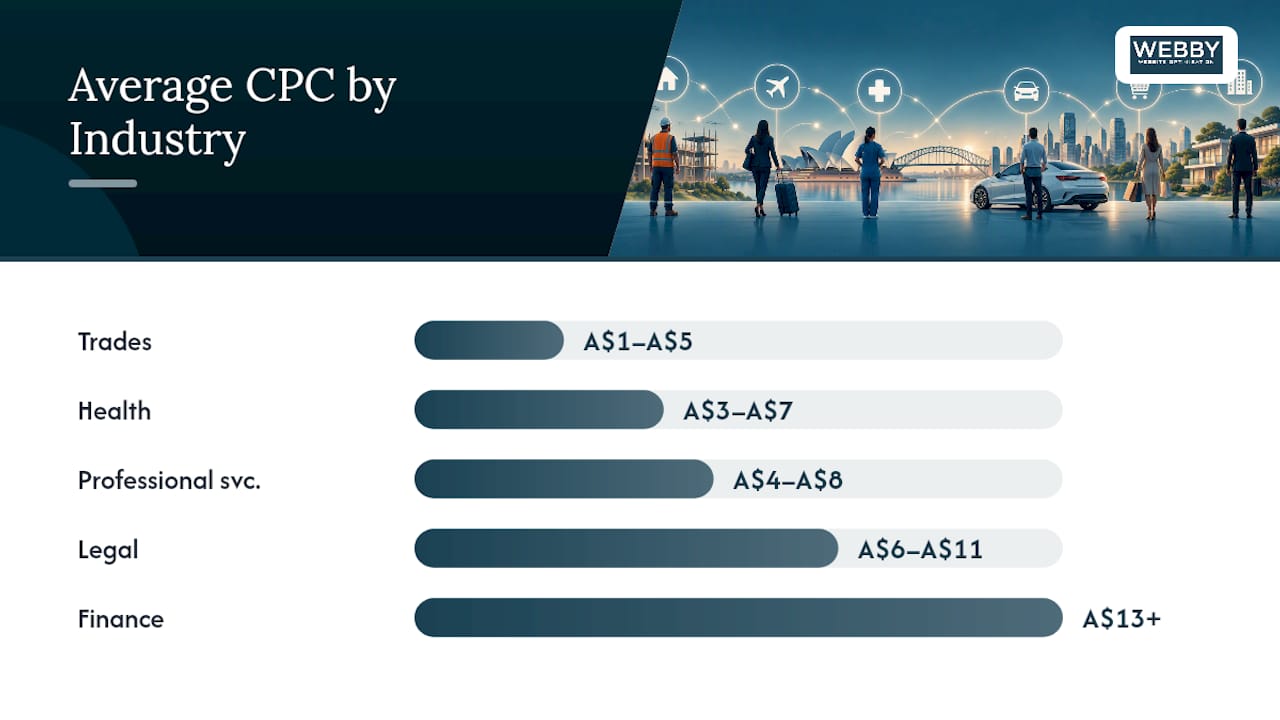
The national average sits around A$2 to A$4 per click for a typical search campaign, but that number hides enormous variation once you break it down by industry. Retail and trades often sit at the cheap end, A$1 to A$5 per click, because the keywords are high volume and competition is spread across thousands of businesses. Legal and financial services sit at the other extreme.
Legal keywords in Australia commonly run A$6 to A$11 per click, and finance keywords can exceed A$13, based on aggregated Statista industry CPC data for Australia. A personal injury lawyer bidding on “car accident lawyer Sydney” is competing against every other firm in the city for a client worth tens of thousands of dollars in fees, so the auction pushes prices up accordingly.
| Industry | Typical CPC range (AUD) |
|---|---|
| Trades (plumbing, electrical) | A$1–A$5 |
| Retail / ecommerce | A$1–A$4 |
| Health and allied health | A$3–A$7 |
| Professional services (accounting, consulting) | A$4–A$8 |
| Legal | A$6–A$11 |
| Finance | A$13+ |
Statista’s data shows industry variance is the single biggest driver of CPC, larger than location in most cases, which is why a Perth electrician and a Perth mortgage broker can face wildly different bills for the same daily budget.
Location still matters, though. Sydney CPCs typically run 15 to 25% above the national average because of sheer competitive density, Melbourne tends to sit 10 to 20% above average, and Brisbane hovers close to the national figure, per market analysis from Nexiiom’s Australian Google Ads cost report. Perth and Adelaide advertisers generally see slightly lower CPCs than Sydney or Melbourne for the same keyword, simply because fewer businesses are bidding in those markets.
Seasonality compounds all of this. Retail CPCs spike hard in the lead up to Christmas and during major sale periods, and any industry tied to a seasonal service (tax agents in June, tradies before winter) will see their own demand curve reflected in the auction price.
What Australian SMBs Actually Spend Each Month
Budget size determines what kind of campaign you can realistically run, and there’s a real ceiling below which Google Ads simply doesn’t have enough data to optimize properly.
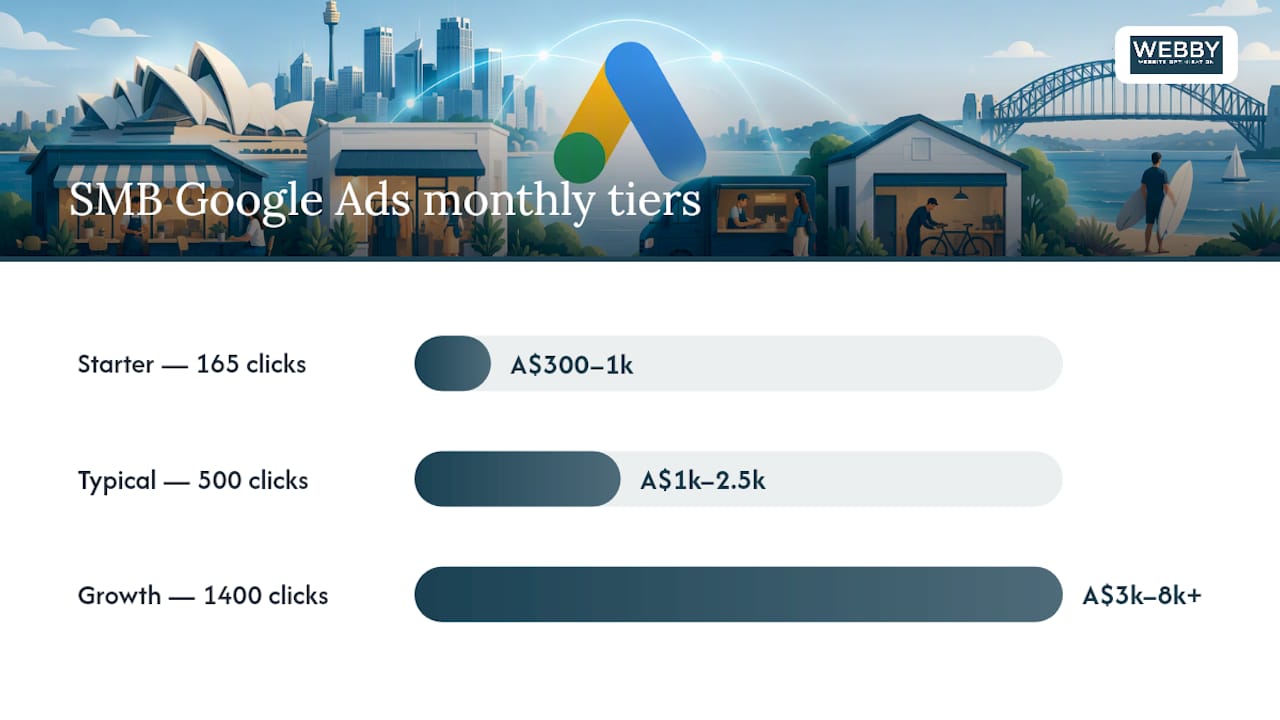
1. Starter and testing budgets: A$300 to A$1,000 a month. This tier suits a business testing a new service line or a very narrow, low-competition niche. At A$3 per click, A$500 a month buys roughly 165 clicks. If your landing page converts at a conservative 2%, that’s around three to four leads a month, based on the funnel approach a PPC guide for Australian SMBs recommends: clicks × conversion rate to lead × close rate. Ten to twenty dollars a day rarely generates enough volume for Google’s algorithm to find its footing in a competitive metro market, though it can work fine in a niche with almost no bidders.
2. Typical SMB budgets: A$1,000 to A$2,500 a month. This is where most Australian small businesses land, and it’s enough for a proper test across two or three campaigns. At an average CPC of A$3, A$1,500 buys around 500 clicks.
3. Growth budgets: A$3,000 to A$8,000 or more. At this level you’re usually running search, display remarketing, and sometimes video simultaneously, with enough volume for Google’s automated bidding to genuinely learn what a good conversion looks like. A A$5,000 monthly budget at a blended A$3.50 CPC delivers roughly 1,400 clicks, which starts producing enough conversion data to optimize toward target CPA rather than just chasing clicks.
The jump between tiers isn’t just more of the same. Moving from A$1,500 to A$5,000 usually means adding new keyword categories, new locations, and new ad formats, not just turning up the dial on what already exists.
Agency Fees and Management Costs in Australia
Ad spend and management fees are two separate line items, and conflating them is the most common budgeting mistake small business owners make when they first get a quote.
Agencies charge for their time and expertise using a handful of models:
- Fixed monthly retainer: a flat fee regardless of spend, common for smaller accounts where a percentage fee wouldn’t cover the agency’s time.
- Percentage of ad spend: typically 10% to 20% of monthly spend, which scales naturally as your budget grows.
- Hybrid: a lower base retainer plus a smaller percentage, common once accounts move past A$3,000 to A$5,000 a month.
- Hourly: less common for ongoing management, more typical for one-off audits or troubleshooting.
- Setup fees: a one-off charge for initial account structure, conversion tracking, and campaign build, separate from ongoing management.
For a business spending A$1,500 a month on ads, a fixed retainer often makes more sense than a percentage fee, since 15% of A$1,500 barely covers an hour of a strategist’s time. For a business spending A$6,000 a month, a percentage model or hybrid usually reflects the added complexity of managing more campaigns and more data.
Pro Tip: Ask any agency quoting you to show a sample report from an existing client (with names redacted). If they can’t produce one, or the report only shows clicks and impressions with no cost-per-lead or conversion figures, that’s a sign you’ll be paying for activity, not results.
Red flags worth walking away from: no agreed KPIs before the contract starts, vague answers about who actually manages your account day to day, and bundled “SEO plus Ads plus social” packages where nobody can tell you which channel is driving your leads.
A 7-Step Checklist to Set Your Google Ads Budget
- Calculate your conversion value. Know what a lead or sale is actually worth to you before setting a dollar figure. If your average client is worth A$800, you can afford to pay more per lead than a business with a A$50 average sale.
- Set a target cost per acquisition or ROAS. Work backward from your margin. If you can spend A$100 per new customer and stay profitable, that’s your target CPA.
- Choose a realistic entry budget. Match it to the tiers above, don’t launch a A$300 budget expecting growth-tier results.
- Convert monthly budget to daily budget. Divide your monthly figure by 30.4 to get the average daily budget Google actually uses.
- Pick a bidding strategy. Manual CPC or Maximize Clicks for early testing, Target CPA or Target ROAS once you have 30 or more conversions logged.
- Set up proper conversion tracking. Without it, none of the above numbers mean anything, since Google’s bidding algorithms optimize toward whatever you tell them to track.
- Use Performance Planner before committing bigger spend. Google’s own budget and cost calculator forecasts expected clicks and conversions at different budget levels, which beats guessing.
Pro Tip: Run any new campaign for at least two to three weeks before judging it. Google’s algorithms need a learning period, and judging performance on week one data is like judging a new employee after their first shift.
What Actually Drives Your Cost Per Click Up or Down
Four forces set your price in every auction, and understanding them explains why two businesses bidding on the same keyword can pay very different amounts.
Keyword competition is the obvious one. More advertisers bidding on “emergency plumber Melbourne” means a higher price, full stop. Broad, high-intent commercial terms almost always cost more than long-tail, specific phrases.
Quality Score is the one most business owners ignore. Google scores every ad on expected click-through rate, ad relevance, and landing page experience, and rewards a high score with a lower cost per click for the same ad position. A business with a fast, relevant landing page and tightly themed ad groups can pay noticeably less than a competitor with a generic homepage sending traffic to a slow site.
Location compounds competition. Bidding across all of metropolitan Sydney costs more than bidding on a single suburb, simply because you’re competing against every business in the wider radius rather than a smaller local pool.
Seasonality shifts prices without you changing a single setting. Retailers see this every November and December. Tax agents see it every May and June. Even a stable industry like plumbing sees a lift heading into winter when hot water systems start failing across the city.
None of these four factors work in isolation. A locksmith with poor Quality Score bidding on competitive city-wide terms during a seasonal spike will pay the highest possible price the auction allows.
How the Google Ads Auction Sets Your Price
Every time someone searches, Google runs an instant auction among every advertiser bidding on that term, and your final cost per click depends on more than just how much you’re willing to pay.
Google combines your maximum bid with your Quality Score and expected impact of ad extensions to calculate an Ad Rank. You can outrank a competitor with a higher maximum bid if your ad is more relevant and your landing page converts better, and you’ll often pay less per click for that higher position.
Your bidding strategy determines how much control you hand to Google’s automation. Manual CPC gives you full control over what you pay for each click, useful early on when you’re still learning which keywords convert. Maximize Clicks tells Google to spend your budget getting as many clicks as possible, which is fine for traffic but says nothing about lead quality. Target CPA and Target ROAS are automated strategies that need conversion history, usually 30 or more conversions in the last 30 days, before they perform reliably.
The mistake most Australian SMBs make is switching to Target ROAS too early, before there’s enough conversion data for Google’s machine learning to work with. The algorithm ends up guessing, and costs per click can swing wildly in the first few weeks as it searches for a pattern. Give it time and a stable conversion tracking setup, and it typically settles into more predictable, often lower, costs per acquisition than manual bidding achieves.
CPC vs CPM vs CPA: Choosing the Right Pricing Model
Cost per click (CPC) is the default for search campaigns and the model most Australian SMBs use. You pay only when someone clicks your ad, which makes it the most direct way to link spend to actual website visits.
Cost per mille (CPM), meaning cost per thousand impressions, applies mainly to display and video campaigns where the goal is visibility rather than an immediate click. A brand-awareness campaign for a new Perth café chain might use CPM because the goal is getting the name seen repeatedly, not driving instant clicks.
Cost per acquisition (CPA), or more precisely target CPA bidding, isn’t really a separate charging model. Google still bills per click behind the scenes, but the bidding algorithm adjusts what it’s willing to pay per click to hit your target cost per conversion. This suits businesses with clean conversion tracking and consistent conversion values, like a solar installer who knows a lead is worth roughly the same every time.
For most Australian service businesses starting out, CPC on search campaigns is the sensible entry point because it’s the easiest to understand and audit. CPM makes sense once you add display or video for brand reach. Target CPA becomes valuable once you have enough conversion volume, generally a few dozen conversions a month, for Google’s algorithm to optimize against reliably. Running all three at once without tracking discipline is how businesses end up unable to explain where their budget actually went.
How Ad Format Changes What You Pay
Search ads carry the highest cost per click because they capture people actively searching for a solution right now, and that intent commands a premium in the auction.
Display ads, the banner-style ads that appear across the Google Display Network, cost dramatically less per click or impression, often a fraction of search CPCs, because they’re shown to people browsing rather than searching. The tradeoff is lower intent and typically lower conversion rates, which is why display works best for remarketing to people who already visited your site rather than for cold prospecting.
Video ads on YouTube use their own bidding models, commonly cost per view, where you pay only when someone watches a set duration or interacts with the ad. Video costs less per interaction than search clicks but requires a reasonable production budget to make an ad worth watching, which is a cost most search or display campaigns don’t carry.
A sensible Australian SMB mix for a growth-tier budget often looks like the bulk of spend on search for direct intent, a smaller slice on display remarketing to recapture visitors who didn’t convert, and video reserved for businesses with an actual video asset worth promoting. Spreading a starter-tier budget across all three formats usually just spreads it too thin to get a real read on any one of them.
Estimating and Improving Your Return on Ad Spend
Return on ad spend, or ROAS, is your revenue from ads divided by what you spent, and it’s the number that actually tells you whether a campaign is working, not clicks or impressions.
Calculate it simply: if you spent A$2,000 and generated A$8,000 in revenue directly traceable to those campaigns, your ROAS is 4:1, or 400%. What counts as a “good” ROAS depends entirely on your margin. A business with 50% margins can be profitable at a lower ROAS than a business with 15% margins, because the profit per dollar of revenue is so different.
To improve ROAS in the Australian market, start with the conversion funnel from click to sale rather than the ad itself. A common early mistake is blaming Google Ads for poor results when the real problem is a slow landing page or a contact form that’s too long. Improving landing page load speed and cutting unnecessary form fields often lifts conversion rate more than any bid adjustment does.
Track ROAS by campaign and by keyword, not just at the account level, since a handful of high performing keywords often carry an account while several underperforming ones quietly drain the budget. Reviewing search term reports monthly to add negative keywords, phrases triggering your ad without producing conversions, is one of the cheapest ways to lift ROAS without spending another dollar.
Tax and Regulatory Factors That Affect Your Google Ads Bill
Google Ads spend in Australia is subject to the standard 10% Goods and Services Tax, which Google applies to your invoice if you’re providing an ABN, and this GST is generally recoverable as an input tax credit for GST-registered businesses. That means your effective cost is often the pre-GST figure once you’ve claimed it back through your regular BAS reporting, though you should confirm the specifics with your accountant since eligibility depends on your registration status and how the ads support your taxable supplies.
Beyond tax, the Australian Consumer Law governs what you can actually say in your ads. Misleading claims about pricing, guarantees, or availability in your ad copy can expose a business to complaints or ACCC action independent of anything Google itself enforces. Google also runs its own advertising policies covering restricted categories like health claims, financial services, and legal services, some of which require certification before you can even run ads in that vertical in Australia.
None of this changes your cost per click directly, but a suspended account from a policy violation, or a restricted category requiring certification you don’t have, can stop your campaigns entirely regardless of budget. Building compliance checks into your campaign setup from day one avoids a far more expensive problem than a high CPC ever will.
Why Most Budget Advice Gets the Order Backwards
The conventional advice tells business owners to pick a budget first, then figure out what it can achieve. That’s backwards. The businesses that get real value from Google Ads pricing in Australia start with their own numbers, what a customer is actually worth, what they can afford to pay per lead, and work forward from there to a budget figure.
The other thing the standard advice underplays is how much Quality Score and landing page quality change the equation. Two businesses with identical budgets in the same city can pay noticeably different costs per click depending on how relevant their ads and pages are. Chasing a lower CPC through bid tweaks alone ignores the cheaper lever sitting right in front of most advertisers: a better landing page.
If there’s one place to start, it’s conversion tracking. Without accurate tracking, every budget decision after that is a guess dressed up as a strategy. Get that right before worrying about whether your daily budget should be A$50 or A$80.
Get Help Setting Up or Managing Your Google Ads Budget
An alternative to hiring a generalist agency for Google Ads in local markets is an agency that treats landing pages and conversion tracking as part of the campaign, not an afterthought billed separately. A lot of the CPC and ROAS problems covered above trace back to what happens after the click, a slow page, a broken tracking setup, a form nobody finishes, and that’s exactly where Webby’s work starts.
A Website Audit for A$1,250 one off checks whether your site is actually ready to convert paid traffic before you spend another dollar on clicks. For businesses wanting the ad management handled alongside the website work, the End-to-End Growth Engine™ bundles paid media, tracking, and conversion optimization under one roof. Ongoing site support to keep landing pages fast and functional runs from Monthly Maintenance at A$59 a month up to Monthly Updates at A$123 a month, depending on how much hands-on work your site needs.
To get a tailored quote, have your current monthly ad spend, your average customer value, and access to your Google Ads account ready. Request a website audit or get in touch through Webby to start the conversation.
Where These Figures Come From
- Budget mechanics and spending limit calculations come from Google’s own budgets overview and average daily budget documentation.
- Industry CPC ranges are drawn from Statista’s Australian CPC by industry data.
- SMB budgeting benchmarks and worked funnel examples come from a PPC guide for Australian SMBs.
- City-level CPC variation is sourced from Nexiiom’s 2026 Australian Google Ads cost analysis.
Sources
FAQ
Is $10 a Day Enough for Google Ads in Australia?
Ten dollars a day works only in low competition niches with cheap clicks, since at a typical A$2 to A$4 CPC you’re buying just two to five clicks daily. In most metro industries that’s too little data for Google’s bidding algorithms to optimize properly, and testing tends to stall.
Is $20 a Day Good for Google Ads?
Twenty dollars a day is a reasonable floor for testing in a moderately competitive industry, delivering roughly five to ten clicks depending on your CPC. It suits early validation of one or two keywords rather than a full campaign, and most Australian SMBs eventually move to a monthly budget well above this once they see which keywords convert.
Is $500 a Month Enough for Google Ads?
Five hundred dollars a month sits at the low end of the starter tier and buys roughly 165 clicks at typical Australian CPCs. It can generate a handful of leads in a low competition niche, but it rarely gives Google’s automated bidding enough conversion volume to optimize well in a competitive metro market.
How Much Do Google Ads Cost in Australia?
Search clicks typically cost A$2 to A$4 on average, though legal and finance keywords often exceed A$6 to A$13. Most small businesses budget A$1,000 to A$2,500 a month for ad spend, with management fees charged separately as a fixed retainer or a percentage of spend.