
FAQ pages are one of the most underused SEO assets a small business can deploy. Done right, they target the exact questions your customers type into Google, feed structured content to AI-powered search tools like ChatGPT and Bing Copilot, reduce support overhead, and push hesitant buyers closer to a decision. Done poorly, they become a cluttered page nobody reads and Google quietly ignores.
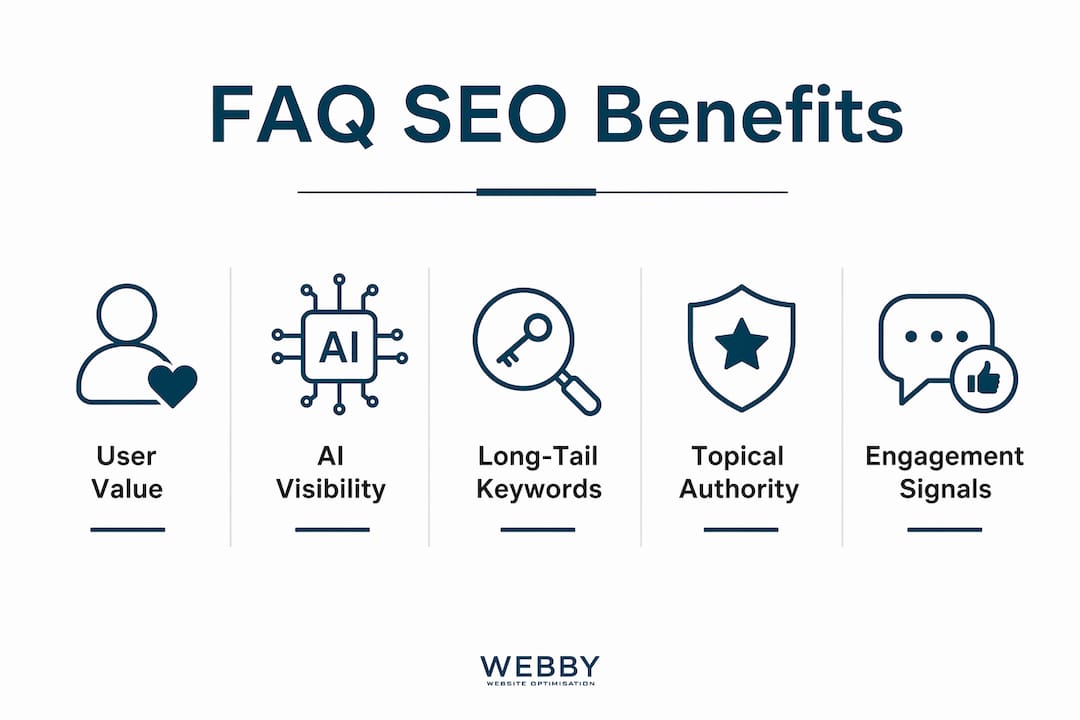
Here is what a well-built FAQ page actually does for your site:
- Captures long-tail, question-based search queries that product and service pages rarely target
- Gives search engines and AI models clear, structured answers they can extract and surface
- Builds topical authority by demonstrating consistent expertise across your subject area
- Reduces repetitive customer support inquiries by enabling self-service around the clock
- Addresses buyer objections at the moment of decision, supporting conversions
- Improves dwell time and internal navigation, both of which send positive signals to Google
The catch is that the rules around FAQ pages shifted significantly after Google’s 2023 update. Understanding what changed, and what still works, is where most businesses get it wrong.
How FAQ pages improve SEO: the real mechanics
FAQ pages earn their place in a content strategy by doing something most pages cannot: they match the exact phrasing of how people search. Someone looking for a plumber does not type “plumbing services Perth.” They type “how long does it take to fix a burst pipe” or “do plumbers charge a call-out fee on weekends.” FAQ pages are built for those queries.

Long-tail keyword targeting at scale. Each question on an FAQ page is a separate ranking opportunity. A page with 20 well-researched questions gives you 20 chances to appear in search results for specific, high-intent queries. These are often easier to rank for than broad head terms, and they tend to attract visitors who are further along in the buying process.
AI search visibility. Structured Q&A content ranks higher and is more likely to be picked up by AI-generated answers in conversational search environments. Tools like ChatGPT, Perplexity, and Google AI Mode scan the web for direct, clearly formatted answers. FAQ pages are purpose-built for that format. If your site is not providing direct, factual answers to user questions, you risk being invisible in AI-powered search results.
Topical authority. A service business that consistently answers questions related to its industry sends a clear signal to search engines: this site understands the topic. That depth of coverage helps the entire domain, not just the FAQ page itself.
Engagement signals. When users find what they need, they stay longer and click deeper into the site. Those behaviors, time on page, pages per session, and low bounce rate, tell Google the content is satisfying search intent.
Schema markup: use it carefully. FAQ schema (FAQPage structured data) once gave businesses expanded search listings with dropdown answers. Since August 2023, Google restricted FAQ rich results to authoritative government and health websites. For most businesses, the schema no longer drives rich snippets, but it still helps search engines understand your content structure and supports AI retrieval.
| FAQ placement | Schema recommended | Primary benefit |
|---|---|---|
| Dedicated FAQ hub (single topic) | Yes, if page is primarily Q&A | LLM retrieval, evergreen reference |
| Service or product page (embedded Q&A) | No | On-page conversions, AI visibility |
| Knowledge base or support docs | Yes, if page is entirely FAQ format | Voice search, customer self-service |
| Promotional or landing page | Never | Sales-driven CTAs only |
The table above reflects Google’s current guidelines on schema placement. The core principle: apply FAQPage markup only where the page exists primarily to answer questions, not to sell.
How FAQ pages boost user experience and business efficiency
The SEO case for FAQs is strong, but the user experience case is arguably stronger for small businesses. A well-built FAQ page works like a 24/7 customer service rep who never takes a day off.

FAQ pages reduce repetitive customer support inquiries by enabling self-service and addressing common buyer objections early. For a local service business fielding the same common questions repeatedly by phone or email, a clear FAQ page can cut that volume noticeably. Your team spends less time answering “do you service my area” and more time doing actual work.
Trust is the other big payoff. When a potential customer lands on your site and finds clear, honest answers to the questions they were about to ask, something shifts. They stop wondering whether you are hiding something and start thinking about booking. Transparency, presented through a well-organized FAQ, does more for conversion than most design tweaks.
There is also a navigation benefit that gets overlooked. FAQ pages, when built with internal links, guide visitors from a general question to a specific service page or pricing page. That path matters for both the user and for conversion rate optimization. A visitor who clicks from “how much does SEO cost” to your pricing page is already warmer than one who found the pricing page cold.
Pro Tip: Track which FAQ questions generate the most clicks to internal pages. Those are your highest-value questions. Expand those answers, add more context, and make sure the linked destination page is optimized to convert.
FAQ pages are a mature information format that creates a feedback loop informing UX improvements and product fixes beyond just answering questions on the page. In other words, the questions your customers keep asking are a direct signal about what your website, product, or service is failing to communicate clearly. That is free research most businesses ignore.
Best practices for creating effective FAQ pages
Getting FAQs right is less about volume and more about precision. Here is how to build pages that work in 2026.
Research real questions, not assumed ones. Pull questions from your support inbox, sales call notes, Google Search Console’s “Queries” report, and the “People Also Ask” boxes in Google search results. The questions your customers actually ask are almost always different from the ones you think they ask.
Write questions in natural language. “How much does SEO cost?” outperforms “SEO Pricing Information” every time. Questions phrased the way real people ask them align naturally with how people search and how AI models parse content.
Keep answers concise and direct. The ideal FAQ answer is two to five sentences. Lead with the direct answer, then add just enough context to make it complete. Avoid jargon, avoid promotional language, and avoid burying the answer under background information.
Organize questions into logical categories. A page with 30 questions and no structure is hard to scan. Group by topic, such as pricing, process, timeline, and service area, and use clear headings so users can jump to what they need. Search engines also read that structure as topical organization.
Embed FAQs on relevant service and product pages. Contextual FAQs keep users engaged longer and provide precise answers at the point of decision, improving both conversion and SEO signals. A page about your landscaping service should answer “do you provide a quote before starting” right there, not on a separate FAQ page the visitor may never find.
Add internal links inside answers. Every FAQ answer is an opportunity to send the reader somewhere useful. Answering a question about your process? Link to your service page. Explaining pricing? Link to your contact or quote page. Internal links within FAQ answers boost SEO by guiding users deeper into the site and strengthening topical authority. This also ties directly into service page lead generation.
Apply FAQPage schema only on genuine FAQ hubs. If you build a dedicated FAQ page around a single topic, with all questions and answers visible in full text, schema markup is appropriate and can help with AI retrieval. Do not apply it to service pages, landing pages, or any page that exists primarily to sell.
Write answers for both people and machines. AI models perform best with content that reflects genuine expertise: direct, clear, and rich with relevant facts and relationships. Avoid filler. Avoid sales copy. A question about your refund policy should read like a policy explanation, not a marketing pitch.
Update FAQs regularly. Prices change. Services change. Customer questions evolve. A FAQ page last updated in 2022 can actively hurt trust if the information is wrong. Set a quarterly review, or tie updates to any change in your services, pricing, or policies.
Pro Tip: Treat your FAQ page as a living UX research tool. When the same question keeps appearing in support tickets or chat logs after your FAQ supposedly answers it, that is a signal the answer is unclear or the page is hard to find. Fix the answer first, then check whether the page is linked from the right places.
Common mistakes to avoid with FAQ pages
Most FAQ pages fail for the same handful of reasons. Recognizing them early saves a lot of wasted effort.
Stuffing too many irrelevant questions. Overloading FAQs with too many questions or vague answers harms usability and SEO. Every question should earn its place by addressing something your actual customers ask. A bloated FAQ page dilutes focus and signals low quality to both users and search engines.
Using FAQPage schema on promotional pages. Google explicitly forbids using FAQPage markup for advertising or promotional purposes. Applying schema to a landing page or a page that exists primarily to drive sales violates Google’s guidelines and can harm search rankings. The schema belongs only on pages built around genuine questions and answers.
Vague or incomplete answers. “It depends” is not an answer. Neither is a one-sentence response to a question that genuinely requires context. If the answer is complex, give a clear two-sentence summary and link to a longer resource.
Letting the page go stale. An FAQ page that has not been touched in two years is a liability. Outdated pricing, discontinued services, or changed policies presented as current fact erode trust fast.
Keyword stuffing in answers. Writing answers to hit a keyword density target rather than to actually answer the question is obvious to readers and increasingly obvious to Google. Clear, useful content naturally aligns with ranking algorithms. Forced keyword insertion does the opposite.
Duplicating content from elsewhere on the site. If your FAQ answer is a copy-paste of a paragraph from your service page, you are creating a duplicate content problem and adding no value. FAQ answers should be original, concise versions of information, not copies.
Isolating FAQs on a single page nobody visits. A dedicated FAQ page buried in the footer, with no links from service pages or the main navigation, will get almost no traffic. FAQs need to live where users are already looking for answers.
SEO expert insights on optimizing FAQ pages for business growth
The consensus among SEO professionals in 2026 is clear: FAQ pages that prioritize user value over keyword manipulation consistently outperform those built primarily for search manipulation. The shift in Google’s algorithm toward helpful content has made this less of a best practice and more of a baseline requirement.
That framing captures where the opportunity actually sits in 2026. The businesses winning in search are not the ones with the most FAQ questions. They are the ones whose answers are the clearest, most direct, and most genuinely useful. FAQ content is frequently cited by AI-powered search engines like ChatGPT and Bing Copilot, extending beyond traditional SEO benefits to AI-generated answer visibility. That is a meaningful expansion of what a well-built FAQ page can do for a local service business.
The trend toward contextual FAQ placement rather than isolated FAQ pages reflects a broader shift in how search engines evaluate content. A question answered on the service page where it is most relevant carries more weight than the same question buried on a standalone FAQ page with no topical context. For a business with SEO-focused web design, this means FAQ content should be woven into the site architecture from the start, not added as an afterthought.
Using FAQ pages as a discovery tool to uncover recurring user questions can highlight areas where business processes or product information need improvement, elevating customer experience overall. One practical application: if your FAQ about pricing keeps generating follow-up calls asking for clarification, the problem is not the FAQ. The problem is your pricing page. The FAQ revealed the gap.
Continuous FAQ optimization based on analytics data improves both SEO performance and user satisfaction over time. In Google Search Console, the “Queries” report shows which questions your FAQ pages are already ranking for and which are generating impressions without clicks. That gap, high impressions and low clicks, usually means the title or meta description is not compelling enough, or the answer visible in the snippet does not match what the searcher expected.
For AI search visibility specifically, the user experience connection to SEO is direct: AI models favor content that is easy to parse, clearly structured, and written in natural language. FAQ pages that meet those criteria are more likely to be cited as sources in AI-generated answers, which is a form of brand visibility that Google Search Console cannot measure but that drives real traffic.
| Optimization action | SEO impact | AI search impact |
|---|---|---|
| Natural language questions | Matches long-tail search queries | Easier for AI models to parse and cite |
| Concise, direct answers | Improves featured snippet eligibility | Higher citation likelihood in AI responses |
| Internal links in answers | Distributes page authority across site | Helps AI map your content to related topics |
| Contextual FAQ placement on service pages | Strengthens topical relevance of the page | Provides answers at the point of decision |
| Regular content updates | Signals freshness to Google | Keeps AI-cited information accurate |
| FAQPage schema on dedicated hubs | Supports content structure understanding | Improves LLM retrieval for eligible pages |
The businesses that treat FAQ pages as strategic content assets, keeping them updated, monitoring performance in both Google and AI tools, and continuously refining based on real user data, build a compounding advantage. Every well-answered question is another entry point from search, another trust signal for a hesitant buyer, and another data point about what your customers actually need.
Key Takeaways
FAQ pages deliver their strongest SEO and business results when they prioritize genuine user value over keyword volume, with contextual placement on service pages outperforming isolated FAQ hubs in 2026.
| Point | Details |
|---|---|
| AI search visibility | Structured Q&A content is frequently cited by AI tools like ChatGPT and Bing Copilot, extending reach beyond traditional search. |
| Schema markup scope | FAQPage schema is restricted to government and health sites for rich results since 2023; use it only on dedicated FAQ hubs, never on promotional pages. |
| Contextual placement wins | Embedding FAQ content on relevant service and product pages improves both conversion and SEO signals more than isolated FAQ pages. |
| FAQs as UX research | Recurring questions reveal gaps in your website, product, or service communication, making FAQs a free source of improvement data. |
| Continuous optimization | Reviewing FAQ performance in Google Search Console and updating answers regularly keeps content aligned with shifting user needs and search intent. |
Is your website answering the questions your customers are already asking?
If your FAQ content is thin, outdated, or buried where nobody finds it, you are leaving search visibility and conversions on the table. Webby Website Optimisation builds websites for local service businesses that are structured to rank, convert, and answer the right questions in the right places.
Whether you need a full website design and development overhaul or a focused SEO strategy that includes FAQ content built for 2026 search, Webby Website Optimisation works with small and medium businesses across Perth to turn their websites into lead-generating assets. Get in touch for a free audit and find out exactly where your site stands.