
Six method types cover almost every practical keyword research need: internal data mining, tool based discovery, competitor gap analysis, first party question mining, local and trend analysis, and clustering with intent mapping. Google Search Console and Google Keyword Planner are your free starting points; layered together with a real customer questions and local search behavior, they beat any single tool used alone. For a local business chasing leads, not just traffic, the priority order is internal data first, local specific tools second, and question mining third. That combination surfaces the searches you can actually convert, which is the whole point.
- Internal data mining (Search Console, Analytics, on-site search)
- Tool based discovery (Keyword Planner, Semrush, Ahrefs, Moz, AnswerThePublic, Trends)
- Competitor and keyword gap analysis
- First party question mining (support tickets, reviews, sales calls)
- Local and seasonal trend analysis
- Clustering and intent mapping
Pro Tip: If you only have an hour this week, spend it in Google Search Console. It shows you keywords you already rank for on page two, which are often the fastest wins available.
Key Takeaways
Combining internal data, local specific tools, and real customer question mining consistently outperforms relying on keyword volume alone.
| Point | Details |
|---|---|
| Start with your own data | Google Search Console reveals keywords you already rank for but haven’t optimized around. |
| Mix free and paid tools | Keyword Planner and AnswerThePublic cover basics; Semrush, Ahrefs, or Moz speed up prioritization. |
| Mine real customer language | Support tickets, reviews, and sales calls surface high-conversion phrases tools miss. |
| Cluster to avoid cannibalization | Assign one primary keyword per page so pages stop competing against each other. |
| Get help scaling the system | Webby Website Optimisation builds keyword clusters into site structure and page content for local businesses. |
Table of Contents
- Types of Keyword Research Methods at a Glance
- How Do You Use Your Own Site Data for Keyword Ideas?
- Which Tools Give You the Best Keyword Data?
- How Do You Find Keywords Competitors Rank For But You Don’t?
- What Can Customer Questions Tell You About Keywords?
- How Do You Capture Local and Seasonal Search Demand?
- How Should You Group Keywords by Intent?
- How Do You Decide Which Keywords to Target First?
- What’s an 8-Step Keyword Research Workflow You Can Start Today?
- What Keyword Research Mistakes Cost Local Businesses the Most?
- Why Local Businesses Get Keyword Research Wrong
- How Webby Website Optimisation Turns Keyword Research Into Leads
- Where to Go Deeper on Keyword Research
- Frequently Asked Questions
- Sources
Types of Keyword Research Methods at a Glance
Each method answers a different question, and none of them replaces the others. Internal data tells you what’s already working. Tool based discovery expands your list with volume and difficulty numbers. Competitor gap analysis finds what rivals rank for that you don’t. First party question mining pulls real customer language from support tickets and calls. Local and trend analysis catches geo-specific and seasonal spikes. Clustering ties it all together by mapping keywords to pages.
- Internal data: low effort, high payoff for quick wins
- Tool based discovery: medium effort, broad coverage
- Gap analysis: medium effort, targeted opportunities
- Question mining: low effort, high conversion relevance
- Local/trend analysis: low effort, timing advantage
- Clustering: higher upfront effort, prevents long-term ranking problems
Pro Tip: Relying on search volume alone is how businesses end up ranking for keywords nobody buys from. Mix methods so intent and conversion potential carry as much weight as traffic numbers.
How Do You Use Your Own Site Data for Keyword Ideas?
Your website already has answers sitting in Google Search Console. Pull the Performance report, sort by impressions, and look for queries with decent impressions but a low click-through rate. Those are keywords Google already associates with your pages. You just haven’t earned the click yet.
On-site search logs, CRM notes, and sales call transcripts hold intent rich phrases that never show up in any external tool, because they’re the exact words your customers use before they buy.
- Export Search Console queries filtered by your top conversion pages
- Flag high-impression, low-CTR queries as title and meta rewrite candidates
- Pull on-site search terms and CRM ticket language for phrase ideas
- Assign each opportunity to an existing page or a new one
- Example: a plumbing site notices “hot water system replacement cost” gets impressions but few clicks, so it rewrites the H1 and title tag to match that exact phrase and picks up rank within weeks.
Which Tools Give You the Best Keyword Data?
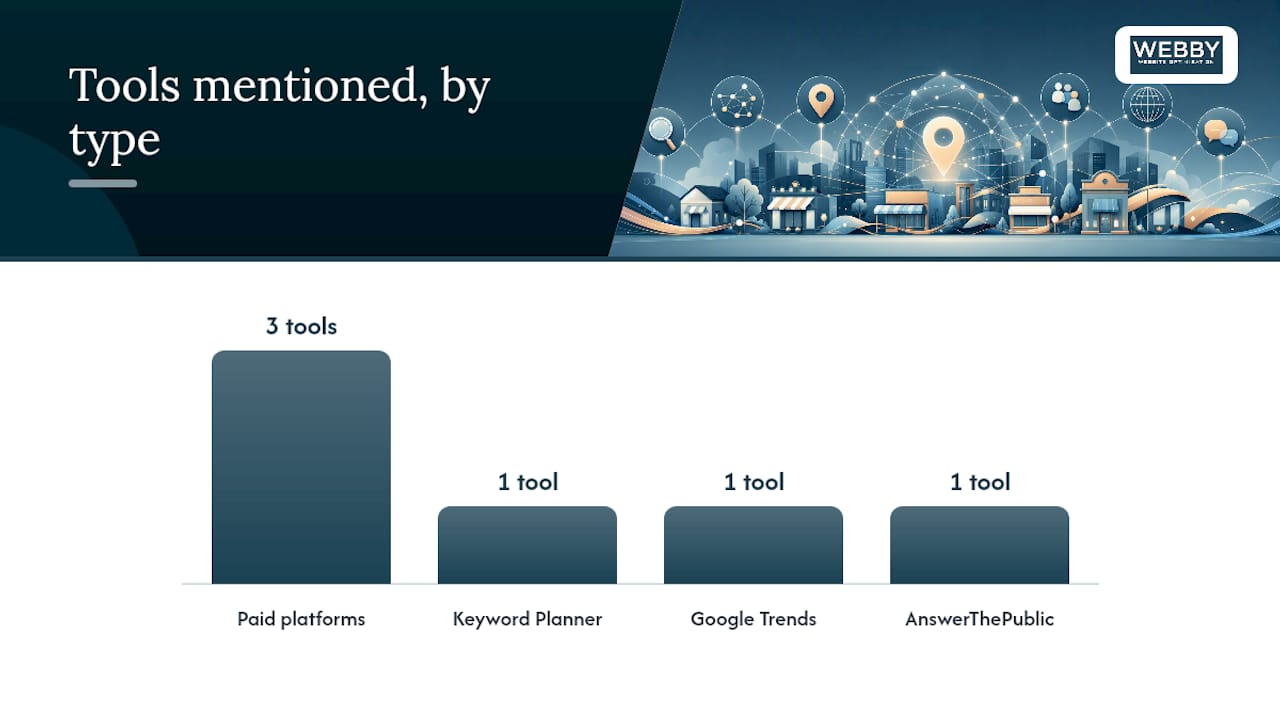
Free and paid tools each play a different role, and the trick is knowing which job each one is built for. Google Keyword Planner gives you volume ranges tied to ad spend, which makes it reliable for commercial terms even if you’re not running ads yet. Google Trends shows you whether interest in a topic is rising or falling over time, though it won’t give you granular keyword lists. AnswerThePublic pulls autocomplete data into question clusters that are useful for content ideas. Paid platforms like Semrush, Ahrefs, and Moz add keyword difficulty scores, “also rank for” reports, and competitor visibility data that speed up prioritization considerably.
- Keyword Planner: volume ranges, commercial intent signals
- Semrush/Ahrefs/Moz: difficulty scores, gap reports, rank tracking
- AnswerThePublic: question and preposition based query clusters
- Google Trends: topic momentum, seasonal timing
Set the location filter to Australia in every tool before pulling data. Volume figures for national platforms default to global or US numbers, and that skews your prioritization if you don’t correct it.
Pro Tip: Cross-check any keyword idea across two tools before committing budget to content. A single tool’s difficulty score can mislead you if its index doesn’t cover your specific market well.
How Do You Find Keywords Competitors Rank For But You Don’t?
Gap analysis compares your domain against a competitor’s in a keyword tool, surfacing terms they rank for that you’re missing entirely. The SEO Competitor Analysis Guide for Digital Marketers walks through the export and comparison process in more detail if you want a deeper dive.
- Export competitor keyword lists using a domain vs. domain comparison
- Remove terms irrelevant to your services or location
- Score remaining terms by intent match, conversion potential, and difficulty
- Add the top scorers to your content calendar
- Ignore branded competitor terms, they won’t transfer to your site
- Prioritize terms tied to services you actually offer
What Can Customer Questions Tell You About Keywords?
Support tickets, reviews, sales call notes, and even in-store questions carry the exact phrasing your customers use, which is often more accurate than anything a keyword tool suggests.
- Support and chat transcripts
- CRM notes and sales call recordings
- Google and Facebook reviews
- In-person or phone inquiries
A landscaping business that keeps getting asked “how often should I mow buffalo grass in summer” can turn that into a dedicated FAQ page. It ranks because it answers a real question in the customer’s own words, not a guessed keyword phrase.
Pro Tip: Ask your front-desk staff or call center what customers ask most. That five-minute conversation often beats an hour in a paid tool.
How Do You Capture Local and Seasonal Search Demand?
Geo-modifiers (“near me,” suburb names) and local pack visibility matter more for service businesses than raw national volume ever will.
- Check for “near me” and suburb-specific query variations
- Monitor Google Maps pack rankings for your core service terms
- Watch People Also Ask and featured snippet boxes for question opportunities
- Use Google Trends to time seasonal content, like pool cleaning ahead of summer
Keyword analysis that ignores local and seasonal specifics misses a large share of buyer-ready searches for service area businesses, since those searchers are often ready to book, not just browse.
How Should You Group Keywords by Intent?
Clustering means grouping related keywords around a single intent and assigning that whole cluster to one page. Skip this step and you end up with three service pages competing against each other for the same search, a problem known as keyword cannibalization that quietly caps your rankings.
- Gather all keyword variations from your research
- Group them by shared intent, not just shared words
- Pick one primary keyword per page
- Map remaining terms as supporting subheadings or FAQ content
| Cluster Seed | Primary Keyword | Supporting Terms | Assigned Page |
|---|---|---|---|
| Water heater repair | “hot water repair [suburb]” | cost, same-day, emergency | Service page A |
| Water heater install | “hot water system installation” | brands, warranty, pricing | Service page B |
| Water heater maintenance | “hot water system servicing” | schedule, checklist, tips | Blog/FAQ page |
Pro Tip: If two pages on your site could reasonably rank for the same search, merge them. Google can’t decide which one deserves the click, so it often ranks neither well.
How Do You Decide Which Keywords to Target First?
Score every keyword candidate against five factors: intent alignment, conversion potential, search volume, difficulty, and effort to produce content. A high-volume term with weak buying intent usually loses to a lower-volume term that matches exactly what a ready-to-book customer types.
| Keyword | Intent Match | Conversion Potential | Difficulty | Priority |
|---|---|---|---|---|
| “emergency plumber [suburb]” | High | High | Medium | Do first |
| “how a hot water system works” | Low | Low | Low | Blog filler |
| “hot water system replacement cost” | High | High | Low | Do first |
- Quick wins: low-difficulty terms you already rank near page one for in Search Console
- Long-term plays: competitive commercial terms worth a dedicated page and backlink push
What’s an 8-Step Keyword Research Workflow You Can Start Today?
This routine borrows from the step-by-step approach WordStream recommends, adapted for a local service business timeline.
- Week 1: Audit Search Console for existing query performance
- Week 1: Pull competitor gap data for your top three local rivals
- Week 2: Mine support tickets, reviews, and call notes for question phrases
- Week 2: Run seed terms through Keyword Planner and AnswerThePublic
- Week 3: Cluster all findings by intent and assign primary keywords to pages
- Week 3: Score and prioritize using the intent, conversion, difficulty matrix
- Month 1: Implement quick wins, title and H1 updates on existing pages
- 90 days: Build new pages or FAQ content for long-term commercial targets, then re-check Search Console data monthly
Small business owners handling this alone can lean on the practical framework in SEO for small business for pacing the workload without burning out in week one.
What Keyword Research Mistakes Cost Local Businesses the Most?
- Chasing volume over intent: a high-search term with no buying signal wastes content budget; check conversion potential first
- Cannibalizing your own pages: multiple pages targeting one keyword split your ranking signal; merge or reassign to one primary page
- Ignoring local modifiers: skipping suburb and “near me” variations misses buyer-ready local searches
- Over-relying on one tool: a single platform’s difficulty score can be wrong for your market; cross-check at least two sources
Pro Tip: Set a quarterly reminder to re-audit your keyword clusters. Search behavior shifts, and a cluster that made sense a year ago might now be splitting traffic across two competing pages.
Why Local Businesses Get Keyword Research Wrong
Most local businesses treat keyword research as a one-time spreadsheet exercise instead of an ongoing habit tied to actual sales data. The gap between what a keyword tool suggests and what your Search Console data confirms is where real opportunity lives, and few business owners ever check both.
Clients who pair Search Console audits with question mining from real customer calls tend to see faster ranking movement on service pages, because the content matches exactly what buyers search, not what a tool guessed they’d search. Detailed outcomes from that kind of work show up in Webby Website Optimisation’s case studies.
If you have an hour a week, DIY the internal data audit yourself. If you’re managing five service lines across multiple suburbs, hiring help to build the clustering and prioritization system pays for itself faster than most owners expect.
How Webby Website Optimisation Turns Keyword Research Into Leads
Webby Website Optimisation handles the part most local business owners run out of time for: turning a messy keyword list into pages that actually rank and convert. That means a Search Console audit to find your quick wins, keyword clustering mapped to specific service pages, local citation cleanup, and content built around the real questions your customers ask, not guessed search terms.
A consultation walks through your current site’s Search Console data, flags cannibalization issues, and outlines which pages need a rewrite versus which need to be built from scratch. If your site needs more than a content refresh, the website design and development service rebuilds the structure around a proper keyword map from day one. Book a free audit and find out which quick wins are sitting in your own data right now.
Where to Go Deeper on Keyword Research
- Google Search Console for tracking existing query performance
- Google Keyword Planner and Google Trends for volume and timing signals
- Semrush, Ahrefs, and Moz for difficulty scores and gap analysis
- AnswerThePublic for question based content ideas
- SEO for small business owners for a broader local SEO framework
Frequently Asked Questions
What are the main types of keyword research methods?
The core types are internal data mining, tool based discovery, competitor gap analysis, first party question mining, local and trend analysis, and clustering with intent mapping. Most effective local SEO strategies combine at least three of these rather than relying on one.
Which keyword research method works best for beginners?
Start with Google Search Console since it’s free and shows keywords your site already ranks for. Layer in Google Keyword Planner and AnswerThePublic next, before moving to paid tools like Semrush or Ahrefs.
Do I need paid keyword tools, or are free tools enough?
Free tools like Keyword Planner, Trends, and Search Console cover the basics well. Paid platforms add difficulty scoring and competitor gap reports that save time once you’re managing dozens of pages.
How do I avoid keyword cannibalization?
Assign one primary keyword to each page during the clustering stage. If two pages could rank for the same search, merge them or reassign one to a more specific, related term.
How often should local businesses redo keyword research?
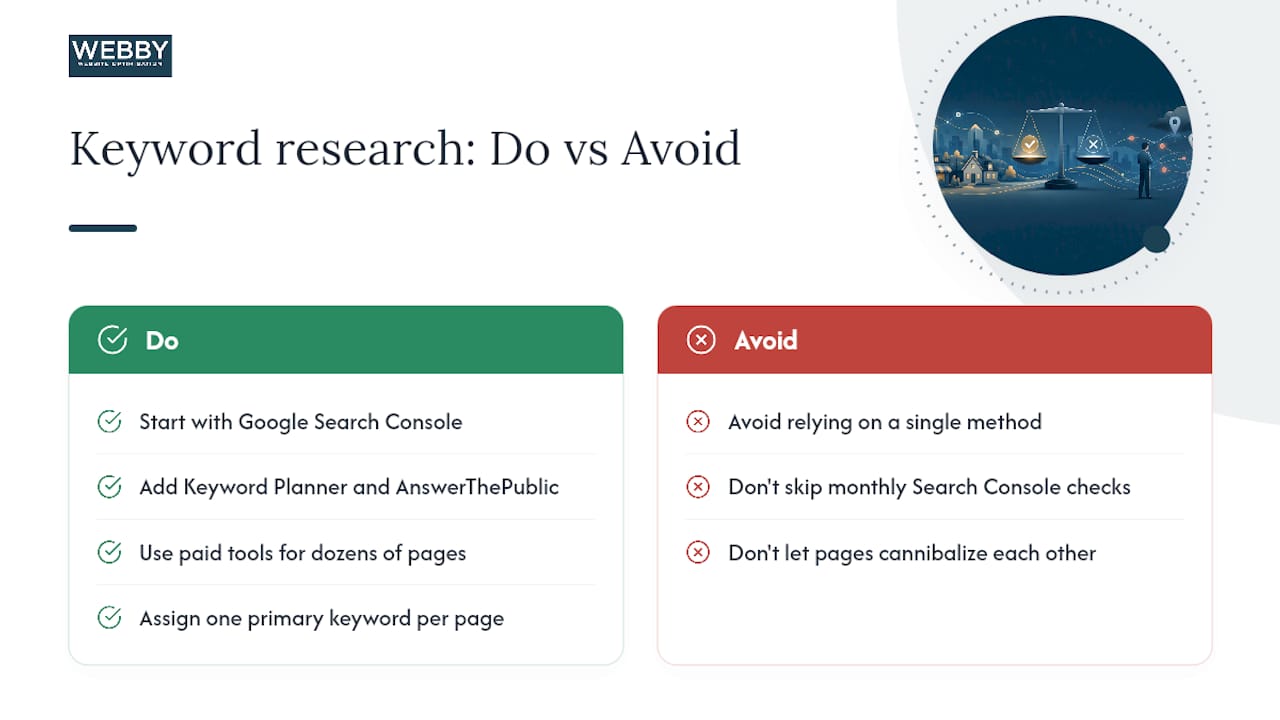
Revisit your keyword clusters quarterly, and check Search Console monthly for new query opportunities. Seasonal businesses should also review trend data ahead of their peak periods.
Sources
- How to do keyword research in 2026 (6 ways + framework)
- How to Do Keyword Research for SEO & PPC (Step-by-Step) | WordStream
- Keyword Analysis: The Complete Guide for 2026
Recommended
- How to Do Keyword Research in Australia for 2026